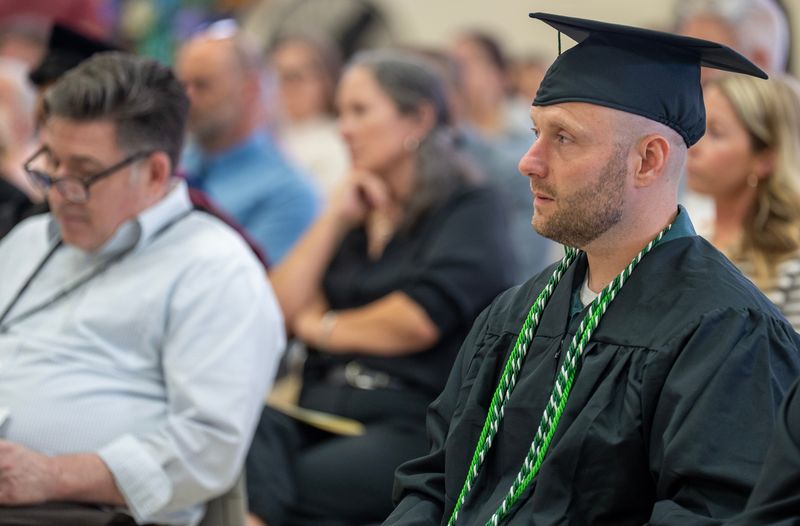
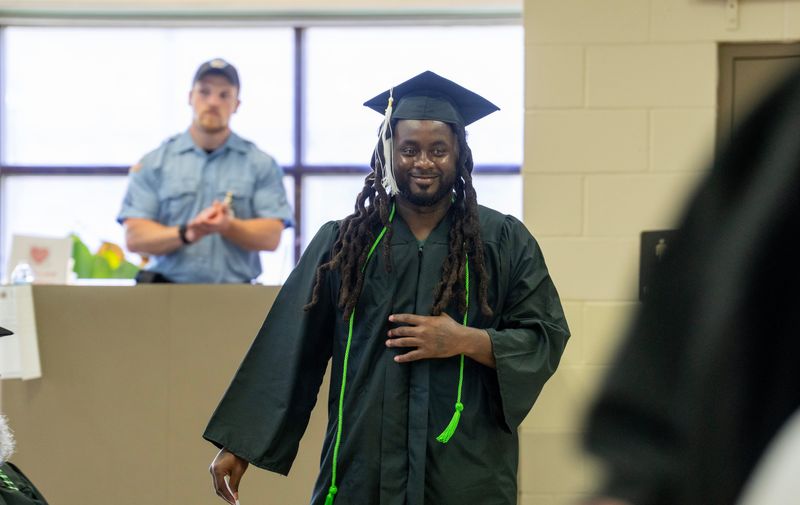
OREGON – Visitors aren’t normally allowed on Mondays at Oakhill Correctional Institution, but May 18 was an exception.
Instead of routine and monotony at this minimum-security prison just south of Madison, there was pride and joy. Instead of prison cafeteria food, there were Costco sheet cakes and coffee.

Family and friends filed into the visiting room to witness their loved ones earn college degrees. It was a milestone for the men in mortarboards, but also for Wisconsin.
The ceremony is believed to be the first commencement for a University of Wisconsin institution to confer bachelor’s degrees inside a state prison since 1975. The springtime ritual reflected a national change in attitude toward prison education access, and new backing from federal financial aid.
“Wisconsin believes in second chances,” Gov. Tony Evers said at the ceremony.
One of the student speakers, Thomas Brinkman, 36, of Pewaukee, experienced the evolution of the shift firsthand. His mom, Carole, had listened to his frustrations over the past decade as he tried earning his degree behind bars through mail-in correspondence courses. The books he struggled to secure. The proctor who didn’t show for his exam.
Access improved when UW campuses launched formal programs inside prisons in recent years, he said. Education gave him hope. Among his favorite courses were environmental science, and logic and reasoning.
Scheduled to leave Oakhill in early 2027, Brinkman plans to apply to law school. He wants to become a public interest lawyer, maybe in environmental law. He’s already started taking practice law school admission tests.
“Through our education and growth, we are reframing the narrative about what rehabilitation looks like,” Brinkman told the crowd. “There is a hunger to prove that we are more than the sum of our worst day.”
With new backing from federal financial aid, education access expands in prisons
Nearly two dozen incarcerated students at Oakhill graduated from the University of Wisconsin-Green Bay. Fifteen men earned bachelor’s degrees in organizational leadership and eight earned associates degrees.
Another ceremony later this week at Stanley Correctional, a medium-security prison in northwestern Wisconsin, will recognize eight students earning bachelor’s degrees from UW-Eau Claire and six from UW-Stout.
The celebrations were prompted by a recent change in federal law expanding federal financial aid access to incarcerated students.
Higher education opportunities in prisons largely vanished in 1994, when a federal crime bill banned inmates from accessing Pell Grants. Proponents at the time said the ban would ensure the limited pot of federal financial aid would go to cash-strapped college students, not convicted felons.
The loss of federal funding left colleges with little incentive to continue programming because most incarcerated people could not afford to pay tuition.
Access expanded somewhat in 2015 under the Obama administration’s “Second Chance Pell” pilot, which the Trump administration later expanded. Milwaukee Area Technical College, Madison College and Moraine Park Technical College launched associate, certificates and vocational programs under the pilot.
In 2023, federal law expanded Pell eligibility to incarcerated students. This opened the door for UW institutions to reach into prisons and connect with inmates hungry to learn.
Coordinated by UW-Madison’s Prison Education Initiative, the statewide effort is starting to bear fruit. Nearly 200 students were enrolled in courses this spring semester. Four of the nine prisons offer bachelor’s degree programs, with UW-Green Bay planning to expand into two more prisons. The other prisons offer jumpstart classes to introduce students to college coursework.
A nearly $6 million state grant and close to $7 million from Ascendium Education Group helped campuses and the state Department of Corrections get programs off the ground. The programs will continue operating primarily through Pell Grants, which are sent directly to universities instead of the students who qualify for the grants.
Emotional speeches delivered at Oakhill Correctional commencement ceremony
Jen Jones remembered to bring tissues this year. The assistant vice chancellor for enrollment services at UW-Green Bay had teared up at a previous Oakhill graduation ceremony for associate-degree earners and wanted to be more prepared this year.
“It’s a cup-filling moment to hear the students’ powerful stories,” she said.
One student speaker said his degree was more than a piece of paper. It was a symbol of hope. Another speaker described himself as a high school dropout whose 30-year education hiatus was ending. During a third speech, a young boy beamed from the last row as his father said he couldn’t believe he can call himself a college graduate.
Michael Allison Sr., of Milwaukee, said he had almost given up on his education. Earning his degree felt deeply emotional because he didn’t graduate from high school and had missed his middle school graduation. His son, Michael Allison Jr., and his godmother, Lynette Eubanks, cheered him on at the ceremony.
“Not even my incarceration can take this very moment from me as I smile,” he said in his speech. “And (to) see all these smiles smiling back, I can’t remember a time when I had this many people so genuinely proud of me.”
Education curbs recidivism, research shows
Benjamin Chacon, 33, talked about not knowing what direction his life was going when he enrolled in 2023.
“I knew I genuinely wanted this to be my last time coming to prison, so I had to do something different,” he told the crowd.
About 35% of Wisconsin inmates released in 2021 were reincarcerated within three years, according to state Corrections data.
Incarcerated students who enroll in postsecondary-education programs are 48% less likely to return to prison than those who don’t participate, according to the Vera Institute of Justice, a nonprofit that opposes mass incarceration. Prisons with such programs have fewer violent incidents than prisons without them.
State prisons and universities make enrollment decisions, accounting for academic preparedness and behavior. Incarcerated students preparing for release are given priority.
Chacon obtained a GED high school equivalency diploma while incarcerated. He initially struggled with the rigor of the coursework for his bachelor’s degree, especially his budgeting and finance course. He’d never been a numbers guy.
His resolve wavered when his grandma died in 2024 and his mom died in 2025. But Chacon kept studying. He hopes to eventually earn a master’s degree in social work.
And Chacon wasn’t alone at the ceremony. His favorite instructor, Rosemary Russ, was there to celebrate with him.
Kelly Meyerhofer has covered higher education in Wisconsin since 2018. Contact her at kmeyerhofer@gannett.com or 414-223-5168. Follow her on X (Twitter) at @KellyMeyerhofer.
This article originally appeared on Milwaukee Journal Sentinel: Behind bars, they earned bachelor’s degrees. Now was their time to turn tassels
Reporting by Kelly Meyerhofer, Milwaukee Journal Sentinel / Milwaukee Journal Sentinel
USA TODAY Network via Reuters Connect