Five years after the closure of the Indian Point nuclear power plant, the Hendrick Hudson School District that long relied on the facility’s tax revenue is nearing a breaking point, school officials said.
The plant’s abrupt shutdown in 2021 left the district with an annual budget gap of $25 million, roughly a quarter of its total budget. So far, school officials have avoided layoffs and program cuts through a combination of state aid, tax revenue and reserve funds.

But with the state aid set to expire, district leaders say they are bracing for a worst-case scenario.
For Superintendent Michael Tromblee, the top priority is protecting jobs and preserving academic and enrichment programs.
“What we have always tried to do is to keep this from affecting our students,” Tromblee said. “Our students didn’t create the problem and they shouldn’t be the ones to suffer.”
While the district seeks an extension of state aid and additional federal support to sustain operations, another source of uncertainty is fast approaching: voters will decide on May 19 whether to approve a proposed school budget that would pierce the cap for the first time, with a 6.49% tax increase.
The measure will require support from more than 60% of voters in a community where a majority of residents do not have school-aged children. If the budget is rejected, non-mandated programs and elective courses could be at risk.
How Hendrick Hudson School District grapples with revenue shortfalls
Located along the Hudson River, the Hendrick Hudson School District serves about 2,200 students across five schools.
The district has long touted its strong academic reputation and enrichment offerings. It has a 92% graduation rate and its high school is the only school in New York to be named a Distinguished School six years in a row for its collaborative STEAM program.
Each year, much of the district’s nearly $100 million budget goes toward student programs, while only a small share is devoted to capital and administrative costs.
A few miles away, a nuclear power plant built on a 240-acre site is being dismantled. For six decades, the plant not only generated electricity for Westchester County and New York City, but also helped fuel the school district’s growth by contributing roughly a quarter of its annual budget.
The shutdown has rattled surrounding communities and upended the school district.
While state aid and tax revenue cover nearly half of the gap, district officials still face the same challenge each year: how to manage the remaining shortfall. Over time, they have pursued a range of cost-saving measures, from restructuring elementary schools to eliminating positions.
The district first reconfigured its three elementary schools in 2021, shifting from neighborhood-based schools — where students attend based on their home address — to grade-banded schools serving kindergarten through first grade, second through third grade and fourth through fifth grade. In 2024, the district restructured again, switching to two pre-K through second-grade schools and one school serving grades 3 through 5.
The district has reduced staff through retirements and resignations. Since 2023, its workforce has fallen from 654 employees to 602. It has also cut spending on equipment and classroom supplies.
The Indian Point closure has not only created a financial gap, but also added new costs and responsibilities. In response to residents’ concerns, the district recently launched a $500,000 radiation monitoring program, with annual operating costs of $12,000. An app on the superintendent’s phone will alert him to any abnormalities.
“We have to divert resources away from their intended purpose. Every year, we have fewer and fewer resources,” Tromblee said. “I don’t know how sustainable it is. You have to go into each budget year with a lot of unknowns. It’s very scary because we may have to change how we educate students.”
Students largely shielded from district’s financial stress
The district’s financial strain has extended beyond the classroom, affecting teachers and families. Teachers are being asked to do more with stagnant wages and limited resources, while homeowners have shouldered steep property tax increases.
Jim Rogulski, president of the Hendrick Hudson Teachers Association, said he worries that stagnant wages and a growing workload will make it harder to retain teachers.
The shrinking workforce is already making it more difficult to meet students’ growing needs, he said, especially for those receiving special education services and English language support. For example, some special education teachers now travel between buildings to cover student needs
Hispanic or Latino students in the district grew from 31% of enrollment in 2020 to 39% in 2025. About 19% of students have disabilities, and 37% are economically disadvantaged.
“We’re getting toward the tipping point,” Rogulski said. “The school district and teachers are working harmoniously to stabilize the district. But if something isn’t done, the district is going to be forced to cut teachers and programs.”
Meanwhile, residents have shouldered steep tax hikes, rising as much as nearly 40% during the plant’s final years of operation as it employed about 1,000 workers.
Even as uncertainty and rising tax burdens strain the community, students appear largely shielded from that stress and continue to benefit from the district’s resources.
During a recent visit to Buchanan-Verplanck Elementary School, students in a first-grade class sat on the carpet reading a book called Monument City, exploring the White House, the Capitol and other landmarks through the eyes of a visiting family. Students took turns reading aloud as teachers offered steady encouragement.
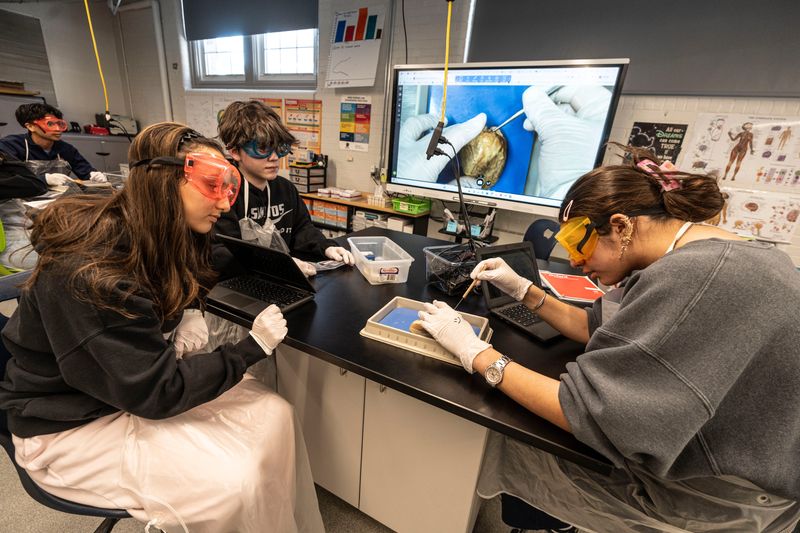
At Hendrick Hudson High School, a mix of freshmen and juniors wearing goggles and gloves were learning to dissect sheep hearts during a biomedical science class in a recently repurposed lab space.
Ella Henderson, a sophomore at Hendrick Hudson High School, said the school has given her room to grow. She is enrolled in honors English and chemistry, takes AP courses, plays on the soccer team, participates in debate and writes for the school newspaper.
“I’m grateful for what I have,” Henderson said. “What’s been offered to me is more than I could have asked for.”
Uncertainty over Indian Point clouds the district’s future
Indian Point shut down amid political and legal pressure over safety concerns related to its proximity to New York City, as well as competition from inexpensive natural gas.
While communities around Indian Point have faced significant revenue shortfalls, the future of the property remains unclear. In the background, an intense power struggle is unfolding as politicians, residents and environmental groups weigh difficult choices: reopen, repurpose or remain closed.
Decommissioning is expected to be completed by 2033.
Gov. Kathy Hochul and Westchester County Executive Ken Jenkins have sided with environmental groups and insisted the plant should remain closed for good, while some local officials have said they are open to reopening or repurposing the site.
Tromblee said he has no interest in joining that political fight, remaining focused instead on securing financial support from the federal and state governments while relying on local voters in the interim.
The $25 million financial gap has so far been covered through a mix of state aid, property taxes and district reserves.
The district receives about $3.4 million a year through its taxing agreement with Holtec International, the company dismantling the plant. A state fund, known as the Cessation Mitigation Fund, provided $10.2 million in 2025 and more than $18 million in total before it is set to expire in 2028.
The district has also managed the shortfall over the past years by using reserves and adopting modest tax increases. But with the expiration of state aid looming, district leaders decided this year to propose a 6.49% tax increase that would exceed the cap and to use $7 million in reserves.
Tromblee is hoping for an extension of the Cessation Mitigation Fund while also seeking federal support to help sustain operations.
In particular, he referred to two bills backed by Rep. Mike Lawler, a Republican who supports reopening the plant, and Sen. Kirsten Gillibrand. Gillibrand’s bill, known as STRANDED (Sensible, Timely Relief for America’s Nuclear Districts’ Economic Development) Act, would tax $15 for each kilogram of spent nuclear fuel stored at power plant site. Lawler’s proposal includes a tax credit for homebuyers to attract new residents and incentives for developers interested in redeveloping the former nuclear site.
The immediate test is fast approaching. Voters will decide on May 19 whether to approve the budget. It will require support from more than 60% of voters in a community where nearly 70% of residents do not have school-aged children. The district has made an extra effort to explain the stakes by hosting forums and posting explanatory videos.
“Of course it’s a concern, but we know our community has shown in the past that the schools are an integral part of community life and are deeply valued,” Tromblee said. “We care deeply about making sure our students get what they need, while also balancing what our voters can handle.”
Helu Wang covers economic growth, real estate and education for The Journal News/lohud and USA Today Network. Reach her at hwang@gannett.com and follow her @helu.wangny on Instagram.
This article originally appeared on Rockland/Westchester Journal News: Indian Point closure left this NY school district facing budget peril
Reporting by Helu Wang, Rockland/Westchester Journal News / Rockland/Westchester Journal News
USA TODAY Network via Reuters Connect