High Desert native James Spooner interviewed 100 Black punks across the nation in 2003 at a time when alternative scenes were perceived as overwhelmingly white. He turned the recorded interviews into an independent film called “Afro-Punk,” which helped catalyze an under-recognized cultural current.
The film became an instant hit. Investors purchased the DIY film from Spooner, with empty promises to elevate his storytelling to the international stage in what Spooner would later call a “shady” business deal. The transaction resulted in the quiet disappearance of “Afro-Punk” from the internet.

There was no proper release and no real distribution. Where it did exist, the film was a low-resolution blur. “The worst possible fate for a film about visibility,” Spooner wrote online.
It took decades and much time spent with pro bono lawyers for the High Desert punk to get the full rights to the film back, which he did in 2025 after filing a contract dispute that ultimately ended in an arbitration award outside of court.
“The story of how ‘Afro-Punk’ went from a little DIY film to a global brand is a long one. In fact, I wrote a whole book about it, which comes out in August,” Spooner told the Daily Press. When asked how he lost the rights to his project, he responded, “The shortest version is that I was young and got involved with business partners who made a lot of promises and slowly squeezed me out.”
After years of legal battles, Spooner has finally regained the rights to his film and is restoring it to the quality he always intended for the DIY documentary. Facets of restoration include color and lighting correction, audio enhancement and modern platform moderation.
The move to reclaim the project is almost more punk than the film itself, and its support has been monumental. “Afro-Punk” hit its goal of raising $6,000 for restoration in the first 10 hours of its Kickstarter campaign. The project currently sits on $17,000 of funding and will incorporate international subtitles with the supplemental funds.
Restored and remastered, “Afro-Punk” will soon be ready for a new generation of punks.
A film of Black isolation and identity
“Afro-Punk” interviews covered themes of isolation, identity and capitalism in punk communities across the nation. Spooner says isolated communities bonded as a result of the film, which eventually led to an “Afro-Punk” festival.
“20 years later, these conversations still matter and are still relevant,” he added.
Interviews take place at classic punk venues Brownies, the Delancey, Southpaw, and CBGB.
At the time of filming, Spooner said Black punks were nearly invisible, and the overt themes of racism were rarely addressed in hard core scenes. “Nobody was talking about the microaggressions, the self-hate or the quietly uncomfortable dynamics of being the only Black punk in any given local scene,” he wrote online.
“Afro-Punk” sought to give Black punks a voice and, in hindsight, opened up broader conversations about race in spaces of alternative culture.
Even Spooner’s posts online about restoring the film have sparked conversation among Black punks and their experiences of growing up on the fringes of society.
Ontray Haley from Fayette Mississippi shared the story of being the only Black student in his all-Black high school who rocked out to punk and hardcore music in the blues state. “I know [how] it is to be a[n] outcast,” he wrote to Spooner online.
Over the two decades since the film’s inception, punk has shifted in ways that would have been hard to imagine in 2003: Festivals built around punks of color, bands performing in their native languages, far more Black punks on stage and in the pit than what used to be the norm. No single film caused all of that, but Spooner is certain that “Afro-Punk” helped puncture the air-tight exclusivity of the punk scene.
Why restore the film now?
“Afro-Punk” was made in the early 2000s for DVD and 4:3 television screens. To create a cinematic look, the image was masked to appear widescreen, which means the film sits between an outdated box of black bars on a modern TV.
The color was never professionally graded. The sound mix was never built for the systems people use today. Without the updated modifications, “Afro-Punk” cannot land on streaming platforms to reach new audiences. It must adapt to become compatible with modern home and computer formatting.
Ties to the High Desert
Spooner is an author, illustrator, director, and vegan tattoo artist who lived in the High Desert for nine years of his childhood.
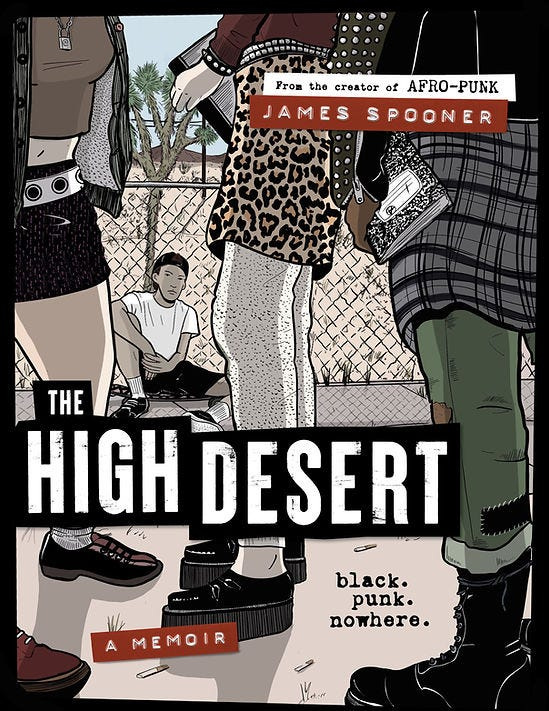
Spooner debuted his first graphic novel in 2022, “The High Desert,” which chronicles his experience as a multi-ethnic youth in the High Desert during the ’80s and ’90s. In it, the local author demonstrated a struggle with accepting his multi-ethnic background amid the blatant racism he battled as an early teen in ’80s-era Apple Valley.
Spooner said his absent father and full-time working mother bonded him with other punks experiencing the same sort of angst towards their parents that one feels listening to the Adolescents’ “Parents.”
The coming-of-age narrative parallels the DIY punk movement, a punk subculture that emphasizes community involvement.
He also published a Black punk anthology in 2023, “Black Punk Now.” His second work novels the voices of Black punks from both recent and “pioneering” times using graphics, poems, short stories, and lyrics. Additionally, there is talk of a possible “The High Desert” television series based on the graphic novel, but Spooner told the Daily Press in a previous interview that the project is in its preliminary stages.
McKenna is a reporter for the Daily Press. She can be reached at mmobley@usatodayco.com.
This article originally appeared on Victorville Daily Press: High Desert filmmaker reclaims rights to groundbreaking Black punk documentary
Reporting by McKenna Mobley, Victorville Daily Press / Victorville Daily Press
USA TODAY Network via Reuters Connect