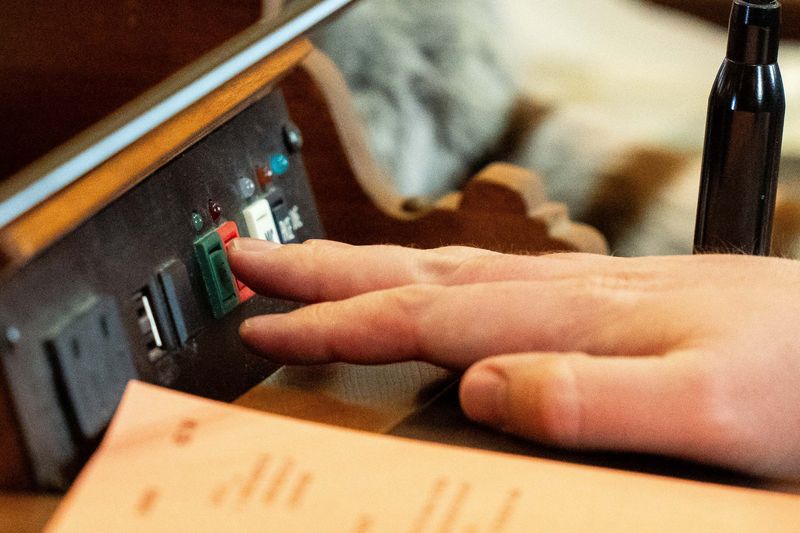
The substance of what Iowa lawmakers accomplished during their 34-hour sprint to freedom May 2 and 3, 2026, is irrelevant to one judgment: That marathon was no way to run the state’s business. Leaders should be ashamed and resolve never to do it again.
Bleary-eyed Republicans, who enjoy decisive control of the Senate and the House, advanced various defenses of the process in interviews and messages to constituents. That the stance “we’re not leaving this building until we have a deal” is essential to compromise. That lawmakers, already weeks past the scheduled end of session, had commitments during the workweek. That they just wanted to get things right. That the Legislature has often operated this way leading up to adjournment.

To start at the end, there is a significant difference between grinding all day and all night before an adjournment between, say, 5 and 8 a.m., and taking the better part of a second full day, as the 2026 Legislature just did. The first way has been done many times before, even though it’s not good for anybody’s health or conducive to reasoned decision-making. Compounding those problems with 12 more hours of meetings, waiting and intermittent debate is a move in the wrong direction, to put it mildly. Compromise can be reached outside of third-shift hours and without all-nighters.
Lawmakers return to a bad habit with stuffed ‘standings’ bill
The final day also saw lawmakers appear to indulge a years-old habit of logrolling, or putting together items that didn’t attract enough support to pass earlier into a final, must-pass bill that in Iowa is called the “standings” bill or, more pejoratively, the “Christmas tree” bill. In 2023, the Iowa Supreme Court savaged lawmakers for the practice by invalidating a law they passed in standings in 2020 concerning electrical transmission projects. The justices ruled that the law’s passage violated the Iowa Constitution’s requirement that bills deal with a single subject.
Legislators appeared slightly chastened for a couple of years, when they passed standings bills with comparatively few provisions. But House File 2800 is a real return to form. The title of the “single subject” bill is 126 words long. The contents include various ideas that didn’t pass earlier or were never mentioned earlier in the session. Some are so piddly as to not seem worth of inserting into Iowa Code ― an extra nonresident deer hunting license, a provision that elected officials can serve on political party state central committees. But others are more substantive, such as civics-education requirements for the public universities that leaders had not advanced earlier in spring.
Lawmakers also deserve criticism for the method in which their final deal on a property tax overhaul was passed. The months and years to come will produce plenty of analysis of the compromise that cleared the Legislature with bipartisan support and set the stage for adjournment. The city of Des Moines has already pulled back a tax incentive strategy as its staff studies Senate File 2472.
It is true that the public had ample opportunity to speak to lawmakers about earlier proposals over the past two years. But it’s still regrettable that over 80 pages of final language for a change with this scope — new spending limits on local government, and what Republican leaders estimated was $4 billion of savings for Iowans over six years — can emerge from a private discussion on a Sunday afternoon and be on its way to the governor just a few hours later.
The only solution is better performances from the Legislature’s leaders
Unfortunately, Iowans cannot do much about this almost-every-year circus except cluck about it. Legislative rules won’t stop it, because lawmakers just waive the procedural rules they find inconvenient in late April and early May. It would be difficult to anticipate all the scenarios that a law would need to encompass to be effective without needless hindrance.
About all we can ask and hope for is for chamber leaders to model and demand the discipline to treat their colleagues, the Legislature’s staff and the public with more respect in the final hours. We’ll try again in 2027.
Lucas Grundmeier, on behalf of the Register’s editorial board
This editorial is the opinion of the Des Moines Register’s editorial board: Rachel Stassen-Berger, executive editor; Lucas Grundmeier, opinion editor; and Richard Doak and Rox Laird, editorial board members.
This article originally appeared on Des Moines Register: A 34-hour session is not the right way to make Iowa’s laws | Opinion
Reporting by The Register’s editorial, Des Moines Register / Des Moines Register
USA TODAY Network via Reuters Connect