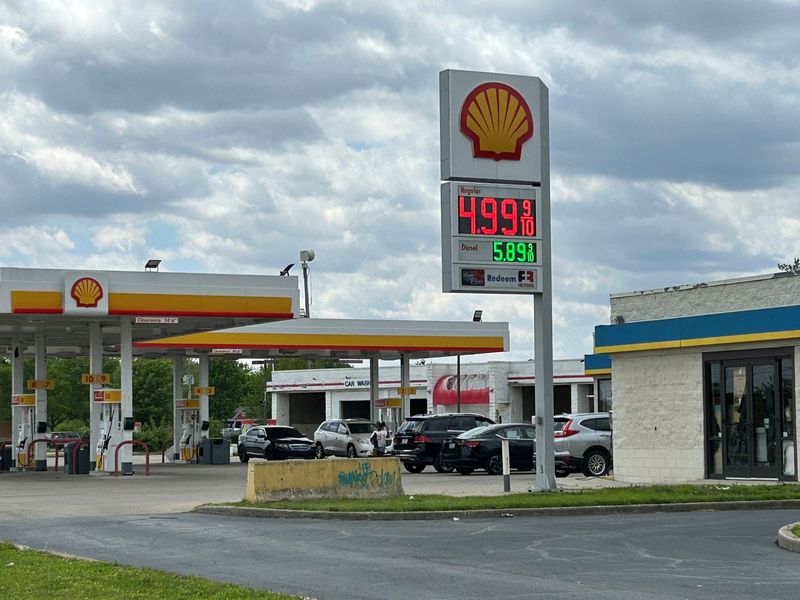
LAFAYETTE, IN — Gas prices hit $4.99 on Thursday, just shy of the national record high price set in June 2022, and consumers are feeling the pinch.
Lawn care and landscape business owner Wesson Lagoy of Clarks Hill rolled into a south-side gas station Thursday afternoon in his pickup truck, towing a trailer hauling a large riding lawn mower.

“I started this morning with about 60 bucks in the tank. That’s been about five hours ago. Now I’m filling up again,” Lagoy said. “It’s definitely cutting into making money. That’s for sure.”
Asked how he’s making ends meet, Lagoy said, “Trying to save as much money as possible, and not eat out as much and do stuff that most people want to do for fun.”
Earlier, Joshua Windler pulled into the gas station driving a large, four-door Jeep Wrangler.
Actually, I am test-driving said Jeep,” Windler said. “We have a Camry to save on gas. This is just a test drive to see for a second vehicle for us.
“Gas prices obviously have an effect on that,” he said. “This is probably going to be a no-go.”
Cause of gas prices spiking stems from war with Iran
Most people know the increase is tied to the United States and Israel fighting Iran, and the worldwide disruption in oil supplies.
“You are paying higher because other countries are paying higher. Meaning that, the global market for energy looks like water,” said Farzad Taheripour, Purdue economics professor.
He explained that oil markets are like connected ponds of water. When the water — or price, in this case — rises in one pond, the price increases in other markets. They’re all related.
“This means that if prices in other countries go up, U.S. consumers also pay higher prices,” Taheripour said. “These markets are connected. So higher prices in other regions means higher prices in the U.S., as well.”
The price of oil has surged higher after the attack on Iran, which claimed it was close to having enough material to build nuclear weapons, according to national news sources.
The fighting has created uncertainty in the oil market, and Iran closed the Straits of Hormuz, creating oil supply shortages to the worldwide market, said Taheripour and Purdue ag economists Ken Foster and Bernhard Dalheimer.
“There are two factors,” Foster said. “One factor is uncertainty and risk. The other factor is real demand and supply for … consumption.”
The war in Iran has created uncertainty in the oil production and increased the risk to transport the oil, Taheripour said.
Ships carrying oil from Iranian ports cannot pass through the Straits of Hormuz, crimping the world market’s supply for the near future.
“The United States is not importing that much oil from Middle East or any part of the world. We import some, but that’s not because we are not able to produce,” Taheripour said. “Basically we are independent in terms of having resources to produce gas, natural gas and crude oil.”
But his example of the oil market being a series of connected ponds trying to find price equilibrium means that even energy independence does not insulate the U.S. markets from price increases in times of oil uncertainty and supply shortages.
“When you have higher future prices, those will be incorporated to today’s market,” Foster said. “There is uncertainty in future, and then future prices are going up. Then uncertainty will affect today’s market as well.”
If there’s a rosy side to the spike in gasoline prices, it might be that prices are lower here than in other places in the world, Dalheimer said.
“We’re still in a better position in the U.S., as compared to other places,” Dalheimer said.
He recently spoke to his father in Germany, where gas prices are $8 or $9 a gallon.
“If prices go up (in other places, such as Europe), they’re also going to go up in the U.S. If they go down, they’re also going to go down in the U.S.,” Dalheimer said.
When the war ends and travel returns to normal in the Straits of Hormuz, gas prices likely will return to prewar prices, the three said.
But the world’s reliance on oil is abundantly clear. Transportation of goods around the world are fueled by oil. Farmers rely on fertilizers, which are made in Middle Eastern countries with the use of natural gas, the economists said.
Food prices are affected by the price of gasoline and diesel fuel, but they are more affected by natural factors such as drought or disease, Foster said.
Still, expect food prices to increase, putting even more of a dent in consumers’ wallets.
“In January, the projections were already 3% increase of food prices over the year and not taking into account any of the Iran stuff,” Dalheimer said.
Time will tell when certainty returns to the oil market and when supplies return to normal levels. When it does, fuel prices will drop, the trio of Purdue economic professors said.
Reach Ron Wilkins at rwilkins@jconline.com. Follow on Twitter: @RonWilkins2.
This article originally appeared on Lafayette Journal & Courier: Gasoline prices aren’t likely to ease for a while, Purdue economists say
Reporting by Ron Wilkins, Lafayette Journal & Courier / Lafayette Journal & Courier
USA TODAY Network via Reuters Connect