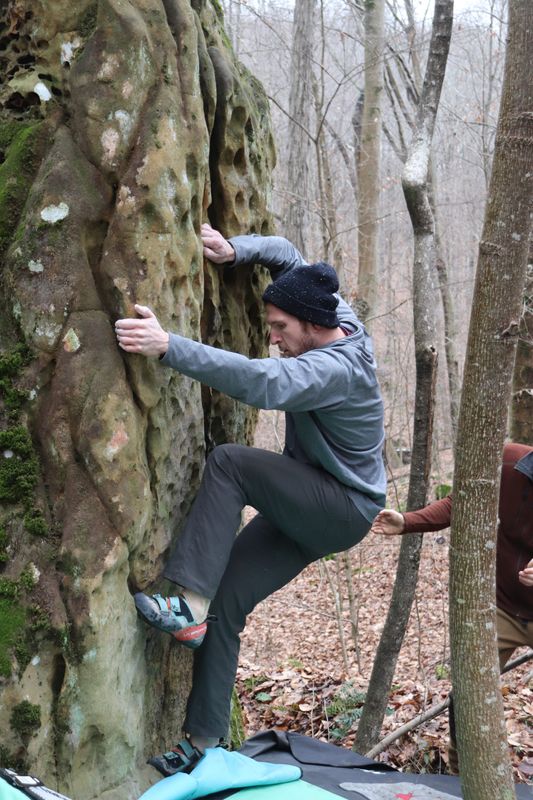
Rock climbers in Indiana these days must content themselves with indoor gyms and artificial boulders instead of the natural limestone cliffs of southern Indiana, thanks to an increasing slew of restrictions to land access across the state.
Climbers can scale the rainbow gradient of plastic holds that line the walls of gyms like North Mass Boulder in Indianapolis and Hoosier Heights in Carmel, but it’s not the same as the real thing, they say.

“There’s just obviously something a lot more natural about climbing rock than climbing plastic,” said Dylan Kehres, the vice president and land management chair of the Indiana Climbers Coalition, a group of climbers working to increase access to the sport in Indiana. “It’s harder. It’s real.”
Until 2023, Indiana’s outdoor climbing hub was a stretch of limestone boulders at Muscatatuck Park in Jennings County. But when the county abruptly banned the sport three years ago, climbers have been left in the lurch.
The state’s climbing enthusiasts are still searching for solutions. They have been bushwhacking through woods and pouring over topographical maps in search of a place where they can once again legally rock climb outdoors.
New options are few and far between, as outdoor climbing in Indiana is limited by myriad factors. For starters, climbers need cliffs, and Indiana’s supply is limited. Choices dwindle as climbers consider rock fragility, ease of access and, crucially, legality.
“It’s definitely an uphill battle, but we’re fighting the fight to try to make sure people can enjoy our public lands and recreate like almost any other user group can,” Kehres said. “Those of us that are invested enough and care enough about it will find ways to go out there and do it.”
Liability and loose rock
A community tethered by a shared love of rock climbing has persisted in Indiana for the past several decades, even though the state isn’t exactly a world-class rock-climbing destination.
Largely smothered by glacial sheets during the last Ice Age, Indiana boasts no real equivalent to Kentucky’s precipitous Red River Gorge — “the Disneyland of rock climbing,” according to Kehres — and local climbers have struggled to find cliffs sturdy enough to hold the weight of a human body.
Indiana sandstone and limestone cliffs that might be safe to climb aren’t an option because climbing on most state land is illegal. State law prohibits rock climbing and rappelling on property the Indiana Department of Natural Resources owns, like state parks, forests and preserves.
So, most climbers have to go elsewhere.
“What happens to climbers who live in Indiana? They leave,” quipped Clifford Martin, former ICC president, at a 2024 town hall held to discuss restoring outdoor climbing access at Muscatatuck Park.
The park, just 90 minutes southeast of Indianapolis, struck the trifecta for Indiana climbers: it had quality cliffs, easy access to the boulders, and for a while, amenable property owners. Hoosiers climbed at the park since at least the 1990s, and dedicated staff spent years mapping routes and creating climbing guides.
In the past five years, the Indiana rock-climbing community has ballooned and Muscatatuck Park was the home base, Kehres said. Climbers hosted litter and graffiti clean ups at the site as well as regular outings and a climbing competition.
Then in 2023, the park abruptly prohibited the sport.
“Jennings County ended climbing at Muscatatuck Park because the County’s liability insurance carrier is no longer willing to incur the liability for allowing climbing at Muscatatuck Park,” county attorney Alex Zimmerman wrote to IndyStar in an email.
While climbers are adamant the sport is just about as safe as swimming, rock climbing can’t seem to shake its dangerous reputation. Kehres said the trickiest aspect of finding places to climb involves assuaging liability concerns of landowners who fear injured climbers and hefty lawsuits.
With the prohibition still in place, Indiana climbers have since turned to well-ventilated and elaborately curated indoor landscapes that offer room to strength train, practice new techniques and scratch the climbing itch.
As nice as these indoor gyms may be, they can’t compete with the great outdoors.
Muscatatuck’s climbing prohibition “hurt the community a lot,” Max Calixto, an Indianapolis-based climber who used to frequent the park, said.
Calixto climbs at North Mass Boulder several times a week, but he said he misses the woods, the mountain air and the feeling of not knowing exactly what will happen when he’s up on a boulder. “It’s the real thing, you know?”
Members of the ICC said they felt like the rug got ripped out from under them when the park closed to climbers. Although interest has waned somewhat, Kehres said he hopes the group can work with Jennings County to restore climbing in the park.
“I do think there’s a possibility that we can bring climbing back to Muscatatuck,” he said. “But in the meantime, we’ve been searching for a new home.”
Enter the Hoosier National Forest
The search brought climbers to Hoosier National Forest, a 205,000-acre woodland in southern Indiana, marked by the occasional cliff face and boulder field.
Rock climbing is legal in most of the federally-owned forest, save for a few areas already eroded by heavy use or teeming with rare lichens, ferns and mosses. So, over the past couple of years, the ICC has been exploring the area.
“When I start going real stir crazy, I start pouring over topographical maps and then go into the woods to try and find new rocks,” said Jack Clarke, an ICC committee member and Bloomington-based climber.
In Hoosier, Clarke, Kehres and other climbers struggled to find quality rock. Most of the sandstone cliffs were too remote or brittle to climb, and they kept running into rock splattered with tafoni, cavities that develop in rock giving it a honeycomb-esque texture. Tafoni can signal that a cliff is too fragile for bouldering.
Eventually, the climbers’ persistence led them to Buff Boulders, a boulder field in the forest near St. Croix in Perry County, about two and a half hours south of Indianapolis.
The area is not perfect, Kehres said, but with decent rock and nearby parking, it is the strongest candidate for a new home base they’ve found.
Clarke has been visiting Buff Boulders about every other weekend to get to know the landscape and lay the groundwork for new climbers. He said developing familiarity with a space like this, one to which he can return time and time again, sets outdoor climbing apart from other activities.
“You start to develop a relationship with the area and really get to recognize and appreciate it in a way you don’t with a lot of other sports,” he said. “It definitely deepens your appreciation for it and also your desire to take care of it and make sure that it stays a beautiful place for the future.”
IndyStar’s environmental reporting is made possible through the generous support of the nonprofit Nina Mason Pulliam Charitable Trust.
Sophie Hartley is an IndyStar environment reporter. You can reach her at sophie.hartley@indystar.com or on X at @sophienhartley.
This article originally appeared on Indianapolis Star: Indiana has cliffs. So why do most rock climbers stay indoors?
Reporting by Sophie Hartley, Indianapolis Star / Indianapolis Star
USA TODAY Network via Reuters Connect