The Upper Peninsula has become the center of growing debate over whether rural Michigan communities should host cryptocurrency mines and AI data centers, especially when such operations are implemented without full disclosure or community input.
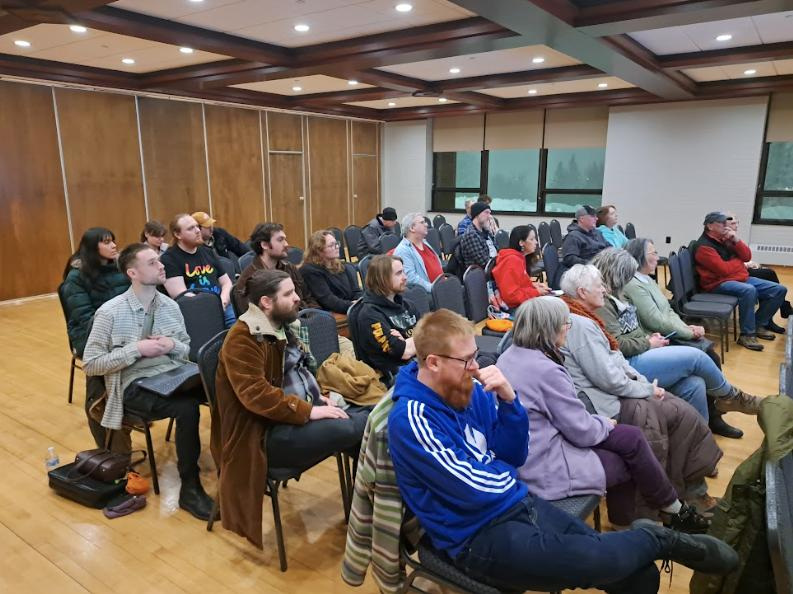
On Jan. 18, the Northern Michigan Alliance for Responsible Development hosted “An Introduction to Crypto Mining and AI Data Centers: A Community Briefing.” The event included in-person attendance in Sault Ste. Marie, Marquette and Houghton. The event also included online Zoom video attendance throughout the U.P. and northern Lower Peninsula.

The goal of the event was to raise awareness among community leaders and environmental advocates of the rapid expansion of cryptocurrency mines and artificial intelligence (AI) data centers across Michigan’s 1st Congressional District. About 225 people attended the hybrid event, with roughly half attending in person and the other half online.
Why the need to raise awareness?
Organizers said Michigan’s loose zoning and lack of township-level ordinances have made the state a desirable target for Big Tech entrepreneurs seeking cheap land and lax regulations. To inform the public, the January event explored how the cryptocurrency and AI industries impact electricity rates, water resources, jobs, climate goals and noise levels. The speakers sought to provide residents with tools to engage local and state lawmakers in properly addressing the new technologies and their potential impact on their communities.
Kalvin Carter, director of Up North Advocacy, emceed the event and introduced the keynote speakers.
“Cryptocurrency mining and data centers can have real, lasting impacts on energy costs, local infrastructure and quality of life in rural communities,” Carter said. “Protecting our towns and natural areas means working together, sharing information, listening to one another and making sure local voices are centered before big outside interests move in. The Upper Peninsula and Northern Michigan deserve development that respects our people and our shared environments.”
Jackie Sawicky of the National Coalition Against Cryptomining provided a presentation on what cryptocurrency mines and AI data centers are, and why community members should stay informed.
“What communities in Michigan are experiencing reflects a broader national trend as cryptocurrency mining and large-scale data centers rapidly expand across the country,” Sawicky said. “These projects are often pushed forward with limited transparency and little regard for local impacts. The public deserves rules that put people first, not a regulatory vacuum that benefits developers at everyone else’s expense.”
Dafter Township at center of discussion
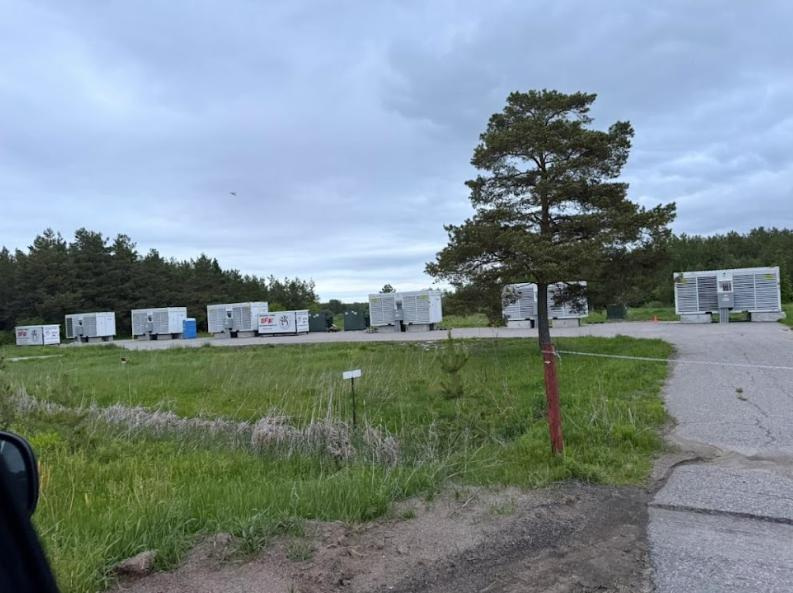
Much of the public discussion about cryptocurrency mining and AI data centers in the region began in early 2025. Odessa Partners LLC, a Florida company, built its Bitcoin mine just 390 feet from Dafter Township’s Lake Superior Academy (LSA), a Montessori school that uses outdoor learning modalities to educate children in grades K-5. After discussions and mediation efforts failed, LSA filed a lawsuit against Odessa for noise disruptions caused by their facility.
“Sault Ste. Marie, our community, is dealing in real time with the impacts of a Bitcoin mining operation that was allowed to move forward without adequate oversight,” said LSA Superintendent Susie Schlehuber. “The constant noise has forced us to change how we teach our students, including moving classes indoors despite our strong focus on outdoor and environmental education. No school or community should be forced to sacrifice learning environments or quality of life because of poorly regulated industrial development.”
School officials and parents allege that Odessa filed paperwork with the township that is not in line with what they ended up building.
“Odessa filed a permit for a ‘storage facility’ across the street from our school,” said Rebecca Torp, who has two children, ages six and four, attending LSA. “We all found out at a June 5, 2025, Dafter Township Planning Commission meeting that Odessa filed a permit for a storage facility or warehouse, but that’s not what they built. They built a Bitcoin mine that produces noise ranging from 65 to 80 decibels as measured by a sound level meter positioned on school grounds. Storage facilities do not produce noise, so we obviously feel as though we’ve been wronged and our children are suffering the consequences of an interrupted learning environment.”
According to a copy of the building permit that Odessa filed with Chippewa County, the permit makes a brief mention of a data center in a section identifying proposed building materials. In the section that identifies what’s being built, the permit clearly states that the building plans are for “Storage, Warehouse, Etc.,” not a Bitcoin mine.
Attorneys representing Odessa were contacted for this story, but they declined to provide comment.
Impact on the community
Odessa’s mine currently has six metal pods housing large computers that run around the clock, requiring huge fans for cooling. Torp described the noise by comparing it to a children’s bounce house.
“Well, we had one of those at the school for a special event last year, and you could hear the Bitcoin mine over the sound of the bounce house,” she said. “And the mine is making that noise on and on and on, 24 hours per day, 365 days per year. Even when Odessa put 150 or so hay bales in front of the units to dampen the noise, we could still hear it, and children are still being affected by it. The children are trying to learn while holding their hands over their ears during outdoor activities. It’s having a particularly adverse effect on our students with IEPs (Individualized Education Programs), of which we have many such students. I’ve spent the past year researching this issue and I can’t find anywhere else in the U.S. where someone put a cryptocurrency mine next to a school. It simply isn’t done.”
Amy Brzuchalski, director of outdoor instruction at LSA, said the school has a science shed behind the main school building where they host a Sturgeons of Tomorrow STEM program.
“We can be standing in the shed, taking care of the fish and conducting a lesson plan for the students, and we can still hear the Bitcoin mine over the low hum generated by our 150 gallon aquarium,” Brzuchalski said. “That’s how loud and distracting it is, and now we’re hearing from Odessa that they want to expand and add more computer pods, which will increase the noise. They have six pods right now, but they have the electrical infrastructure on-site to support 40-50 pods. That’s a lot of fan noise, especially during the warmer months, and we’re a year-round school.”
Dafter Township does not currently have noise ordinances in place that might have prevented the construction of a Bitcoin mine.
Township Supervisor Robert Brown said he recognized the upset the mine has caused within the community.
“The township recognizes this is a neighbor dispute and asks both parties to return to the table, have open discussion again and to please leave emotion out of the conversation,” Brown said in a statement.
Brown added that online discourse about the issue is only making residents more polarized, rather than bringing them together to find solutions.
“As a reminder, social media is a shield for accountability and only hinders productive communication and problem solving,” he said.
Pros and cons
Emily Veler, an LSA staff member, said she thinks there’s nothing inherently wrong with cryptocurrency, but that the community wasn’t consulted before the mine went in and that transparency has been severely lacking at every step.
“My partner trades Bitcoin, so we don’t think it’s the mine itself that’s bad, just the location where they (Odessa) chose to place it,” Veler said. “LSA is a Montessori school, and Montessori is rooted in calm and a respect for the environment. Noise pollution directly affects concentration, emotional regulation and learning, and young children are especially sensitive to it. That constant noise has been affecting our day every single day, particularly during the warmer months.”
While many at the January event and those affiliated with LSA have voiced opposition to the Bitcoin mine and regional cryptocurrency and AI developments more broadly, others have spoken out in support of them or the benefits they can bring to local communities.
“I guess I’m ambivalent about it, but I don’t necessarily think it (the mine) is a bad thing,” said Chippewa County Commissioner Damon Lieurance, who represents Dafter Township. “They (Odessa) are currently following all the rules and have an agreement with Cloverland Electric. They’re paying taxes, which is a net benefit for Dafter, as there’s not much tax income being generated there. It’s prime commercial real estate they’re operating on and the property is being used for something that generates revenue for the community, rather than just sitting vacant.”
Lieurance said he has been in talks with Odessa about the noise generated by the Bitcoin mine.
“They said they’re going to look into more permanent solutions to the noise problem than just hay bales,” he said. “They let slip that they might install better cooling fans that are quieter, or that they might switch to a closed water-cooled system.”
Lieurance also noted that it wasn’t acceptable for students to be disturbed by noise pollution and that students have a right to a peaceful learning environment.
“I feel like we can figure this out,” he said.
Energy concerns
One concern that many residents have about cryptocurrency mines and AI data centers is their impact on the environment and energy use.
According to the U.S. Energy Information Administration, the recent surge in the establishment of AI and crypto facilities has reversed roughly 15 years of relatively flat energy demand. Currently, AI data centers account for 4.4% of U.S. electricity consumption, and cryptocurrency mining adds another 0.6-2.3%.
The laws of supply and demand suggest that when demand for energy rises, prices will also surge. That has certainly been the case in other places. For example, Tennessee is in the process of establishing 27 AI data centers in the Nashville area alone. In 2025, the Volunteer State went from having one of the lowest average energy costs per consumer to being one of the top 10 states in the nation for the highest year-over-year energy cost increases.
But a representative at Cloverland Electric Cooperative, a utility that serves much of the Upper Peninsula, said it’s not that simple.
“When you buy power matters almost as much as how much you’re buying,” said John Sawruk, vice chair at Cloverland. “I can’t reveal confidential client information, but I will say we negotiated a deal with Odessa in which they’ve agreed to engage in ‘peak shaving’ which means they will shave off their energy demands when the community at large is experiencing peak demand, which will help keep energy usage in the ‘sweet spot’ we like to be in to maximize savings for customers.”
Sawruck said that another misconception is that Cloverland had a choice not to provide power to the Bitcoin mine.
“We can’t simply refuse to provide power to a business that meets the criteria for connecting to the grid and receiving power,” Sawruck said. “If we tried to do that, we’d be sued.”
Nearby townships prepare for the future
All of the Jan. 18 keynote speakers strongly urged communities to hold open, frequent discussions about whether residents want these types of industries in their neighborhoods. And if communities democratically decide they don’t, they will need to pass regulations and ordinances that either prevent such operations or provide specific regulations.
Shawn Merritt, chair of the planning commission for nearby Clark Township, said his wife, Kristi Autore, was present at the June 5, 2025, Dafter Township Planning Commission meeting where community members challenged Odessa representatives about their lack of transparency surrounding the Bitcoin mine.
Autore came home that night and told Merritt what was happening in Dafter. He then immediately got to work with Clark Township officials to pass a one-year moratorium on cryptocurrency mines in order to give the township time to formulate new rules and ordinances.
“Clark Township seeks to prioritize land uses that contribute to community resilience, economic diversity, quality of life and environmental sustainability,” Merritt said.
He added that there is a lack of a regulatory framework regarding cryptocurrency mining and AI data centers, especially in rural Michigan, which he says is probably why such operations are trying to set up facilities in the U.P. and the northern Lower Peninsula.
“If communities don’t want these facilities, they’re going to have to come together and develop new regulatory frameworks and ordinances that reflect the interests of residents,” Merritt said at the January meeting.
Upper Peninsula communities are still organizing and having open discussions about the issue months later. On April 16, community members packed a meeting of the Chippewa County Board of Commissioners to voice their concerns. Commissioner Scott Shackleton made it clear the county does not plan to regulate crypto mines or data centers, but he invited community members to speak their mind.
Ren Brabenec is a Brimley-based freelance writer and journalist with The Sault News. He reports on politics, local issues, environmental stories, and the economy. For questions, comments, or to suggest a story, email hello@renbrabenec.com.
This article originally appeared on The Sault News: U.P. center of Bitcoin mine debate after Dafter Township controversy
Reporting by Ren Brabenec, Sault Ste. Marie News / The Sault News
USA TODAY Network via Reuters Connect