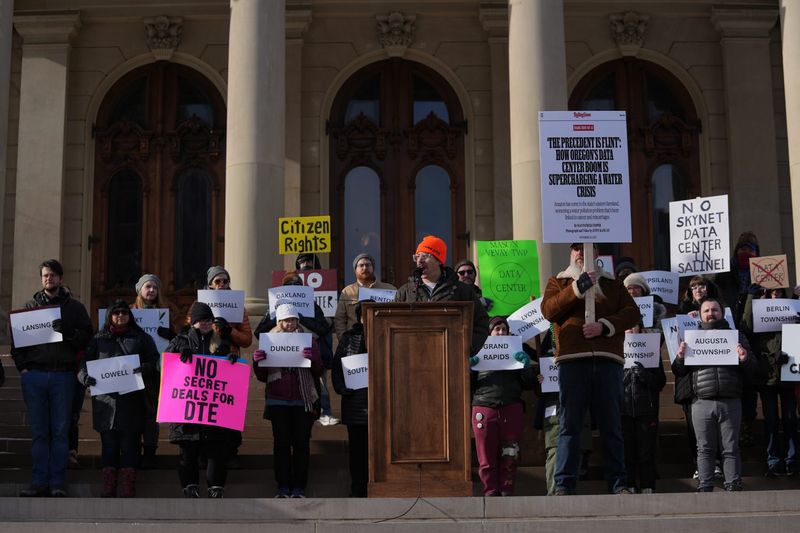
A recent op-ed in the Times Herald titled “We didn’t stop the assembly line — why stop data centers?” deserves a response grounded in the science and evidence I’ve been working on as a research scientist and director of a nonprofit who is leading statewide efforts against the construction of data centers in Michigan. Let’s go claim by claim.
‘Data centers are the infrastructure that makes modern life possible’

There’s a kernel of truth here, but the author of that column, Mike Brownfield, a vice president for the Goldwater Institute, inflates it into something entirely unreasonable. Yes, data centers support cloud computing and digital services and just about everything we use in modern society. But the hyperscale AI facilities being proposed across Michigan aren’t being built to keep your email running. They’re being built to fuel an AI arms race among trillion-dollar Big Tech corporations—many companies that have spent two decades hoarding personal data and selling it to advertisers and are now racing to monetize it further through artificial intelligence. The infrastructure that “makes modern life possible” already exists. What’s being proposed is a massive expansion to serve corporate ambitions, not public needs.
The Switch lie
The Switch data center in Grand Rapids is not the success story it’s often heralded as. When Switch arrived in Michigan in 2015, it promised 1,000 jobs and $5 billion in investment in exchange for sales and use tax exemptions. By the 2022 state reporting deadline, Switch had created exactly 26 full-time jobs—2.6 percent of what was promised by developers—at a median wage under $38,000 a year. These were not the six-figure careers the community was sold.
Rather than revoking the tax breaks as the law required, the state quietly amended the deal, letting Switch count employees of other companies toward its total. Then in 2024, the Legislature extended those exemptions through 2050, at a cost to the state exceeding $90 million. As John Mozena, president of the Center for Economic Accountability, put it, “data centers are some of the dumbest things a state can subsidize.”
‘Data centers have deep pockets — you won’t foot the bill’
This is a misleading claim, and it is directly contradicted by a growing body of research.
A March 2025 paper from the Harvard Electricity Law Initiative, titled “Extracting Profits from the Public: How Utility Ratepayers Are Paying for Big Tech’s Power”, examined nearly 50 regulatory proceedings and found that utilities are entering secret contracts with data center operators and shifting the costs of discounted rates onto residential customers. As the authors concluded: “Without systematic changes to prevailing utility ratemaking practices, the public faces significant risks that utilities will take advantage of opportunities to profit from new data centers by making major investments and then shifting costs to their captive ratepayers.”
A November 2025 Consumer Reports survey of over 2,100 U.S. adults found that 78 percent of Americans are concerned that new data centers will raise their energy bills. And they’re right to be worried. A Bloomberg analysis found that wholesale electricity costs have surged as much as 267 percent over five years in areas with high data center concentrations. Utilities nationwide requested a record $31 billion in rate increases in 2025, which is more than double the prior year.
In March 2026, Federal Reserve Chair Jerome Powell put it plainly during a press conference: “In the short term, what’s happening is we’re building data centers everywhere, and that’s actually putting pressure on all kinds of goods and services that go into building these things. So that’s actually probably pushing inflation up.”
The Kalkaska story
Brownfield writes about Kalkaska County as if local residents made a mistake by rejecting what would’ve been the largest data center to-date in the United States. What actually happened in Kalkaska was nothing short of remarkable. The Kalkaska Republicans and Kalkaska Democrats came together to fight on the same side, in what reportedly looks like the first time in… forever. That kind of bipartisan unity doesn’t happen because people are confused or misinformed on data centers. It happens because common Americans looked at what developers were promising and said, “no thanks.”
This is a pattern that is repeating across Michigan. At least 19 communities have passed or proposed moratoriums on data center development. A bipartisan group of state lawmakers introduced legislation for a one-year statewide moratorium, calling it the Data Center Regulation Act (HB 5594-96). More than 130 Bridge Michigan readers named data centers a top issue for 2026 candidates. Nationally, community opposition has blocked or delayed an estimated $98 billion in data center projects.
These aren’t uninformed Americans panicking about the rise of a new industry,. These are well-informed Americans who are watching the horror engulfing small-town USA, where big tech corporations are dropping into quiet communities and ruining residents’ standard of life (like in Saline).
The skinny
Brownfield’s op-ed compares data centers to the auto industry that built part of Michigan. Yet it’s also true that when the auto industry left, it gutted the communities that helped originally lead to its success. Detroit and Flint have been recovering from that abandonment for generations.
Data centers and auto plants aren’t the same thing. One employed hundreds of thousands of people and created a burgeoning middle class. The other employs a skeleton crew and sends its profits out of state. Treating them as equivalent is one of the grossest examples of the false equivalency fallacy that I’ve ever come across.
The fact is, AI and Big Tech should worry all of us, for more reasons than any single op-ed can cover. We simply don’t have the legislative guardrails in place yet. As Tristan Harris, computer scientist, former Google employee, and founder of the Center for Humane Technology, put it:
“We are currently releasing the most powerful, inscrutable, uncontrollable technology we’ve ever invented, that’s already demonstrating behaviors of self-preservation and deception that we only saw in science fiction movies. We’re releasing is faster than we’ve released any other technology in history, and with under the maximum incentive to cut corners on safety.”
Funnily enough, we haven’t even gotten to the peer-reviewed scientific literature on the public health and environmental impacts of data centers — the noise pollution, the PFAS and anti-freeze discharged into our waterways, the diesel backup generators, the air quality concerns, the loss of agricultural land. That’s a column for another day.
Mitchell Ryan Distin, Ph.D, is a evolutionary biologist and director of the environmental nonprofit The New People Foundation. He currently writes for the Northern Express, and has authored several books (mostly academic), including his new trade book “Common Enemy: The Falsity of the Left-Right Divide.” Distin recently announced his candidacy for the 104th district seat in the Michigan House of Representatives.
This article originally appeared on The Holland Sentinel: No, data centers are not assembly lines | Opinion
Reporting by Mitchell Ryan Distin, Holland Sentinel / The Holland Sentinel
USA TODAY Network via Reuters Connect