BARABOO – It’s a few minutes after sunset April 13 and the sky north of Baraboo flashes with lightning.

But our group takes little notice of the weather.
We’re fixated on another airborne phenomenon.
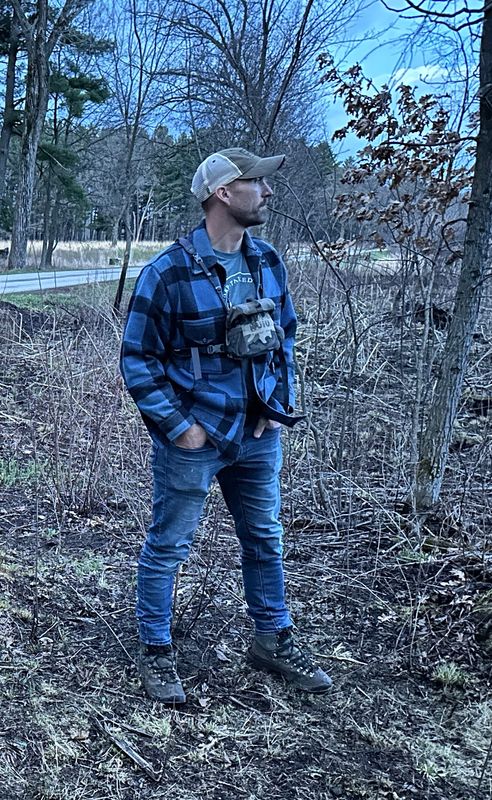
“There’s one,” says Karl Malcolm of Cedarburg, tracing a descending line in the dusky air with his forefinger. “Landed just on the other side of that apple tree.”
Doppler radar is no doubt showing thunderstorms to the north. We’ve seized a break in the clouds to use eyes and ears and feet to find a feathered gift of the season: American woodcock.
And we’ve come to famed conservation grounds to do it.
We’re on the Leopold-Pines Conservation Area, about 4,000 acres in the Wisconsin River corridor where the Aldo Leopold Foundation and partners are restoring prairie and savanna habitats.
In addition to Malcolm, vice president of conservation for the Ruffed Grouse Society and American Woodcock Society, our group includes Steve Swenson, program director at the Aldo Leopold Foundation; Arik Duhr, the foundation’s stewardship manager; Luke Benson, a Leopold Fellow; and me.
Just 300 yards north of us is “The Shack,” the chicken coop Aldo and Estella Leopold converted into a family cabin in the 1930s and the centerpiece for many essays in Aldo Leopold’s famous book “A Sand County Almanac.”
And extending to our south is a 20-acre opening recently treated with fire.
The earth here, softened by recent rains and covered with sparse, short vegetation, has all the ingredients for woodcock foraging and the evening spectacular: courtship displays.
As we stand and look south, the clearing is alive with buzzing vocalizations and twittering wings.
Aldo Leopold dedicated essay to woodcock mating ritual
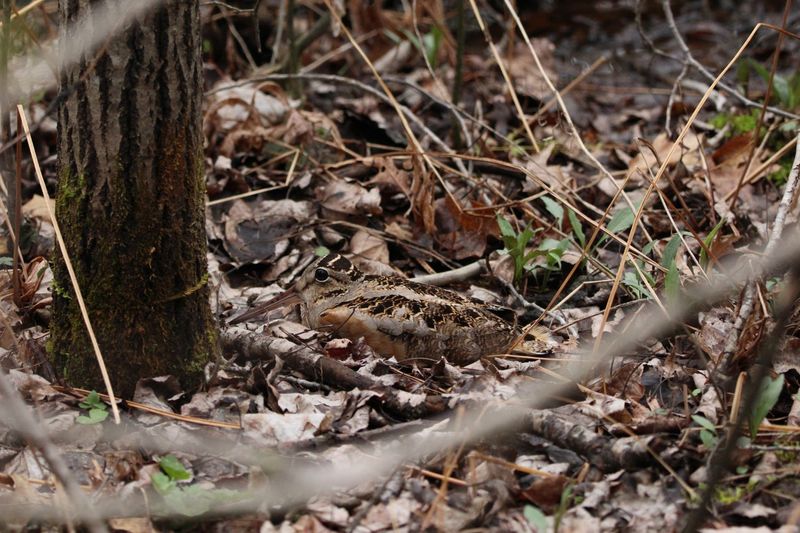
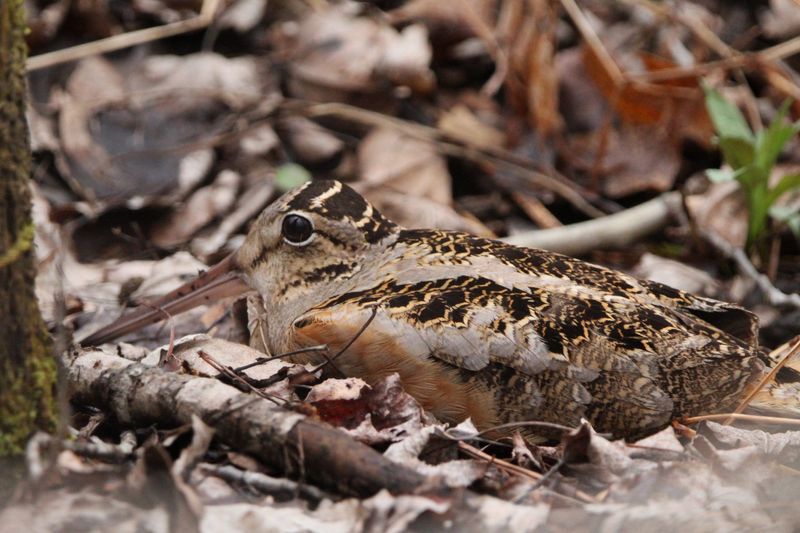
The American woodcock is a native North American bird species found in Wisconsin and much of the eastern United States and Canada.
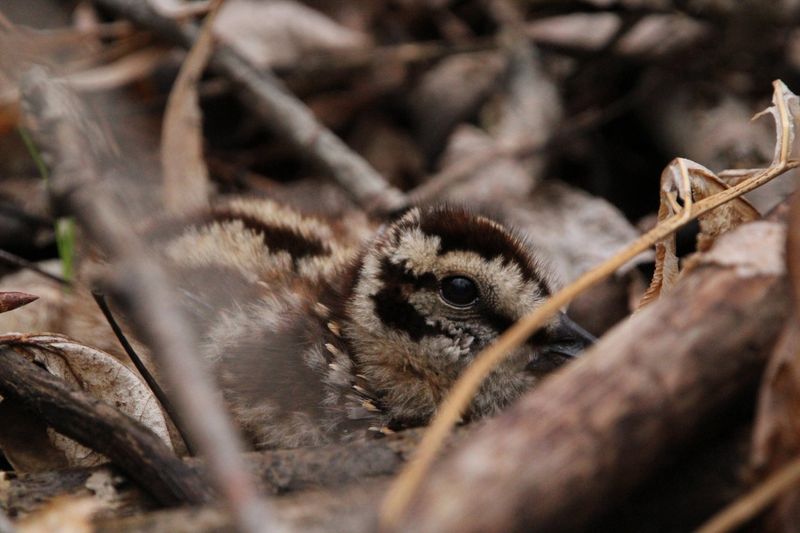
Known by a host of colloquial names, including timberdoodle, Labrador twister, bogsucker and mudsnipe, the species is about the size of the American robin, but with mottled russet or brown plumage and a very long bill it uses to probe the ground for earthworms, its primary food.
Woodcock are migratory, spending the spring and summer in Wisconsin and other northernly areas and wintering in the southern or southeastern U.S.
The species is dependent on early successional – or young – forests and is often found on recently disturbed areas such as those treated with prescribed fire or were logged and have new tree growth.
Woodcock are also well-known for their spring mating behavior, a ritual Leopold learned about only after he and Estella bought their farm along the Wisconsin River.
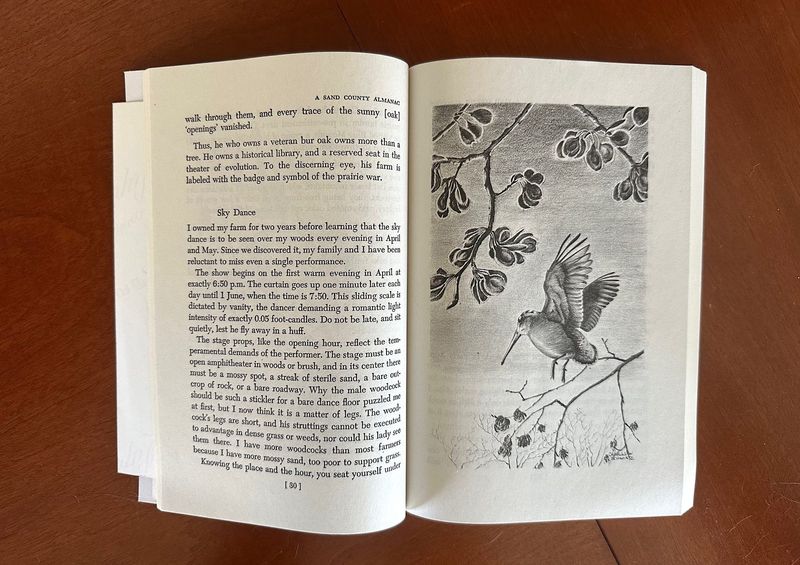
In his essay “Sky Dance”, Leopold describes his wonder at the birds.
“Since we discovered it, my family and I have been reluctant to miss even a single performance,” Leopold writes. “The show begins on the first warm evening in April at exactly 6:50 p.m. The curtain goes up one minute later each day until 1 June, when the time is 7:50. This sliding scale is dictated by vanity, the dancer demanding a romantic light intensity of exactly 0.05 foot-candles. Do not be late, and sit quietly, lest he fly away in a huff.”
The stage must be an open amphitheater in woods or brush, and in its center there must be a mossy spot, a streak of sterile sand, a bare outcrop of rock, or a bare roadway, Leopold said.
“Why the male woodcock should be such a stickler for a bare dance floor puzzled me at first, but I now think it is a matter of legs,” Leopold writes. “The woodcock’s legs are short, and his struttings cannot be executed to advantage in dense grass or weeds, nor could his lady see them there.”
“Knowing the place and the hour, you seat yourself under a bush to the east of the dance floor and wait, watching against the sunset for the woodcock’s arrival. He flies in low from some neighboring thicket, alights on the bare moss, and at once begins the overture: a series of queer throaty peents spaced about two seconds apart, and sounding much like the summer call of the nighthawk.
“Suddenly the peenting ceases and the bird flutters skyward in a series of wide spirals, emitting a musical twitter. Up and up he goes, the spirals steeper and smaller, the twittering louder and louder, until the performer is only a speck in the sky. Then, without warning, he tumbles like a crippled plane, giving voice in a soft liquid warble that a March bluebird might envy. At a few feet from the ground he levels off and returns to his peenting ground, usually to the exact spot where the performance began, and there resumes his peenting.”
Organizations partner to improve habitat for declining woodcock population
My visit was timed for the evening woodcock flights and was a cherished opportunity to gather with Malcolm and the Aldo Leopold Foundation staff, all of whom I’ve known for many years.
It also came after a day of meetings between Malcolm of the Ruffed Grouse Society/ American Woodcock Society and the foundation staff.
The two organizations are partnering to offer a 2026 conservation membership, merging Leopold’s land ethic with active forest management. The collaboration is intended to promote healthy forest ecosystems and sustainable habitat for upland wildlife.
It also aims to foster a “land ethic” within the hunting community and beyond, ensuring sustainable, science-based conservation for the future, as well as emphasize the role of hunters in conservation.
People who join receive a RGS/AWS membership, Leopold Foundation newsletters, assorted merchandise and a copy of “A Sand County Almanac.”
Malcolm, 44, grew up in Michigan enjoying all things outdoors. It led to an academic path in science, culminating in a doctorate in wildlife ecology from the University of Wisconsin-Madison and now work as a conservation leader with the RGS/AWS.
He can still recall the first time he saw woodcock courtship behavior.
“Of course it was fascinating to see and hear and I got my mom to show her,” Malcolm said. “No one had told me about it and I thought I discovered it.”
But about a year later someone gave Malcolm a copy of “A Sand County Almanac” and he read “Sky Dance.”
“I thought, ‘Who is this Leopold guy, anyway?'” Malcolm said. “I’m a big fan of the birds and Aldo.”
And these days, Malcolm applies the might of RGS/AWS and partners to help woodcock and other species that depend on similar habitat.
Woodcock can use it, too. Across North America, woodcock populations have experienced a longterm, broad-scale decline.
The U.S. Fish and Wildlife Service’s Singing-ground Survey – one of the longest-running wildlife surveys on the continent – shows sustained downward trends across both management areas.
In its “American woodcock, Population Status 2025” report, the data from 1968 to 2025 summarizes the change with annual declines of 0.74% in the Eastern Management Region and 0.52% in the Central Management Region (including Wisconsin).
This pattern is neither localized nor unexpected, Malcolm said. American woodcock are now listed as a species of greatest conservation need in 29 states, reflecting widespread agreement among state and federal wildlife agencies that current habitat conditions are insufficient to support stable populations.
While woodcock are persisting, the forest conditions they depend on – early successional forest habitat – have become increasingly rare.
Decades of reduced disturbance, aging forests and fragmented management across ownerships and jurisdictions have reduced woodcock habitat and led to the population decline, Malcolm said.
But where active forest management has been implemented at sufficient scale, woodcock have responded quickly and positively.
Change already seen at Leopold-Pines Conservation Area
One example is right in front of us. Staff at the Aldo Leopold Foundation have been intensively working to restore habitat on the Leopold-Pines Conservation Area.
Arik Duhr, the ALF stewardship manager, said reintroduction of prescribed fire has not only improved the property’s savannas and prairies.
“In addition to the response of native plant species, we are seeing more woodcock, one of our priority bird species,” Duhr said. “Woodcock love the shrubby regrowth that pops up between fires.”
This spring while working on the property, he’s flushed about 30 woodcock, most on record and roughly five times as many as he observed just a few years ago.
“We attribute it to improvements in the quality of the habitat we are creating,” Duhr said. “Very few things elicit the same excitement as flushing a woodcock in the field. Woodcock are one of our priority species, so seeing more of them in recent years has affirmed our management is making a real difference.”
Witnessing woodcock display is a rare privilege
As the evening of April 13 grew darker, we hunched low in the opening south of The Shack, doing our best not to disturb the woodcock performance.
At one point three males were peenting along the ground within 30 yards of us, then periodically flying high and falling back to earth.
We cupped our ears and squinted our eyes, trying to take it all in.
In “Sky Dance” Leopold writes: “The woodcock is a living refutation of the theory that the utility of a game bird is to serve as a target, or to pose gracefully on a slice of toast. No one would rather hunt woodcock in October than I, but since learning of the sky dance I find myself calling one or two birds enough. I must be sure that, come April, there be no dearth of dancers in the sunset sky.”
About 80 years have passed since Leopold wrote those words.
But the team I was privileged to join this evening has taken up the mantle for woodcock.
“The woodcock is a valuable indicator of forest health at a flyway scale,” Malcolm said. “They’re telling us something important and we are working on delivering what they need.”
Woodcock presentation in Grafton
Karl Malcolm, vice president of conservation for the Ruffed Grouse Society and American Woodcock Society, will give a presentation titled “The American Woodcock as a Bellwether of Changing Forests and Conservation Opportunity” on Tuesday, April 28 at the Grafton USS Liberty Memorial Public Library. Malcolm will share stories, insights, and lessons spanning the forests of the North Woods to the Gulf Coast, tracking the trends and needs of one of Wisconsin’s most unique and revealing species. The event is free and will run from 6:30 to 7:30 p.m. The Grafton public library is at 1620 11th Avenue, Grafton. For more information visit graftonpubliclibrary.net or call (262) 375-5315.
This article originally appeared on Milwaukee Journal Sentinel: American woodcock inspire awe and conservation partnerships | Paul A. Smith
Reporting by Paul A. Smith, Milwaukee Journal Sentinel / Milwaukee Journal Sentinel
USA TODAY Network via Reuters Connect