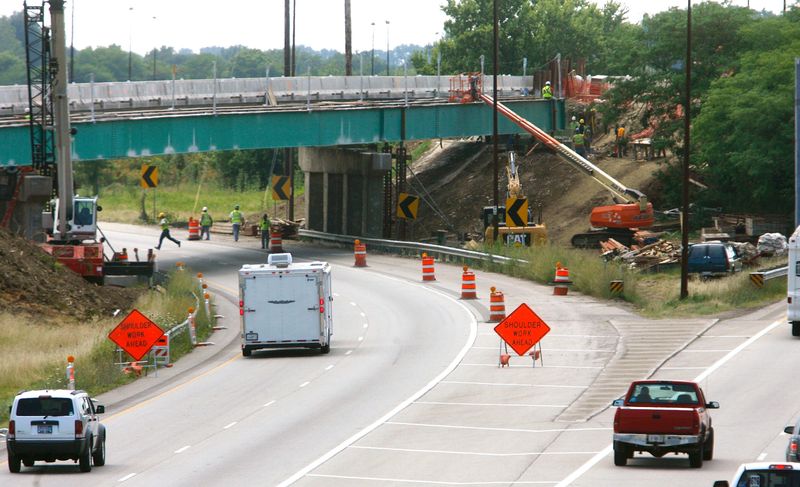
A multi-car pile-up with one fatality in December. A two-car, two-fatality crash in January. Another in March. Five deaths within ten miles. In between these accidents, drivers saw road closures, construction, or police operations, any of which could slow traffic by hours.
Drivers on I-55 between Williamsville and Southern Springfield have been waiting for years for its expansion from a 4-lane highway to a 6-lane highway, as well as adding a concrete median, making ramps more efficient and adding roads between interchanges to reduce high speeds during merging.

For drivers who rely on this critical interchange between the two largest highways in the area, these updates are overdue. Crashes, delays, and congestion have become routine, forcing drivers to navigate narrow lanes at high speeds with uncertainty of what’s around the corner.
The chronic logjam at the I-55/72 interchange is just one example of a much larger, statewide infrastructure challenge. Across Illinois, thousands of roads and bridges need repair or replacement. According to state data, roughly one-third of roads in the Chicago region are rated in fair or poor condition. Downstate, that number climbs to nearly 45 percent.
This is not a localized issue, it’s systemic. Decades of underinvestment have pushed Illinois’ infrastructure to a breaking point. While IDOT continues to stretch available resources as far as possible, the reality is simple: without sustained, reliable funding, the system will continue to deteriorate.
The state has been discussing widening this stretch of I-55 for more than a decade. The timeline for construction and execution of this well-studied, highly needed expansion depends entirely on securing full funding, something that remains uncertain. The project is listed in IDOT’s Multi-Year Plan but lacks a dollar tag attached to it.
The consequences of inaction affect everyone. On January 20th, 2026, Illinois state senators waited in stopped traffic for hours while I-55 was closed, trying to get to Springfield to do the work of the state. How can things change to improve the roads if the lawmakers can’t even get to their jobs?
Poor road conditions contribute to more than one-third of fatal crashes statewide and cost Illinois drivers nearly $800 each year in vehicle repairs, wasted fuel, and depreciation—totaling an estimated $6.6 billion annually. That’s a direct hit to household budgets and the broader economy. But there is a path forward.
Every dollar invested in Illinois infrastructure returns as much as $2.50 in economic activity. These projects create jobs, support local businesses, and strengthen communities across the state.
In fact, every $1 billion invested in infrastructure can support up to 25,000 jobs—many of them skilled, union positions that sustain families and fuel local economies, particularly in downstate communities.
The workforce is ready. Union laborers and skilled tradespeople stand prepared to rebuild Illinois’ roads, strengthen our infrastructure, and support the communities that depend on them. What’s needed now is leadership.
Illinois must commit to sustained, long-term infrastructure investment that matches the scale of the challenge. That means building on the progress of recent programs while ensuring reliable funding to address both immediate needs and future demands.
We can continue to react to crises, or we can invest now, fix what’s broken, and build a stronger, safer future for Illinois. We can’t afford to wait any longer.
Mike Murphy is the President and CEO of the Greater Springfield Chamber of Commerce.
This article originally appeared on State Journal-Register: Unfounded road projects leave Springfield drivers in danger | Opinion
Reporting by Mike Murphy, Special to the State Journal-Register / State Journal-Register
USA TODAY Network via Reuters Connect