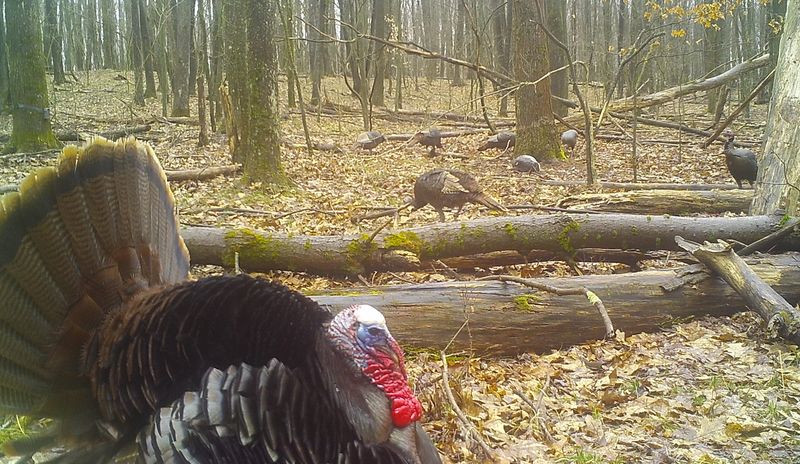
While spring gobbler hunting, one could say, “I found an edge.”
And that’s what it takes sometimes to successfully fill a turkey tag.

When we first started using decoys to hunt turks, back in the 1980s, our fake hens would typically be set up about 30 yards out in a field or inside the middle of the woods someplace we thought felt good.
We would set up and call and call with our backs against a wide-trunked tree or a blind, with guns covering the dekes.
Lots of gobblers answered.
Lots of excitement.
Even tagged a bird or two that way.
But the success percentages were poor.
An old wild tom turkey is most often a very crafty critter.
They usually move carefully, suspiciously, and take their time, slowly processing everything in their surroundings.
These full-fanned patriarchs don’t get old by being hasty and running their mouths at the first thing that looks or sounds like a hen, despite what we see on TV and videos.
Those days are gone.
Full-brushed longbeards now act like a different breed.
They are wily critters that do not come in easily.
A gobbler hunter that duels with one of these old long spurs usually needs an edge.
A few springs ago … probably somewhere after the turn of the millennia, during the middle of May, I had hit my third spot of the morning. Move the dekes, one more time. As so often happens, the first two setups didn’t pan out that day, so with time still on the clock, I drove my truck to the third.
Running and gunning around the county.
But that specific morning was memorable.
This third hunting spot that day was a smallish property surrounded by heavily hunted acreages.
As I was hustling up the hollow, with two bagged decoys, and shotgun strapped on, a tom sounded off.
Game on.
The bird … well, sounding more like two or three …
I was pinned down and not in a good spot. Too thick, didn’t dare move, but played coy and hard to get. They were close.
You know, just a putt or a purr occasionally. And maybe five minutes later … a yelp so they’d not commit but move off. Maybe allow some space and time for a secondary move and decent setup where I could get the job done.
Sure enough, they eased off a bit and I made my next reposition, scrambling up to the edge of a hidden meadow.
But my jake and hen decoy were still back down in the woods, still set there were I had originally been calling.
I chomped at the bit, wanting to put those dekes out in the field so badly. I surmised, “that way the toms could see ‘em better.”
But no way.
Didn’t dare because the cover was too sparse.
They’d spot me.
Too big of a risk.
The best I could do was crawl up to an ancient apple tree next to a rusted old barbwire fence, and position again, with shotgun pointed down at the decoys.
The revelation came in the form of three turkeys.
The trio of long-beards had swung out into the meadow, circling, making a big loop, sneaky and coming in silently from my right side.
Good thing I hadn’t moved into the field.
The first bird was a sub-dominant, probably a two-year old. And it was fun to watch him stretch his long neck out on his tiptoes, looking over the barbwire at my two decoys down below.
(Luck was on my side because the plastic hen and jake were actually positioned in the woods, not too close to the field and not too far away either … probably around 30 yards.)
My attention and my breath were snatched away. Out of the corner of my eye, I could see on the highest rise out in the field a dominant bird’s fan.
What a beauty. He strutted in full display, letting the other two smaller toms walk point, go down, and check out the hens.
Didn’t have to wait long. The two young gobblers slipped through the fence, drawn to the decoys.
The old tom broke strut and followed to the fence, peering down at the other two approaching the dekes, just before he wore my zip-tied tag with a bang.
So instead of placing your deke out in a field, make the tom have to come in to see the hens. Place the decoys back in the woods so that they can barely be seen from your field edge.
This article originally appeared on The Evening Tribune: How to gain an edge on a tom turkey hunting this spring | Column
Reporting by Oak Duke, Outdoors Columnist / The Evening Tribune
USA TODAY Network via Reuters Connect