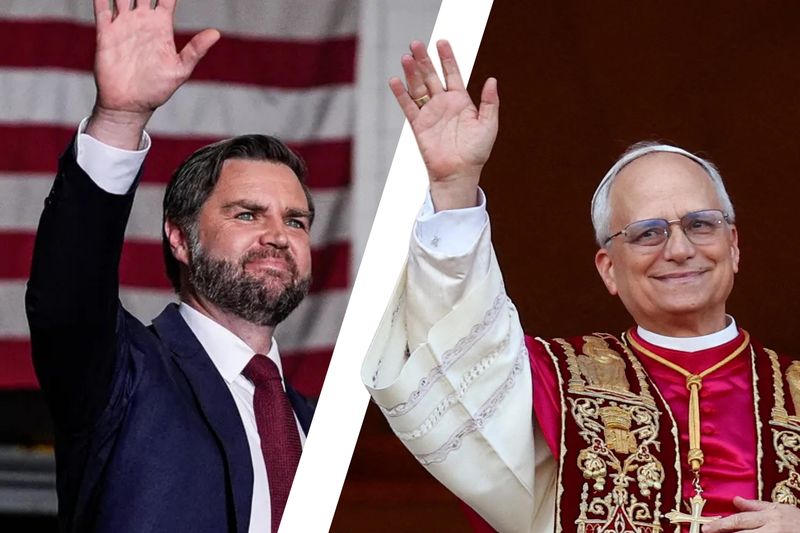
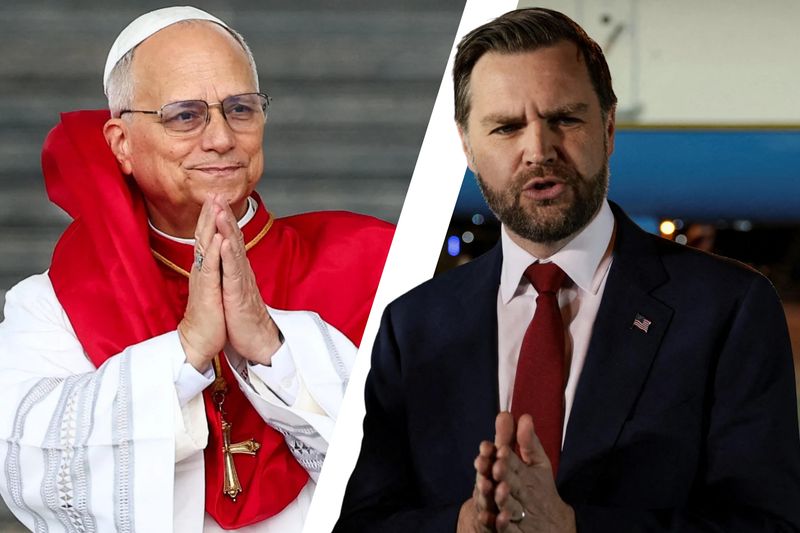
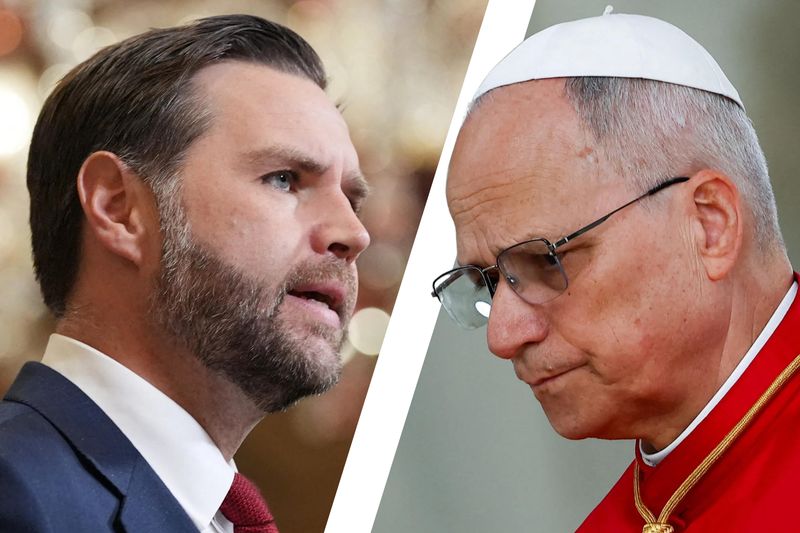
A month after picking a fight with American bishops, and a few weeks after he drew public rebukes from the current pope and the future pope, Vice President JD Vance arrived at the National Catholic Prayer Breakfast in February 2025 with a message.
Catholics, he said, should stop arguing so much.

“I don’t think it’s good for us as Christians to constantly fight with one another over every single controversy,” Vance told the crowd.
More than a year later, the vice president still is struggling to take his own advice, especially when it comes to Pope Leo XIV, who became the church’s first American pope last year after the death of Pope Francis.
The most recent disagreement between the two men erupted last week over the war in Iran, which the vice president defended as necessary to protect U.S. interests and the pope decried as needless death and destruction.
Vance responded to Pope Leo’s criticism of the war by suggesting the pope should “be careful when he speaks about matters of theology.”
It was an extraordinary moment: Vance, a recent Catholic convert, questioning the Vicar of Christ’s grasp of Catholic teaching.
Yet the American pope and the American vice president had been building to that moment for almost a year, talking past one another on some major issues and expressing opposing views on others.
They disagree on immigration, the death penalty, climate change, aspects of Catholic theology, the war in Iran, Ukraine, the bombing of suspected drug smugglers in the Caribbean and the proper way to define the term “pro-life.”
Every difference, whether it arises in an interview, a speech or a social media post, is magnified because Pope Leo and Vance are now the two most prominent American Catholics in the world.
What they say, especially when they disagree, carries weight with millions of American Catholics who are today as politically divided as the nation they call home.
A devout vice president takes on ‘Da Pope’
Sparring between Catholic politicians and Catholic clergy, even popes, is nothing new in American politics. Former President Joe Biden and former House Speaker Nancy Pelosi both ran afoul of their church for supporting legal abortion, and Catholics of all political persuasions have questioned the wisdom of their popes from time to time.
But Vance and Pope Leo pose challenges to one another that their predecessors never encountered.
In Vance, the pope faces a devout Catholic vice president willing to argue theological points and to defend his boss, President Donald Trump, even when he calls the pope “weak” and “radical.”
In Pope Leo, the vice president must contend with a determined, popular American pope who knows this country’s history, culture and politics as well as he does.
Pope Leo’s rise from Chicago’s South Side to the Vatican is as much an American story as Vance’s climb from a poor home in Middletown, Ohio, to the vice presidency.
If this pope disagrees with a politician, he does it with a Chicago accent. He’s a White Sox fan, his brother is a Trump supporter, and a hometown brewery named a beer after him called “Da Pope.”
“When Pope Francis was pope, Americans could say, ‘Oh, he doesn’t understand America. He’s from Argentina,’” said the Rev. Thomas Reese, an author and senior analyst for Religion News Service who has written extensively about the Vatican.
“The new pope is American,” he said. “You can’t say this guy doesn’t understand America.”
In some ways, the disagreements between Pope Leo and Vance reveal how much they have in common with millions of their fellow Catholics in the United States.
They share a faith but differ on how to live that faith in the real world.
Large numbers of American Catholics consistently land on opposite sides of the biggest issues of the day, from immigration and armed conflict to abortion bans and presidential elections. The Pew Research Center found Catholic majorities voted for Trump in 2016, Biden in 2020 and Trump again in 2024.
“There’s no confusion about what the church teaches, but Catholics make up their own mind about what they’re going to do and what they’re not going to do,” Reese said. “If every Catholic who disagreed with church teaching left, we wouldn’t have anybody in the church.”
Pope’s mission ‘spans well beyond politics’
But Pope Leo and Vance are not just any American Catholics. The pope is the spiritual leader of the church’s 1.4 billion followers, and the vice president, a convert baptized in 2019 at St. Gertrude Priory in Cincinnati, is the nation’s highest-ranking Catholic politician.
Together, they give Catholics in the United States unprecedented clout in the church, which is why their differences matter so much to so many.
Vance, who declined an interview for this article, suggested during their recent clash over the Iran war that the pope should limit his commentary to “matters of morality” and leave American public policy to Trump.
The pope’s job, however, requires more of him than to recite passages from the Gospels and remind Catholics to go to Mass on Sunday. He’s expected to speak about moral and spiritual issues in real time.
Pope John Paul II delivered blistering critiques of the Soviet Union during the Cold War, while Pope Francis complained often about economic policies that he believed left millions in misery.
“At the end of the day, Vance is a politician. The pope has a larger mission that spans well beyond politics,” said Melissa Deckman, CEO of the Public Religion Research Institute, a Washington, D.C., nonprofit that studies religion and society. “They are totally different offices and purposes.”
The first hint at how dramatic those differences might be came in January 2025, about a month before the vice president delivered his speech at the prayer breakfast urging Catholics to avoid arguing with one another.
In a Fox News interview, Vance cited a Christian concept known as ordo amoris, or “the order of love,” to defend the Trump administration’s immigration crackdown.
“You love your family, and then you love your neighbor, and then you love your community, and then you love your fellow citizens in your own country. And then, after that, you can focus and prioritize the rest of the world,” Vance said.
Pope Francis, who died weeks later, wrote a letter to American bishops refuting Vance’s take as a misunderstanding of “Christian love.” The future Pope Leo, who was then Cardinal Robert Prevost, shared an essay critical of Vance on his X account.
“JD Vance is wrong,” he wrote.
Around the same time, Vance took on the U.S. Conference of Catholic Bishops, suggesting the bishops opposed foreign aid cuts because the church received money to resettle refugees, a charge the bishops denied.
“The U.S. Conference of Catholic Bishops has, frankly, not been a good partner in common sense immigration enforcement,” Vance said. “I hope, again, as a devout Catholic, that they’ll do better.”
Picking a fight with the pope can be risky
Despite his spats with the bishops and popes, Vance speaks often about how his understanding of his faith informs his public life.
It’s a recurring theme in his speeches and in his upcoming book, “Communion,” which chronicles his journey to Catholicism.
“I believe I have been placed in this position for a brief period of time to do the most amount of good for God and for the country I love so much,” Vance said at a Turning Point USA event in Mississippi in October 2025.
“All of us have a duty,” he told the crowd. “And I have two very important duties as vice president of the United States: to the American people and to God.”
Speaking about his faith and his politics in such a way makes sense for Republicans like Vance, whose voters, according to pollsters, tend to be more religious and more Christian than Democrats or independents.
But there are risks, too. Catholicism is impossible to pin down politically because church teaching swings from positions popular on the right, such as bans on abortion and gay marriage, to those favored by the left, such as aid for immigrants and the poor.
Catholics who lean into their faith on one issue may find it works against them on another.
This is where the pope can complicate matters for politicians. While other religions have powerful and outspoken clerics, the Catholic Church is a worldwide, hierarchical institution with a single person, the pope, as its recognized leader.
If the pope disagrees with a politician, he might say so publicly. And the fallout from such a disagreement can drag the politician, the church, or both, into a public feud that ends up alienating or dividing Catholics.
Most popes and politicians do their best to avoid arguing directly with one another, said John Carr, founder of the Initiative on Catholic Social Thought and Public Life at Georgetown University. But he said the combination of a popular American pope and a combative Catholic vice president creates a different dynamic.
“It’s never a good idea to pick a fight with the pope, no matter who the pope is,” Carr said. “But for an American public official to pick a fight with an American pope is particularly dangerous.”
Divided politics and a shared faith
And yet, the list of disagreements keeps getting longer.
While Vance has described Trump as “an incredibly good president” for the pro-life movement, Pope Leo has said someone who favors the death penalty and embraces the harsh treatment of immigrants is “not really pro-life.”
When Vance joked he “wouldn’t go fishing right now” in the Caribbean because the U.S. military was blowing up suspected drug smugglers, Pope Leo appealed for “peaceful political solutions.”
And when Vance said he supported Americans who say, “I don’t want to live next to people who I have nothing in common with,” Pope Leo urged Catholics to treat immigrants in their communities as they would “Christ himself.”
The most direct conflict between the two came during their recent back-and-forth over the Iran war, when Vance challenged Pope Leo’s assertion that the conflict did not meet the church’s definition of a “just war.”
Trump, who is not Catholic, also took exception. He criticized Pope Leo in one social media post and in another shared an AI-generated image of himself in Christ-like robes, healing a bedridden man.
Although many Catholics were outraged, Vance defended Trump on both occasions.
Vance’s supporters say his differences with the pope are normal, the product of two well-meaning Catholics doing very different jobs. They say all Catholics, including politicians, must use “prudential judgment” to determine how best to apply church teaching to their daily lives.
“The first question with any Catholic politician isn’t whether they perfectly mirror every policy preference coming from church leaders, it’s whether they are actively contradicting the church’s moral teachings,” said Logan Cutrona, spokeswoman for CatholicVote, a conservative Catholic advocacy group.
“Vance is clearly engaging these issues as a Catholic, trying to apply the church’s teaching on human dignity within the real responsibilities of governing the American people.”
Carr said the way American Catholics respond to disagreements between Vance and Pope Leo may say more about their own divided politics than their shared religion. Those on the right can applaud Vance’s take on theology, while those on the left can cheer on the pope.
“For a lot of us,” Carr said, “our politics shape our faith instead of the other way around.”
Vance calls for humility but acknowledges the struggle
John F. Kennedy, the first Catholic president, wrestled with a different set of political problems, including the fear among many non-Catholics that he would be more loyal to the Vatican than to his own country. He understood, as well as anyone, the risk of popes and politicians drifting too often into one another’s business.
“I do not speak for the Catholic Church on issues of public policy,” Kennedy said while campaigning in 1960. “And no one in that church speaks for me.”
Vance made a similar case in his 2025 speech at the National Catholic Prayer Breakfast, though at the time he framed his remarks around his recent disagreements with the bishops and the pope. He said clerics and politicians have different responsibilities and, therefore, won’t always see eye to eye.
That’s when he delivered his admonition for Catholics to stop arguing so much, to resist the urge to jump into the nation’s rough-and-tumble political discourse at every opportunity.
“We are not called as Christians to obsess over every social media controversy that implicates the Catholic Church, whether it involves clergy or a bishop or the Holy Father himself,” Vance said.
He said he, too, must remind himself to hold back, noting that he’s still “a baby Catholic” with much to learn. “I try to be humble, as best I can, when I talk about the faith publicly,” he said.
Moments later, though, Vance admitted he wouldn’t always succeed.
“Sometimes, I can’t help but spout off,” he said, stirring laughter from some in the crowd. “I am a politician after all.”
This article originally appeared on Cincinnati Enquirer: JD Vance told Catholics to stop arguing. Then he took on Pope Leo
Reporting by Dan Horn, Cincinnati Enquirer / Cincinnati Enquirer
USA TODAY Network via Reuters Connect