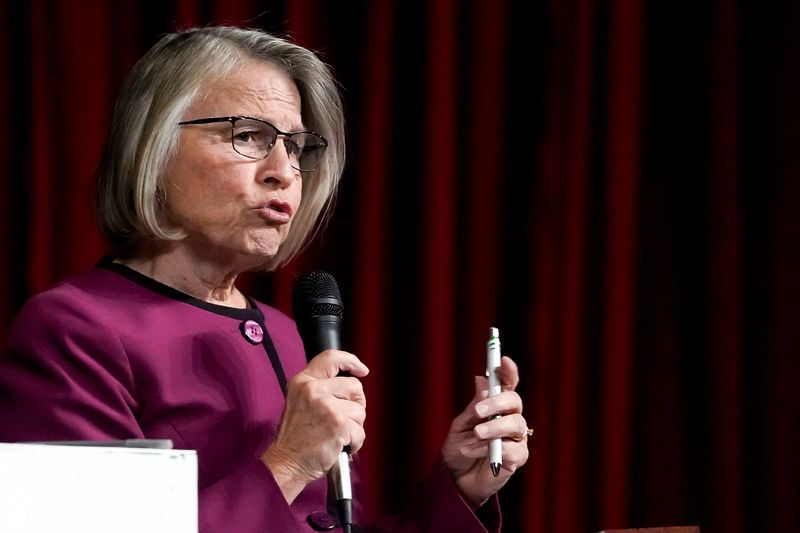
BURLINGTON — GOP U.S. Rep. Mariannette Miller-Meeks says she would “look very carefully” at proposed spending cuts to fund the U.S. war with Iran while defending Republicans’ signature tax and spending law.
Miller-Meeks, who represents southeastern Iowa’s 1st Congressional District, saw pushback to federal Medicaid spending cuts under the “One Big Beautiful Bill” during a roundtable discussion Monday, April 6, with business leaders at the Greater Burlington Partnership office.

She was there with U.S. Chamber of Commerce officials to trumpet tax cuts the law made permanent, as some Burlington area business leaders said the measure’s new tax provisions would fuel economic growth in the Hawkeye State.
Asked if she would support further cuts to social programs including Medicaid to fund President Trump’s $200 billion request to fund the war with Iran, Miller-Meeks told reporters, “we haven’t seen any of that at this point in time. Those conversations are just now going on as we look towards a reconciliation bill to fund all of Department of Homeland Security.”
And she said growth spurred by the tax cuts will likely trump federal projections.
“I think economic growth is critically important for us to be able to take care of our most vulnerable, to be able to provide for our defense, but also to allow people to improve their lives through job mobility and increased wages and then for us to be able to compete economically around the world,” Miller-Meeks said during the roundtable.
‘We’re trying to figure out what to do’ about Medicaid cuts
While touting the measure’s tax cuts, a hospital administrator pressed Miller-Meeks on the nearly $1 trillion in estimated federal spending cuts to Medicaid the new law will usher in over a decade.
Mike McCoy, president and CEO of the Great River Health system in southeastern Iowa, raised concerns about rural hospitals being forced to make tough calls while they already operate on thin or negative operating margins.
More than 40% of rural hospitals across the U.S. are operating in the red, according to health care analytics firm Chartis. McCoy put his hospital system among them.
He said “we’re trying to figure out what to do” because more uninsured patients will seek more costly emergency care without having a way to pay for their treatment.
Miller-Meeks said some hospitals have “been struggling for years with operating margins” and defended the law’s Medicaid changes, saying they preserve benefits for those who need them most.
She said states such as Democrat-led New York and California reimbursed at higher rates for able-bodied adults, but the new law bars undocumented immigrants from receiving Medicaid benefits and established work requirements. There are exceptions, including for those who are medically unable to work.
“Those individuals should be in some program that is helping them to improve their status in life and work rather than asking somebody else making $50,000 or $60,000 a year to work so that they can remain at home,” Miller-Meeks said.
McCoy maintained that hospitals would have to care for a growing number of uninsured patients as a result of the law.
The nonpartisan Congressional Budget Office estimates the law will increase the number of uninsured Americans by 10 million over a decade.
“I think there’s a lot of debate about what that will do or not do,” McCoy said. “Here’s what I know we’ll see. We’ll see more patients that don’t have insurance, so they’re going to be self-pay or no pay, and we’re going to see more charity care.”
Miller-Meeks touts tax cuts, ‘pro-growth’ provisions
Republicans’ tax and spending law made permanent the tax cuts that Trump signed into law in 2017 during his first term as part of the Tax Cuts and Jobs Act.
It contains provisions that manufacturers have said give companies tax certainty, fuel economic growth, strengthen supply chains and help businesses innovate and invest in facilities and equipment.
The measure also expands the child tax credit from $2,000 to $2,200. And it creates tax-deferred investment accounts with a $1,000 government-funded starter deposit for children born between Jan. 1, 2025, and Dec. 31, 2028.
Miller-Meeks said this would be “a game-changer, especially when it comes to low-income individuals, people who don’t have a culture of savings within their family structure.”
“I like this idea of trying to reinstitute a culture of savings, delayed gratification, compounded interest, seeing that grow over time, and I think it reinforces very positive behaviors for people’s personal financial status,” Miller-Meeks said. “And then so I really like the baby accounts and I like reinforcing that you don’t have to have to be a person of wealth in order to have your charitable giving acknowledged.”
Tom Wickham, senior vice president of state and local policy at the U.S. Chamber of Commerce, said the law has helped address child care deserts with a provision encouraging on-site or third-party childcare by covering costs for staff, construction and training.
“That really has been helpful in creating solutions to a problem we hear about in many chambers across the United States,” he said.
And the law includes a temporary deduction on overtime pay, which allows workers to deduct overtime pay from federal income tax from 2025 through 2028.
Bob Huffman, president of Huffman’s Farm and Home supply store, said the provision has encouraged more employees to volunteer to work overtime, which has helped address his business’ work backlog.
“With this passing, we have seen that it’s been a lot easier to get those folks to voluntarily work that additional overtime because they know they’re keeping more of it in their paycheck,” Huffman said.
Marissa Payne covers the Iowa Statehouse and politics for the Register. Reach her by email at mjpayne@registermedia.com. Follow her on X at @marissajpayne.
This article originally appeared on Des Moines Register: Iowa’s Miller-Meeks noncommittal on spending cuts to fund Iran war
Reporting by Marissa Payne, Des Moines Register / Des Moines Register
USA TODAY Network via Reuters Connect