A federal appeals court cleared the way for Iowa to enforce its 2023 law banning certain topics related to sex and gender from the state’s classrooms and school libraries.
In separate decisions Monday, April 6, a three-judge panel of U.S. Eighth Circuit Court of Appeals the struck down injunctions in two lawsuits, one by a group of parents and LGBTQ rights advocates and the other primarily by a coalition of publishers and authors. Both suits had challenged provisions of Senate File 496, a 2023 law that banned “instruction related to gender identity or sexual orientation” in Iowa schools, and requiring removal of materials with “descriptions or visual depictions of a sex act” from school libraries.

Monday’s decisions send the cases back to the district court for “resolution on the merits,” meaning the lawsuits can continue while the laws take effect. But in both decisions, the court made clear what it believes that final resolution should be, writing that neither plaintiff can show a “likelihood of success on the merits” in their challenges to the law.
Attorney General Brenna Bird praised the rulings Monday, while opponents of the law voiced disappointment that the state will be allowed to engage in what they regard as censorship.
State can ban ‘programs,’ ‘promotions’ related to gender and sex
In one lawsuit, the group Iowa Safe Schools and a number of parents and students challenged the parts of the law forbidding discussion of gender identity or sexual orientation. Derided by foes as the “Don’t Say Gay” law, the language forbids providing “any program, curriculum, test, survey, questionnaire, promotion, or instruction relating to gender identity or sexual orientation” in grades K-6.
After a broader injunction was struck down in a previous Eighth Circuit ruling, U.S. District Judge Stephen Locher imposed a narrower one in May 2025. Locher wrote that the state can reasonably restrict any “curriculum, test, survey, questionnaire … or instruction,” categories that clearly apply to classroom activities. But he found the bar on “program(s)” and “promotion” were too broad and could cover extracurriculars such as Gender & Sexuality Alliance clubs. That would unconstitutionally restrict student speech and association.
Judge Ralph Erickson, writing for the court in Monday’s decision, did not hold the law can constitutionally ban such groups and other non-curricular programs and promotions. Instead, the court ruled that the state’s argued interpretation of the statute — that programs and promotions may only encompasses curricular activities — is reasonable, and that the law under that interpretation is constitutional.
Because the plaintiffs argued the law was unconstitutional on its face rather than challenging any particular application, the ruling does not address what would happen if a district does cite the law to restrict Gender & Sexuality Alliance groups, which originated as Gay-Straight Alliance clubs, or other extracurricular activities. According to the plaintiffs, several Iowa districts ended or curtailed the programs in the wake of the law’s passage.
Parental notification law also upheld
The decision also restores a provision, challenged in the same lawsuit, requiring schools to notify parents if students ask for an “accommodation that is intended to affirm the student’s gender identity.” The district court had found that language impermissibly vague, in part because of ambiguity over what constitutes an “accommodation.” The appeals court did not share those concerns.
“The ordinary and common understanding of ‘accommodation’ in the context of this statute is straightforward — it applies if a student requests to change, adapt, or modify an aspect of their gender identity,” Erickson wrote. “The examples provided by the district court in an effort to demonstrate overbreadth — such as a female asking to sit with boys at lunch, or a male choosing a pink pencil, or a male choosing to write reports about female historical figures — are not on their face student requests to change or modify gender identity.”
If disputes do arise over whether a student has requested or obtained an “accommodation” without parental notification, Erickson wrote, that plaintiff could bring a new case challenging the law as it has been applied to their specific situation.
Book ban block struck down
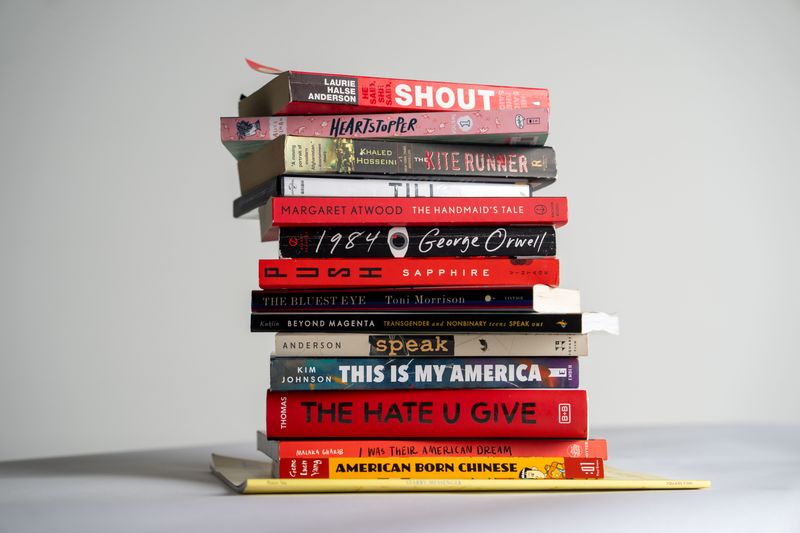
The second lawsuit, brought by publishers such as Penguin Random House and authors including Jodi Picoult, who has written on LGBTQ themes, and Laurie Halse Anderson, whose characters include sexual assault survivors. also was making its second appearance before the federal appeals court.
The Eighth Circuit had previously ordered Locher, who heard that case as well, to reconsider his injunction under a different legal standard. On remand, Locher again blocked the school library provisions of the law as infringing on both students’ and authors’ rights.
Locher’s decision hinged in part on the finding that the selection of books for a school library is not part of the school’s curriculum. In Monday’s decision, the appeals court disagreed, and held that school library catalogues are effectively government speech that can be restricted by government statute.
“It is indisputable that the purposes of a school library are to enhance education, supplement classroom learning, andfacilitate the development of students’ knowledge and skills. … A school library bears the imprimatur of the school and is properly characterized as part of the school’s curriculum,” Erickson wrote.
The appeals court also rejected concerns about whether the law is “unreasonable” or difficult to apply, noting it specifically defined the types of sex acts that cannot be depicted in library materials. As for the rights of publishers and authors, Erickson wrote that the challenged books can easily be found in other venues and that the Iowa Legislature’s restrictions are “reasonably related to legitimate pedagogical concerns” and thus are likely constitutional.
Thousands of books removed, survey found
An exclusive Des Moines Register survey of Iowa’s 325 public school districts found in 2024 that some schools pulled dozens — even hundreds — of books apiece under the law before Locher issued his initial injunction in December 2023.
Across the state, the Register’s data showed, districts removed nearly 3,400 books and two DVDs to comply with the law, including nearly 1,000 unique titles. After the injunction, 1,295 of the books were returned to shelves.
More than half of districts did not remove any books, with some citing the injunction.
Teachers union calls law ‘government censorship’ in response
The Register reached out to the litigants and other interested parties for comment. The Iowa State Education Association, a teachers union which joined in the publishers’ lawsuit with several individual Iowa educators, said in a statement it was disappointed in the court’s ruling and considering its next steps.
“This case is about much more than legal technicalities; it is about protecting the freedom of speech and the right to share ideas — values guaranteed by the First Amendment,” ISEA President Joshua Brown said. “Our schools should be safe spaces where students are free to learn, teachers can use their professional expertise without fear, and families can trust that education is based on open inquiry rather than government censorship.”
Penguin Random House officials said they are looking into their next legal steps.
“The fight continues, and we stand with authors, educators, librarians, and students to protect access to books and the freedom to read,” said Dan Novack, Penguin Random House vice president and associate general counsel on behalf of the plaintiffs, in a statement to the Des Moines Register.
The ACLU of Iowa and Lambda Legal — which joined forces to file the lawsuit on behalf of Iowa Safe Schools — said in a news release that the ruling is a setback but not the end of legal battles.
Nathan Maxwell, senior attorney at Lambda Legal, said in the release, “Iowa’s SF 496 is a cruel and unconstitutional law that silences LGBTQ+ children, erases their existence from classrooms, and forces educators to expose vulnerable students to potential harm at home. We will continue to use every legal tool available to protect these young people. They deserve nothing less.”
The plaintiffs’ lawyers argue the law only narrowly applies in its interpretations — for example, it does not limit the sponsorship or promotion of students’ gay-straight alliance clubs, according to ACLU of Iowa Senior Staff Attorney Thomas Story.
But Story added, “To be clear, all of this is still contrary to students’ best interests, their education, and, in the case of forced outing, their safety. All of this is still unconstitutionally vague and overbroad. While this case proceeds, students, teachers, and parents should be wary of any person or official who attempts to use SF496 as an excuse for discrimination.”
Rulings ‘a huge win for Iowa parents,’ attorney general Bird says
Bird, the Iowa attorney general, whose office defended the law in court, praised the rulings in a statement calling them “a significant victory for parental rights and local control in education.”
“This is a huge win for Iowa parents,” Bird said. “Parents should always know that school is a safe place for their children to learn, not be concerned they are being indoctrinated with inappropriate sexual materials and philosophies. I am grateful that our law protecting children was upheld today.”
The ruling is “an acknowledgement of common-sense policy,” said Mason Mauro, a spokesperson for Gov. Kim Reynolds.
“No elementary or middle-school student should be exposed to mature adult content in the classroom,” Mauro said. “In Iowa, we are focused on meaningful reading, math and civics education in our schools.”
William Morris covers courts for the Des Moines Register. He can be contacted at wrmorris2@registermedia.com or 715-573-8166.
This article originally appeared on Des Moines Register: Court lifts injunctions on Iowa’s ‘Don’t Say Gay,’ book ban laws
Reporting by William Morris, Phillip Sitter and Samantha Hernandez, Des Moines Register / Des Moines Register
USA TODAY Network via Reuters Connect