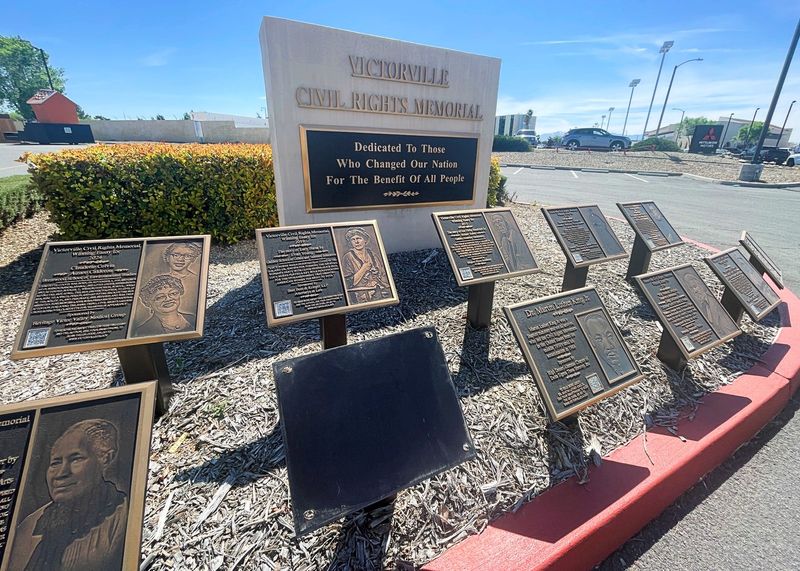
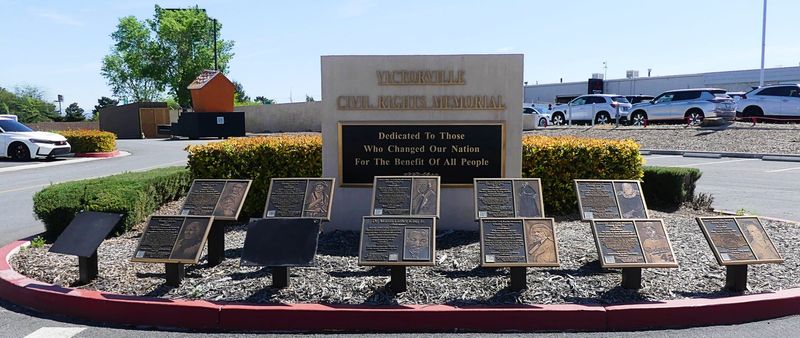
The plaque honoring Cesar Chavez has been removed from the Civil Rights Memorial near Victorville City Hall after the late labor leader was accused of sexual abuse.
Mayor Liz Becerra told the Daily Press on Friday that the Chavez plaque was taken out earlier this week, with the decision made at the city manager level.

On Friday, an empty plaque holder, which contained the memorial for Chavez, stood next to the one honoring Dr. Martin Luther King, Jr.
Student-inspired tributes
Each student-inspired plaque was installed over nearly a decade as part of the city of Victorville’s Annual Civil Rights Memorial Essay Contest in conjunction with local elementary schools.
Each year, the city invites 5th- and 6th-grade students to submit entries about an American civil rights leader and indicate why they should be honored with a bronze plaque within the memorial.
The winning essays determine the civil rights leader to be honored at the memorial, and a portion of each student’s winning essay is displayed on a bronze plaque for the civil rights honoree.
Plaques displayed at the memorial site in Victorville recognize civil rights activists Claudette Colvin, Dr. Martin Luther King, Jr., Asa Philip Randolph, Frederick Douglass, Harriet Tubman, Lucy Burns, Jackie Robinson, Ruth Bader Ginsburg, Frances EW Harper, Katherine Johnson and Ella Baker (yet to be installed).
Mayor Becerra told the Daily Press the student, now a teen, behind the essay on Chavez, was spoken to prior to the plaque being removed.
The student was also given the opportunity to write a new essay associated with farmworkers, the mayor stated.
The allegations
A New York Times investigation published on March 18, included allegations that Chavez sexually abused two minor girls. The Times also reported that Chavez raped civil rights activist and co-founder of the United Farm Workers of America union, Dolores Huerta, an allegation she also made public in an online statement, USA TODAY reported.
USA TODAY Co. generally does not name victims of sexual assault; however, Huerta spoke out publicly to tell her story, in an interview with the New York Times and in a statement posted online.
Erasing Chavez
Since the allegations, many city, county and state leaders across California have made efforts to remove Chavez’s name and likeness from public view.
Additionally, California Gov. Gavin Newsom signed into law a bill that would rename annual Cesar Chavez Day (March 31) to Farmworkers Day. The bill was approved by California legislators on Thursday, March 26.
On March 24, the Sacramento County Board of Supervisors unanimously approved a provision to rename Cesar E. Chavez Day to Sacramento County Farm Workers Appreciation Day.
In Sacramento, the state’s capital, city officials ordered the covering of a statue of Chavez in the Cesar E. Chavez Plaza, which has stood a few blocks away from California’s State Capitol as a reminder of the historic march he led in the 1960s.
Officials in Los Angeles, Fresno, Monterey, Stanislaus, Santa Cruz, Ventura and other counties have also moved forward with removing Chavez’s name from city parks, streets and the holiday.
Who was Cesar Chavez
Chavez was a labor organizer and civil rights activist who became one of the most influential figures in the modern farmworker movement, particularly in California and the U.S. Southwest.
Born in 1927 in Yuma, Arizona, Chavez grew up in a family of migrant farmworkers and experienced poverty and unstable housing firsthand. Those experiences would shape his later activism and commitment to improving working conditions for agricultural laborers, many of whom were immigrants and people of color with few legal protections.
Chavez rose to prominence in the 1960s after co‑founding what would become the United Farm Workers. He advocated for nonviolent protests that drew national attention to the treatment of farmworkers.
History of the UFW
The United Farm Workers traces its roots to the early 1960s, when farm laborers — many of them immigrants and people of color — were excluded from basic labor protections and worked under harsh conditions with little political power.
Chavez, Huerta and other organizers founded what began as the National Farm Workers Association, which later became the UFW. The union focused on organizing agricultural workers facing low wages, pesticide exposure and limited access to healthcare.
The UFW gained national attention through nonviolent campaigns, including strikes, marches, boycotts and public fasts. The Delano grape strike and grape boycott helped propel farmworker conditions into the national spotlight and drew support from labor, religious and civil rights groups.
Over time, the union won contracts that improved wages, working conditions and protections for farmworkers, becoming closely identified with Chavez and his leadership.
USA TODAY contributed to this story
Daily Press reporter Rene Ray De La Cruz may be reached at RDeLaCruz@VVDailyPress.com. Follow him on X @DP_ReneDeLaCruz
This article originally appeared on Victorville Daily Press: Cesar Chavez plaque removed from Victorville’s Civil Rights Memorial
Reporting by Rene Ray De La Cruz, Victorville Daily Press / Victorville Daily Press
USA TODAY Network via Reuters Connect