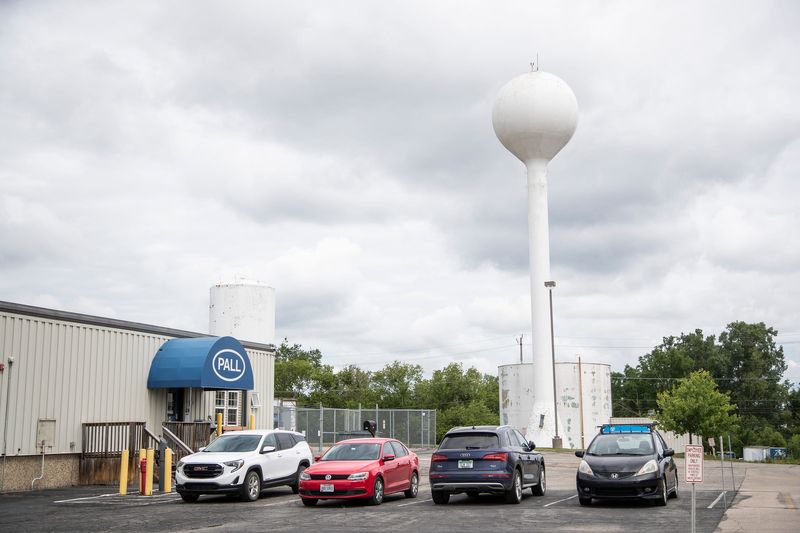
One of Michigan’s largest hidden, unrectified environmental disasters − a miles-long plume of toxic 1,4-dioxane in groundwater beneath the Ann Arbor area − has over decades contaminated dozens of residential wells, created a large, court-ordered “prohibition zone” where groundwater can’t be used, and is slowly moving toward one of the city of Ann Arbor’s main drinking water sources. Now the federal government is intervening and declaring the mess a Superfund site.
The U.S. Environmental Protection Agency on Thursday, March 12, announced the Gelman Sciences Inc. site is being added to the Superfund National Priorities List, a list of the nation’s most contaminated sites. The move will shift primary regulation of the contamination response from the Michigan Department of Environment Great Lakes and Energy to the EPA.

“With this Superfund designation, EPA will use its statutory authorities to hold the company responsible for near- and long-term actions to more expeditiously address possible risks to human health and the environment,” EPA Regional Administrator Ann Vogel said.
The announcement, which local elected representatives, community groups and residents have sought for years, was immediately hailed as a significant shift for the better.
“Bringing in these federal resources is going to allow for proper cleanup of the site,” said Dan Bicknell, a Dexter resident who discovered the contaminated runoff leaving the Gelman site and flowing into and contaminating nearby waterways as a University of Michigan student in the mid-1980s. Bicknell went on to work for the EPA and in recent years has advised local governments and citizen groups on the dioxane plume and response.
“It was just a wonderful message to begin the day,” said Scio Township Supervisor Jillian Kerry. “We have been working so hard regarding this plume and the consent judgments” in Washtenaw County Circuit Court related to it. “It’s been decades long, and the community has come together. The EPA will step in and will hold the polluter accountable.”
From 1963 until its closure in 2013, Gelman Sciences made microfilters and sophisticated membranes used in science and health care at its facility in Scio Township. It also used dioxane, a synthetic industrial solvent, in its manufacturing processes until discontinuing its use in 1986. Gelman held dioxane-containing wastewater in retention ponds on its property and received multiple violation notices from state regulators for improper discharges from the ponds into nearby waterways. Gelman at one point also disposed of its dioxane-containing wastewater through a sprinkler system, spraying it on the ground near its facilities.
The since-discovered groundwater contamination plume − more than 4 miles long, a mile wide and to uncertain depths − is still moving, affecting more areas. It’s slowly moving toward the main intake area for the city of Ann Arbor’s water supply, which serves 120,000 residents, at Barton Pond on the Huron River. The dioxane levels have ranged up to 200,000 parts per billion, astronomically higher than the state’s health standard of 7.2 parts per billion for drinking water.
According to the EPA and the U.S. Centers for Disease Control and Prevention, 1,4-dioxane is a “likely human carcinogen,” with studies showing it causes cancer in animals. High-level exposure can lead to severe damage to the liver and kidneys. Short-term exposure via inhalation can cause eye, nose, and throat irritation. The compound is commonly ingested through contaminated drinking water, inhaled, or absorbed through the skin. It does not easily break down in the environment and is difficult to remove with conventional water treatment.
The state and Gelman reached a settlement agreement in 1992, entered as a consent judgment of the Washtenaw Court. Gelman, without admitting fault, agreed to actions to address soil and groundwater contamination. The two parties have amended the consent agreement multiple times since. Company ownership has changed a few times over the years with each new owner taking on responsibility for the Ann Arbor groundwater plume. The company is currently owned by Washington-based Danaher Corp.
“The plume has never been investigated by Gelman or the state as to what is really necessary to stop that plume from migrating,” Bicknell said. “The state and Gelman have an agreement, a voluntary agreement, not an agreement that has been litigated in court. Therefore, what Gelman volunteers to do the state accepts, instead of the state asking Gelman to do what is really necessary.
“The U.S. EPA will ask Gelman to do what is necessary to comply with U.S. EPA regulations, which includes halting the plume and/or mediating (the contamination down) to drinking water criteria.”
Roger Rayle, a Scio Township resident, has fought for solutions to the languishing pollution since the early 1990s. Rayle helped form two grassroots citizen groups, Scio Residents for Safe Water and later the Coalition for Action on the Remediation of Dioxane, or CARD, to advocate for the community on the problem. He called the EPA Superfund listing of the plume “a key step in the whole process we’ve been working on for all of these years.”
“There is a lot of work to be done; this is a long-term project,” he said. “That’s why the EPA needs to be involved, with its enforcement capabilities.”
Both Rayle and Kerry singled out U.S. Rep. Debbie Dingell’s efforts over years to seek more federal involvement in cleaning up the longstanding dioxane plume. Dingell, a Democrat from Dearborn, on Thursday hailed the EPA decision as “a major milestone for the Ann Arbor community and for everyone who has worked for years to hold Gelman Sciences accountable and ensure this contamination receives the resources it deserves.”
Gov. Gretchen Whitmer, in a statement, said, “Adding the Gelman plume to the National Priorities List is a meaningful step forward that strengthens the tools available to address contamination.”
Contact Keith Matheny: kmatheny@freepress.com.
This article originally appeared on Detroit Free Press: Groundwater contamination plume near Ann Arbor named EPA Superfund site
Reporting by Keith Matheny, Detroit Free Press / Detroit Free Press
USA TODAY Network via Reuters Connect