Get ready for Ford v Ferrari, Part Two.
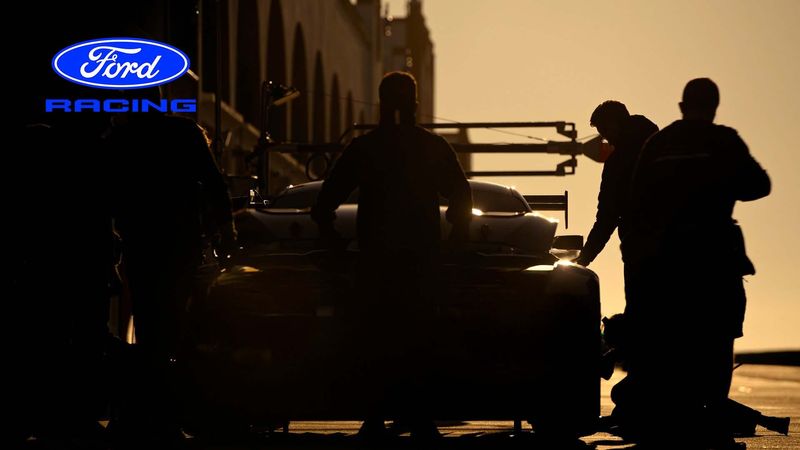
The Dearborn automaker is going back to the World Endurance Championship’s 24 Hours of Le Mans in 2027 to win it all. Sixty years ago, the GT40 prototype won the 1966 French race, dethroning Ferrari and kicking off a four-year run of dominance at the world’s greatest endurance race. Ford’s sweep of the ’66 podium inspired the Oscar-winning Hollywood blockbuster, “Ford v Ferrari.”

For the first time since 1969, Ford is returning to try and win it all. With French chassis partner Oreca, Ford in June 2025 began the arduous climb back to the podium’s top step. Its competition will be formidable as Ferrari, Cadillac, Alpine, Genesis, McLaren, Toyota, Peugeot, and Aston Martin fill out the 19-car Hypercar class.
Reigning world-champion Ferrari — winners of the last three Le Mans — is still the team to beat.
The competition
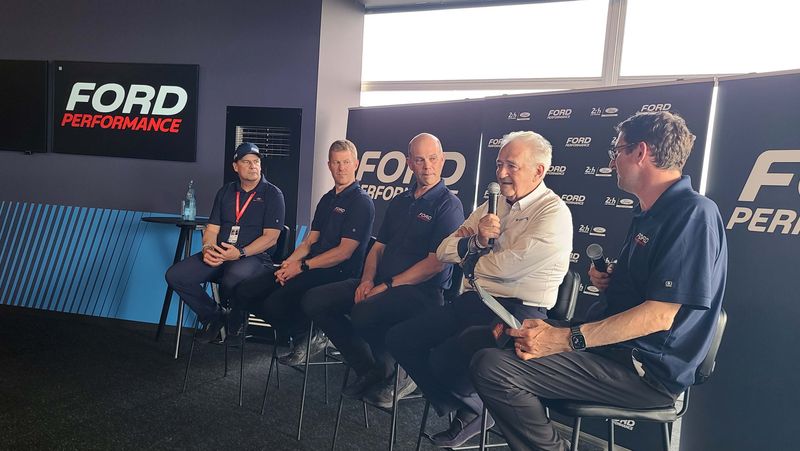
“Ferrari has proved they are the mark for the last couple of years, especially at Le Mans,” WEC Hypercar Program Manager Dan Sayers said in an interview. “They obviously have a very good car, very good driver line-up, and they operate very well. There are several (others) that are benchmark teams out there as well.”
One of them is Toyota, which beat Ferrari to the checkered flag at the first WEC race this year in Imola, Italy. Toyota won five-straight Le Mans from 2018-22 before Ferrari stole the show. Likely missing in 2027 is the Porsche-Penske team — the 2025 Le Mans runner-up — which has pulled out of WEC as the Porsche mothership gets its financial house back in order.
Le Mans 2027 is hardly the clear-cut Ford v Ferrari prototype duel of 60 years ago, when eight GT40 Mark IIs and six Ferrari P2/P3s dominated qualifying and the race. The only non-Ford/Ferrari to break the Top 10 in qualifying was a Chaparral.
Under current Hypercar rules, Le Mans promises its most competitive field ever.
“We just need to make sure we go out and measure ourselves against ourselves,” said Sayers. “We need … to ignore things you can’t influence and just focus on things we can influence.”
Car and drivers
Sayers’ influence is considerable. Unlike the ‘66 effort in which Ford built the cars, then contracted race prep to teams like that of Shelby American (Matt Damon played the charismatic Carrol Shelby in the movie) and Holman & Moody, the 2027 Le Mans effort flips the script.
Race prep is led in-house by Sayers (Ford is developing a raucous, hybrid, naturally aspirated, 5.4-liter V-8 powertrain) while the chassis has been outsourced to Oreca, which also makes chassis for Alpine and Genesis.
“Ford would like the hypercar to represent the Ford aerodynamics and body shape,” smiled Sayers in reference to the GT40, one of Ford’s most iconic designs. “We have a lot of input from our (design) studio, so it’s not just purely done from an Oreca aerodynamics perspective. Hopefully it represents a Ford and it doesn’t look like an Oreca.”
Expect two Ford Hypercars (the modern prototypes class) at Le Mans next year, not eight.
The race cars are being built, said Sayers, with an official rollout in the south of France in the next 2-to-3 months. On-track testing will begin around July, followed by testing in the United States, culminating in a 30-hour endurance test early in the new year. First race? Likely Qatar in February 2027 as the WEC season gets underway. In 1966, the season started with the Daytona 24-Hour race in Florida, but Ford has not committed to North America’s IMSA Weathertech Series, only WEC.
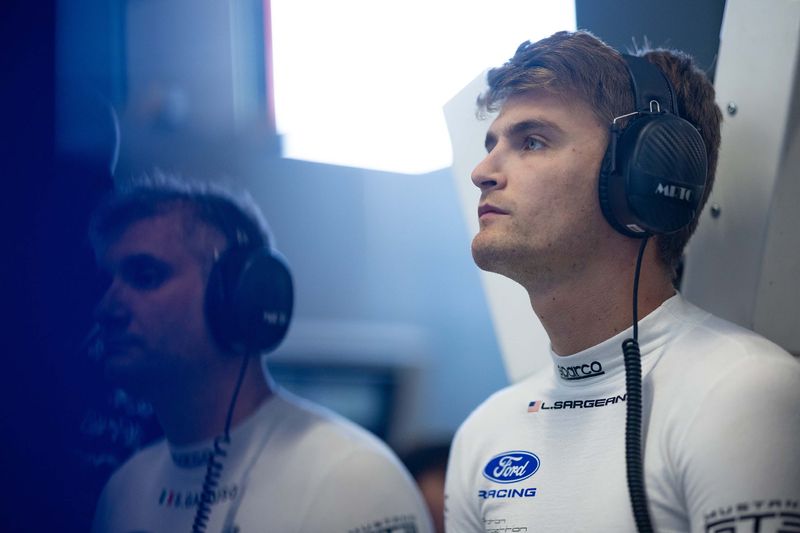
Ford brought a who’s who of international talent to the 1966 fight, including American stars Mario Andretti, Dan Gurney, and Mark Donahue. Expect a smaller, if still formidable, gang of six in 2027 — including ex-Formula One American driver Logan Sargeant.
“Being an American driver, having being around Ford cars growing up … it’s really cool to have the opportunity to win at Le Mans with Ford,” Sargeant, who is racing a Mustang in WEC’s GT3 class this year, said in an interview. “It’s definitely a huge privilege.”
Family passion
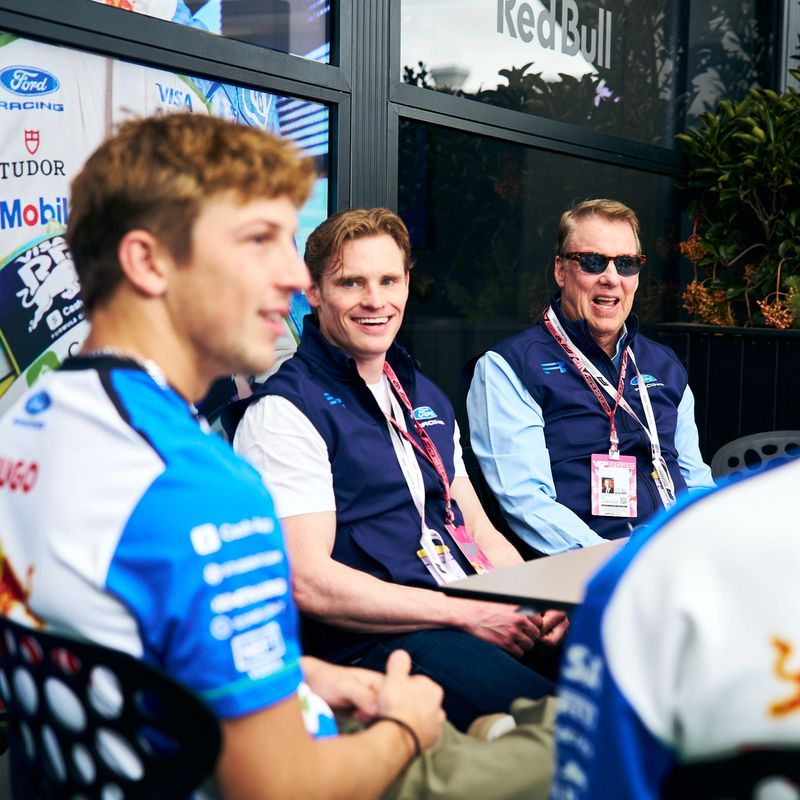
Another key area of continuity between the 1966 effort and 2027 is family. Henry Ford II’s determination to showcase the Blue Oval’s capability on the world stage has been handed down to a new generation of Fords passionate about motor racing: Executive Chairman Bill Ford Jr., and his son, Will, general manager of Ford Racing.
Ford Racing is central to the brand’s identity and technical development. Its motorsports ambitions run from the Dakar Rally in Saudi Arabia to Formula One.
“We’re on the whole sports car pyramid from our Mustang challenge spec series in GT (racing) all the way up to Hypercar next year with our return for the overall win at Le Mans,” Will Ford said in an interview earlier this month at the Miami Grand Prix. “It’s really important, for example, for Mustang in the sportscar category to stay relevant … for another generation of Mustang fans. We are transitioning Mustang from an American muscle car to a global sportscar.”
Hybrid era
Will Ford works alongside Ford Racing Chief Mark Rushbrook, who says that developing the Oracle Red Bull and Racing Bulls F1 teams’ complex hybrid system has improved engineering learnings across the company.
In the 1960s, Ford’s naturally-aspirated, 3.0-liter V-8 Cosworth engines won four F1 championships. The Le Mans-winning, 7.0-liter Ford GT40 Mk II engines had more than double their displacement. Fast forward 60 years and F1 and Hypercars are both electrified — but in very different ways.
“We are able to share everything we’ve learned so far in Formula One with our Hypercar program,” said Rushbrook of F1’s 50-50 hybrid systems. “(It helps) with the calibration, the Hypercar tuning, and also (we’ll) put it directly into our road products as well.”
Rushbrook said drivers have embraced the 90-10 gas-electric split in the sportscar Hypercar class, while drivers have panned F1’s 50-50 system. Hypercar driver Sargeant concurred.
“I think everyone’s been pretty happy” with Hypercar drivability, said Sargeant, adding that the Hypercars don’t require constant regeneration that has proved controversial in F1. “It’s positive for me; it’s nowhere near the extreme you’re seeing in F1.”
He’s eager to test the new Oreca Hypercar chassis.
“I’ve spoken to many drivers with teams that have an Oreca-chassis Hypercar. (They say it has) similar drivability to an LMP2 car,” he said, referring to Hypercar’s junior LMP2 prototype class where Oreca chassis proliferate.
“You don’t say no to Ford,” said Oreca president Hughes de Chaunac last year when Ford came knocking. “They are extremely hands-on and are very open to collaboration. They want to win.”
hpayne@detroitnews.com
Henry Payne is auto critic for The Detroit News.
This article originally appeared on The Detroit News: Ford v Ferrari, Part 2: How Ford is prepping to win Le Mans. Again.
Reporting by Henry Payne, The Detroit News / The Detroit News
USA TODAY Network via Reuters Connect