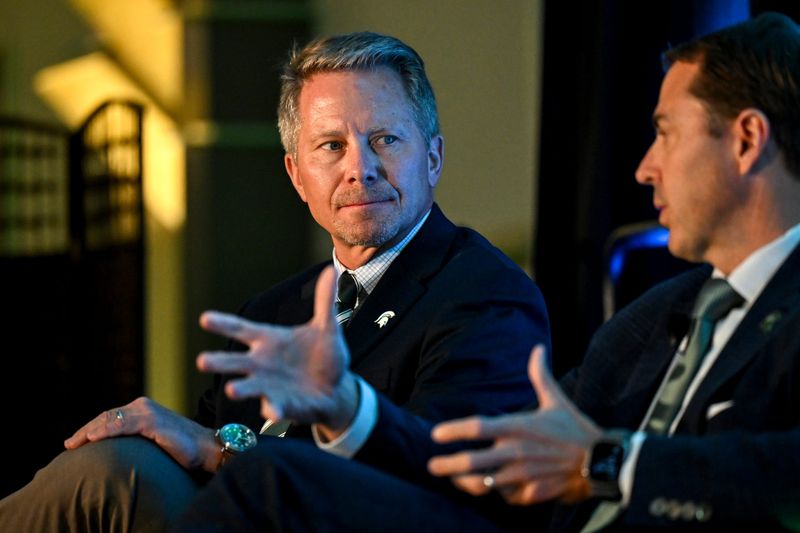
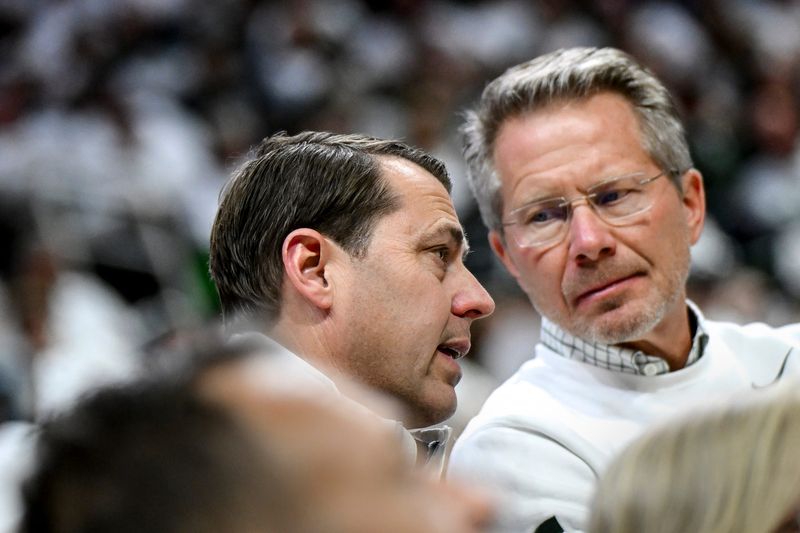
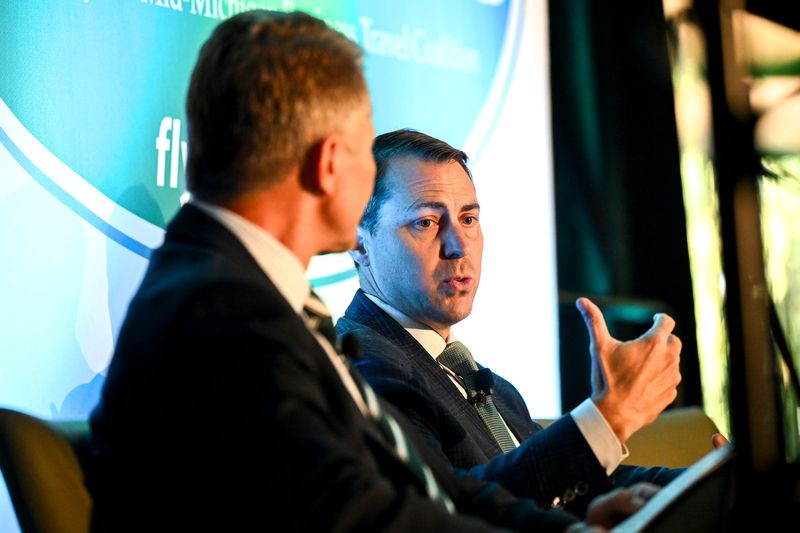
Upgrades to Spartan Stadium are in the planning phases and projected to be finished by 2029, Michigan State athletic director J Batt said Friday, May 8.
However, Batt said he anticipates the Spartans’ football team will be able to play through the construction when it gets underway – whenever that might be.

“We still have a lot of dollars to raise,” Batt told the Detroit Economic Club at MotorCity Casino.
Funding the project, which Batt said will cost in the $500 million range, is a major part of both President Kevin Guskiewicz’s $4 billion “Uncommon Will, Far Better World” capital campaign. Guskiewicz told business leaders that MSU is nearing the halfway mark toward that goal, with $1.9 billion raised so far.
Batt, who is approaching his one-year anniversary on the job, said he has spent a significant amount of time in his new position working to create the Spartan Ventures nonprofit and to find new streams of revenue. The launch for that is July 1, and Batt said the mission is to raise revenue to support the entire athletic department during the ever-changing college sports landscape and to help bring along the latest round of upgrades for the football stadium that originally was built in 1923.
“There’s lot of ideas,” Batt said. “I think you’ve seen some of the renderings that have been out. There are a lot of priorities. I think Spartan Stadium is an incredible game-day experience, we just need to evolve it and update it.”
Guskiewicz is pushing for a “Spartan Stadium District” next to the stadium in the space where IM West, which will be demolished, is currently. That plan would include hotels and restaurants in a public-private partnership in the center of the campus. Guskiewicz also said it could include new student housing options, and he hopes to have more concrete plans to the MSU Board of Trustees sometime in the next four to five months.
“It’s about how do you get people back to campus as often as possible,” Guskiewicz said. “It’s not just about hockey, basketball and football. It’s about creating a district there that creates the athletics opportunities with the rest of campus.”
Increasing premium seating at Spartan Stadium is one of Batt’s goals with the renovations, along with “investing in the game-day experience.” He joked that he “may or may not get an email occasionally” from fans complaining about the audio and visual barrage during the games, so altering the sound system is another part of the project.
A lot of increasing the money flow goes back to the growing costs of running major college athletic departments, including now having to share that revenue with the athletes. Batt, a former college soccer player at Virginia who arrived after running the athletic department at Georgia Tech, delivered a stark assessment of where he feels his industry is heading over the next decade without finding new streams of funding.
“I think the current state of college athletics is unsustainable. I think that’s a hard thing to say,” he said. “But the reality is we’re in a period of constant change. College athletics has changed more fundamentally in the last five years than it has in the last 50. And that runs the gamut from the advent of unlimited transfers and the proliferation of transfer portal usage to the advent of (Name, Image and Likeness).”
With the House settlement taking effect last year to require revenue sharing with athletes, Batt and other leaders helped create the College Sports Commission to become a regulatory body. However, Batt – who was part of the NCAA’s House Settlement Implementation Committee – said that has not yet happened.
“I think the hope was that the advent of the College Sports Commission, some of the regulation around that would create really a sustainable go-forward,” he said. “And the reality is that has not happened.”
Batt said he remains for athletes getting a share of revenue. However, he also is seeing “the escalation of dollars and sense of student athletes” has “created a tremendous amount of pressure on the model” of college athletics.
Batt said that model “has never been more stressed.”
“Holistically, everything from what it requires of our student-athletes, our coaches, certainly the financial pressures created across the industry,” he said. “Those will have to evolve. The way in which that becomes governed, regulated, whatever the right answer for that is, those will have to evolve. And those things will create two things – hopefully some sustainability long-term, but also opportunity. Opportunity to find innovation on our campus, innovation in our league.
“It’s certainly a good place to be in the Big Ten as we traverse change. … I think at the end of the day, constant change is our reality. So those are near-term, mid-term and long-term changes, some more acute than others. But it’s really important that we continue to evolve to get to a better place.”
Both Batt and Guskiewicz touched on a number of athletics-related topics during and after their hour-long presentation:
J Batt on College Football Playoff and NCAA basketball tournament expansion:
“I certainly applaud the NCAA for continuing to find ways in which to increase opportunities. At Michigan State, we’re focused in on maybe the second, third and fourth weekends (of the NCAA Tournament) to win championships and be in Final Fours. But I certainly applaud the NCAA around the tournament, trying to add opportunity.
“I would say on the expansion of the (College Football Playoff), I’m fully supportive of going to 24 (teams). That’s an important evolution that provides more access, particularly access to the best leagues and those that have the best opportunities.”
Guskiewicz on the potential for expansion of the Big Ten beyond 18 schools:
“In the Big Ten, since we brought in four schools … from the West Coast, we have had very few if any conversations as a group of 18 presidents and chancellors on that council. I think it’s probably halted for a while. We have to see how the House settlement is going to play out, we haven’t even finished the first year of that, that was July 1 of this past year (with) the revenue share and I think that we’re committed to see how that plays out and what it means to each of our individual schools in terms of their expenses at the end of every year and the conference in what that looks like.
“It could change in the next 2-3 years, probably closer to 3-4 (years) as we’re renegotiating the next media contract. But I think it’s halted for now.”
Batt on corporate sponsorship for MSU’s major arenas:
“That’s a good question. What I would tell you is we’re open for business. Whether it’s jersey patches, field logos, floor logos in Breslin – if you have a business and you’re interested, Jared Kozinn (MSU’s new deputy AD/chief revenue/marketing officer) is here. … We are actively having conversations with many of the companies and businesses here in the room and throughout the region about how do we do that. It comes back to being forward thinking and creating new opportunities for revenue.
“I think it’s really important that whatever those brands are we affiliate with Michigan State … we want it to be the right brand, we want it to be the right partner. It matters. I think it takes careful consideration, and those are partnerships that will stand the test of time. It’s not simply slap a logo down, that’s hollow ground. We’ll do it the right way.”
Batt on potential for five years of eligibility for athletes:
“That’s an important initiative in that we create some sustainability around how in which we look at student-athlete eligibility. Obviously, it’s something that’s been challenged a lot, whether it’s in court, over the last couple of years (with) some different, interesting situations. So at least it’s a step in the right direction towards creating sustainability and some clarity there.”
Contact Chris Solari: csolari@freepress.com. Follow him @chrissolari.
Subscribe to the “Spartan Speak” podcast for new episodes on Apple Podcasts, Spotify or anywhere you listen to podcasts.
This article originally appeared on Detroit Free Press: Michigan State AD J Batt projects Spartan Stadium upgrades by 2029
Reporting by Chris Solari, Detroit Free Press / Detroit Free Press
USA TODAY Network via Reuters Connect