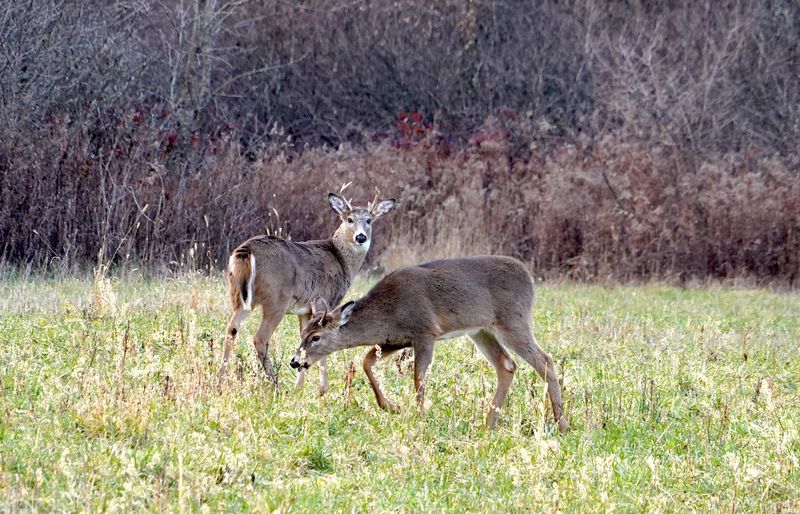
The epidemic that wiped out tens of thousands of deer in southeastern Ohio during summer and fall offered a spectacular reminder of what pathogens in the wild can do.
The outbreak of epizootic hemorrhagic disease (EHD) grabbed massive attention, all of it deserved, and disrupted whitetail hunting within a significant swath of the state.

Nearer to central Ohio, moreover, another lethal malady with nowhere near the kill count of EHD is moving glacially through the deer population. Chronic wasting disease, aka CWD, not only is spreading but isn’t likely to go away.
Differences between the two deer banes are substantial in both causes and effects.
While the death toll from EHD can be high, outbreaks persist but a few months before cold autumn weather eliminates the midges that spread the virus. A quick repeat of an outbreak in an area is unlikely because conditions including temperature and rainfall vary from year to year. What’s more, surviving deer generally retain some immunity.
Sometimes, as likely will be the case after this year’s Ohio outbreak, death counts can be high enough to deplete deer numbers in a location for a few years.
CWD, though not so deadly at this point as EHD in terms of numbers, seems more ominous.
One reason is that, as far as is known, deer don’t develop immunity. Further, an infection is always fatal. Another is that CWD is triggered by a kind of rogue protein known as a prion that can survive in soil long after an infected animal has departed.
The chance for more infections among even later arriving deer persists. Infected whitetails don’t stand still, so spreading infection involving more and more deer is almost inevitable.
Most hunters are aware that CWD-infected deer can appear normal for years. Infected deer surely have been eaten, given that symptoms of brain and nervous system breakdown develop late.
Fortunately, evidence is scarce to nonexistent that humans who eat venison from infected deer can develop a brain-wasting disease, but such a possibility hasn’t been ruled out. Prudence dictates that deer showing any disease symptoms shouldn’t be eaten; carcasses demand special handling.
A Wyandot County deer in 2020 became Ohio’s first confirmed CWD case in a free-ranging whitetail.
Since then, CWD has been confirmed by lab testing in additional animals from Wyandot, Marion, Hardin, Allen, Crawford and Hancock counties. Meanwhile, slivers of Delaware, Union and Morrow counties have been included in a designated zone in which hunters must conform to enhanced regulations.
Ohio went into the September start of the recent deer season with 73 cases of CWD confirmed in wild whitetails. During the 2025-26 hunt, the count of authenticated cases increased to 109, a jump of 36, or almost 50%.
Results were pending on additional deer, many from well outside the infection zone.
Finding animals far from the zone might seem unlikely, but positives are possible given that some young bucks have been known to travel long distances. Also possible is that a hunter, inadvertently or otherwise, might dump an infected carcass distant from where the animal was taken.
All of this along with the burgeoning harvest will affect how much, if at all, deer regulations change in 2026-27. Proposals will be made public soon.
Loose ends
At the close of another exceptional season for Ohio deer hunters it shouldn’t surprise that Licking, typically among the top-producing counties among the 88, led central Ohio with 5,754 deer, 16 fewer than a year ago.
Trailing Licking were Fairfield with 2,351, Delaware 1,877, Union 1,401, Pickaway 1,153, Madison 767 and Franklin 709.
outdoors@dispatch.com
This article originally appeared on The Columbus Dispatch: Deadly chronic wasting disease spreading in Ohio deer population
Reporting by Dave Golowenski, Special to The Columbus Dispatch / The Columbus Dispatch
USA TODAY Network via Reuters Connect