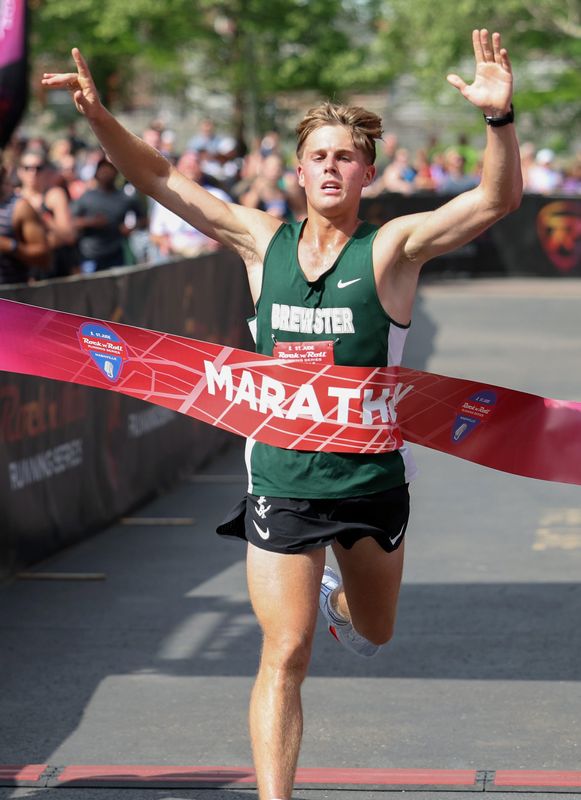
When Pat Ford, running his first ever marathon, broke the tape to win the 2026 St. Jude Rock ‘n’ Roll Series Nashville Marathon on April 25, he did so with hands raised and with plenty of emotions.
Tired might have been his top feeling.

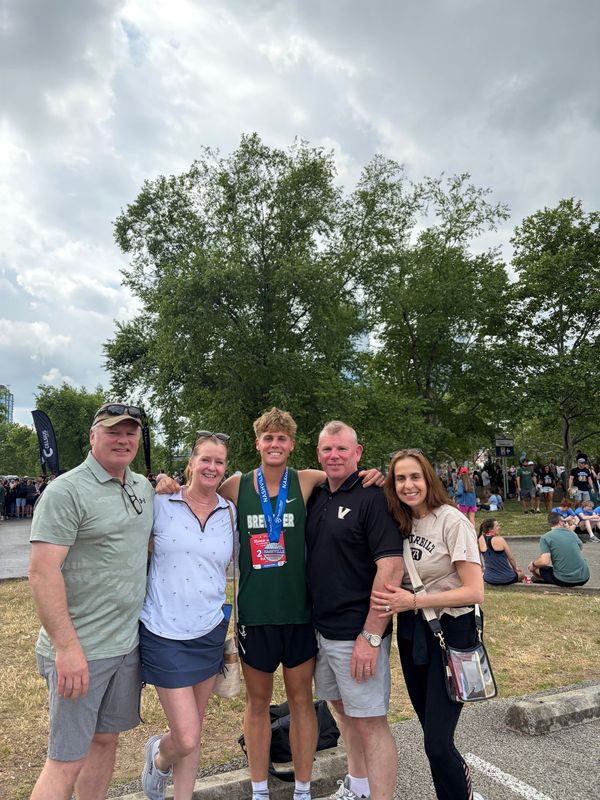
Surprised and proud were also front and center, especially with his mom, dad, uncle and aunt by the finish, cheering.
But, also, satisfaction, derived from a measure of vindication, was undeniably in the mix.
A guy whose college team, Vanderbilt, had dropped him had just beaten more than 5,000 runners — many of them veteran marathoners — a stone’s throw from his school.
“I was always in the back of my mind to make them think about their decision a little bit,” he said.
It wasn’t long ago that the now 20-year-old Ford, who ran wearing his old Brewster High School singlet, was Westchester/Putnam Boys Cross-Country Runner of the Year.
Ford drew interest from multiple Div. I colleges, including Penn State, Boston University, South Florida and Vanderbilt. He was the silver medalist in the boys 2022 state Class B public school championship and seventh-place medalist in a field of 274 in the state Federation (all schools) championship.
He chose Vanderbilt even though it only offered men’s cross-country and not track (he was a 4:19 miler in high school and is Brewster’s top all-time steeplechaser). Ford also chose Vanderbilt, despite it not offering cross-country scholarships.
The lack of a scholarship is what made what happened to Ford last August so head shaking.
After running for two years for Vanderbilt and spending last summer training for the upcoming cross-country season (he peaked at 80 miles per week), he went to the team’s pre-season camp. It was only then that Ford, who’d been in touch with coaches over the summer, learned, along with his 13 teammates, that four runners would be cut from the team a week later.
“I had no idea this was coming,” he said, noting one coach had told him earlier during the summer, “we’re good to go.”
The 2025 negotiated settlement between Congress and the NCAA regarding athlete payments has done many things but chief among them is hurt sports that cost little to run but also bring in little to no revenue. The NCAA decided to cap Div. I men’s cross-country rosters at 17 athletes per season. By comparison, football teams may carry 105 players — all on scholarship, if a school chooses.
But the Southeastern Conference, always known for its focus on football and basketball, decided 17 was too many. It put the max for men’s cross-country at 10 to further cut expenditures on that low-cost sport. Still, it allowed schools to grandfather in existing runners, so that, in Vanderbilt’s case, it could keep all 14.
But Vanderbilt decided not to grandfather anyone and to stick with 10, keeping this quiet until the camp.
Ford’s bio on Vanderbilt’s athletic site notes he won multiple academic honors his two years on the team and, as a sophomore, ran a personal-best 10K time in scoring as one of his team’s top runners at the NCAA South Region Championships. Ford said he was blindsided, both by being cut and by Vanderbilt not keeping all 14 of its runners.
“It’s very minimal cost. It was a little weird,” Ford said, noting costs in cross-country amount to motel rooms for meets requiring overnight stays, meal money when on those trips and uniforms.
“Especially because it came out of nowhere, it was upsetting at first to be sitting and watching,” Ford said.
But he didn’t completely do that. He and another teammate who’d also been cut decided to train together and compete unattached at some NCAA meets. Ford did so at two before contracting mononucleosis.
Vanderbilt wasn’t at the meet in which he ran. Mono prevented him from running, as he intended, in a meet against his former teammates. But with courses very similar (collegiate NCAA cross-country is generally run on largely flat courses, most often golf courses), the time he posted before becoming ill pointed to him likely beating some of the runners Vanderbilt retained.
His illness could have ended his competitive running.
Ford, after all, was still busy with school and Naval ROTC there. He should graduate next spring as a Marine lieutenant and begin his service.
But with running very much in his blood, over the winter he started to think about running a marathon, then committed to the training to do so.
After peaking at 60 miles a week before tapering the last two weeks before the race, he toed the starting line April 25, believing he could finish in the top 10 and if he ran really well he could get top five. His hope was to break 2:45 and maybe even get close to 2:40.
None of Vanderbilt’s current team, nor his fellow cut teammates were in the race, but many other students with whom he is friends were.
Ford, who’d run sections of the course in his training and whose longest non-stop training run was 20 miles, had no idea who his competition was, besides those friends.
“I don’t really know marathons like that. I thought if someone looks good, maybe they know what they’re doing,” he said.
Ford may not have had marathoning experience on his side but knew pacing would be key.
In a field of more than 5,000, he immediately moved near the front. He was in either third or fourth place throughout much of the race, taking over second around the 19-mile mark.
Between the 22-mile and 23-mile mark, with the leader fading, he put on the burners and took the lead.
“I was running a very consistent pace — 5:30-5:40 every mile. The guy in front kept (slowing). I thought, ‘If I throw in one surge mile and pass him, (I can) settle back into that pace,’ ” Ford explained.
When he subsequently found himself alone, he figured — quite correctly — that he’d dropped that competitor.
He also significantly dropped his time from what he’d anticipated.
Ford hit the tape in 2:28.54. He was just under five minutes ahead of runner-up Ahmad Thabit, 22, who’d been third in the Oct. 2024 Garmin Kansas City Marathon.
“I was pretty exhausted but it was a great feeling crossing the line. With my mom, dad, aunt and uncle there, it felt very rewarding,” Ford said, noting both his time and the fact he won shocked him.
There was no prize money but Ford said he won a “nice big medal,” was given the race banner and enjoyed going out to celebrate in Nashville afterward with family and friends.
In the hours and days that followed, all his old teammates reached out to congratulate him. He considers them friends.
He has yet to hear from any of his former coaches. He said if he were to be offered a place on the team again next fall, he thinks he’d decline because of the way things were handled and also because he’s happy now.
Ford, who’s majoring in human and organizational management with a business minor, will finish his junior year in the coming days before heading to Virginia for six weeks of officer candidate school, which he equates to boot camp.
Next year at this time, he’ll be preparing to leave for his first military assignment.
But chances seem good that no matter where that is, Ford will find places to run.
Of doing another marathon, he said that’s “to be determined.”
But maybe. And, maybe, he said, he’ll tackle a triathlon.
He has no experience in either competitive cycling or swimming, he noted.
But he also had no experience running marathons and, as the estimated 70,000-plus spectators who lined the Nashville course and the 5,000 or so runners who trailed Ford can attest, that didn’t turn out so badly.
Nancy Haggerty covers sports for The Journal News/lohud.
This article originally appeared on Rockland/Westchester Journal News: How Pat Ford went from a college cut to a Nashville marathon win
Reporting by Nancy Haggerty, Rockland/Westchester Journal News / Rockland/Westchester Journal News
USA TODAY Network via Reuters Connect