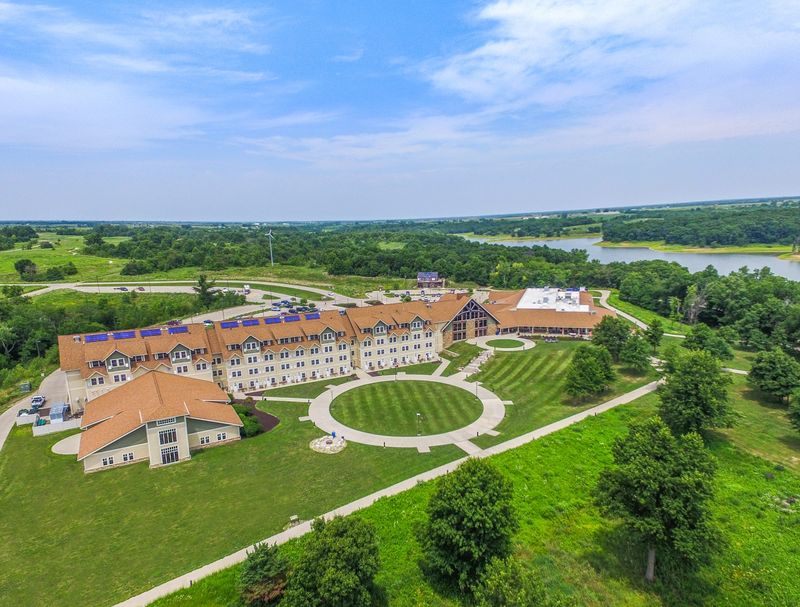
The long and troubled course of Iowa’s Honey Creek Resort took another sharp turn as a court granted its state-contracted operators a temporary injunction, reversing the state’s abrupt late October shutdown of the hotel, cabins, golf course and other amenities at the Lake Rabun property.
In an order Friday, Dec. 26, Polk County District Court Judge Jeffrey Farrell found that the Iowa Department of Administrative Services had acted without sufficient justification to close the resort following a heated Oct. 21 telephone conference call in which the operators, Terry and Beth Henderson of Achieva Enterprises, and state officials clashed.

Farrell, in granting the temporary injunction, reversed the department’s action. He gave Achieva access to the grounds and said the reopening should come “as soon as reasonably practicable,” and no later than March 12.
He wrote that his order “means that the lodge and cabins shall be open for customers by that date and the golf course shall be open for play by that date weather permitting.”
He also required the company to obtain property insurance for the resort in lieu of posting the bond usually required as part of a temporary injunction.
Previously, he had barred the state from reopening it on its own or under a new operator until issues the Hendersons raised in their lawsuit were resolved.
Judge finds state failed to justify closing down resort after heated phone call
The crux of the disagreement that prompted Achieva’s lawsuit and injunction request was the Department of Administrative Services’ actions following the contentious phone call, which was recorded.
Achieva had been contracted to operate the resort beginning in 2023, taking over after decades of disappointing financial performance by the facility, built at a cost of $60 million. It opened in 2008 and received a $33 million state bailout in 2013.
A previous contractor ended its contract, which was supposed to run through 2030, in 2021 or 2022.
The arrangement with the Hendersons followed a meeting in Appanoose County, where the resort is located, in which they presented their ideas for the property to an audience that included Gov. Kim Reynolds. Farrell noted in his decision that the Hendersons eventually hoped the resort could be privatized, though that goal is complicated by limitations on the use of the 850-acre tract, which is under the auspices of the U.S. Army Corps of Engineers and cannot be turned over to private ownership.
Despite that, the Hendersons contended in a Dec. 19 hearing on their injunction request that they steadily had been working to improve the resort, addressing years of neglected maintenance. The state provided a $6.8 million fund for the work and they said they had invested $1 million of their own.
A particular problem was the resort’s indoor water park. Farrell wrote that the Hendersons estimated they had been losing $500,000 a year on the aquatic facility, so deteriorated and hazardous that the water slide had become known as the “butt-cutter.”
With repair costs estimated at $2.2 million, Farrell wrote, the Hendersons said they wanted to replace the water park with a high-end mini golf course.
But in the phone call, he wrote, Department of Administrative Services Director Mark Campbell told them he wanted a pool company to inspect the facility and “see what it would take to rehab it.” The Hendersons already had been chafing under what they felt was micromanagement by Campbell, appointed earlier in the month, Farrell wrote, and Beth Henderson, joined by her husband, said that if the state was going to insist the water park be open, they would shut down the resort.
Farrell found Henderson was, as she later testified, speaking in the heat of the moment and had not followed through on the threat. He noted that the resort took reservations through March and planned several events, even buying food for one of them. But on Oct. 29, he wrote, Campbell and department deputy director and general counsel Nathan Reckman called the couple and told them the department would be shutting down the resort to protect the state’s interest in the property.
Campbell and Reckman, in the phone call, cited Beth Henderson’s statements about closing the facility. Department officials arrived later that morning with Appanoose County sheriff’s deputies, placed concrete barriers and chains to cut off access to the resort and “walked-out all of the resort employees,” Farrell wrote.
He wrote that a letter from the department informed the Hendersons it was terminating their six-year contract based on five grounds: the Oct. 21 threat to close the resort; failure to obtain required insurance coverage for the property; charging guests a resort fee; failure to provide monthly and annual financial and operation reports; and failure to make monthly deposits to certain funds, including a capital improvement fund.
Judge finds state had other options than immediate shutdown
In his decision, Farrell cited evidence in the Dec. 19 hearing that the state previously had waived or ignored most of the requirements cited, or in the case of the resort fee, was objecting to a standard charge previous operators of the resort had imposed.
He also found the Hendersons, by continuing to operate the resort and making future plans for it, had shown no inclination to actually shut it down, and said the state’s move to close it and terminate its 50 employees was not in the public interest.
In addition, he found the state had not complied with a provision in the contract with Achieva under which it could give the company notice of noncompliance with the contract and legal requirements and allow 60 days to rectify any problems. While the state could immediately terminate the contract under circumstances including fraud, it failed to show in the hearing that those conditions existed, he wrote.
“It is true that the Hendersons’ conduct during the call with Campbell and Reckman went off the rails,” he wrote, adding that “they very well could have avoided this litigation by keeping their cool and rationally discussion their points with Campbell, who was new to the position, and Reckman,” who he noted also was new to working with them.
He found that while they did not do so, the state exceeded its rights by shutting down the business without providing notice, having failed to present evidence of justification for immediate contract termination. “To any extent the State is making an after-acquired evidence claim, that can be considered as the case proceeds forward,” he wrote.
Meanwhile, he wrote at the time of the shutdown, “there were golfers on the golf course. There were patrons at the lodge. There were employee(s) on the grounds. Achieva was booking reservations and had outings planned over Halloween, Thanksgiving, and Christmas. It had bought food to prepare for the upcoming outings. It had groups booked into March.”
“Notwithstanding the Hendersons’ puffing and threats, there is no evidence that they actually did anything to terminate or suspend the business,” he wrote.
Obtaining the property insurance, which the previous Department of Administrative Services director had waived, will serve as Achieva’s required bond in connection with the injunction, he wrote.
Achieva accuses state of ‘smear campaign’
Asked for comment, a spokesperson for Achieva referred to a Dec. 23 news release in which Beth Henderson is quoted as saying, “Achieva remains dedicated to transparency, fairness, and the ongoing success of Honey Creek Resort for guests, employees, and the State of Iowa. We’ve devoted ourselves to revitalizing a property that deserves to be a cherished destination in Southern Iowa.”
The release characterized the Department of Administrative Services’ actions and statements about the case as a “smear campaign” and quoted Henderson as saying the agency “chose speed and spectacle on October 29, 2025. They committed extreme and punitive actions in immediately shutting down the resort, barricading its entrances, evicting guests and sending home over 50 employees.”
“The DAS actively destroyed livelihoods and damaged the reputation of both (Achieva) Enterprises and the Resort without prior notice of their intentions.”
The state, represented in the case by Attorney General Brenna Bird’s office, did not immediately respond to a request for comment.
This article originally appeared on Des Moines Register: Judge hands keys to Honey Creek Resort back to operator, nixing shutdown
Reporting by From staff reports, Des Moines Register / Des Moines Register
USA TODAY Network via Reuters Connect