Legislatively directed spending, enhancement grants, special legislative grants, earmarks, pork. Whatever the preferred nomenclature, new Michigan laws will bring greater transparency to state spending directly awarded to a specific entity, such as a nonprofit or local government, at a lawmaker’s request.
Gov. Gretchen Whitmer on Nov. 18 signed a pair of bills establishing new disclosure requirements and mandating a 45-day period for the public to learn about earmark funding proposals before lawmakers approve the spending. Earmarks don’t go through the typical process for distributing public dollars in which a state department or agency evaluates which bidders should receive funding.

The changes to the law come after recent state budgets saw an explosion in earmark spending following an unprecedented surge in state revenue due to federal COVID-19 stimulus support, according to Citizens Research Council of Michigan Senior Research Associate for State Affairs Bob Schneider.
When it comes to budgeting, Schneider said a competitive process for awarding state funds is better than earmarks, which don’t always deliver money where it’s needed most. But most troubling to Schneider is the last-minute addition of earmarks just before lawmakers are expected to pass the state budget. For instance, he found about two-thirds of the over $1.3 billion in earmarks in the state budget for the fiscal year that ended Sept. 30, 2024, were not included in either the governor’s budget request of previously approved budget bills, meaning neither lawmakers nor the public had time to vet what he labeled “eleventh-hour earmarks” and called “the worst of the worst” in terms of bad earmark budgeting.
“That shouldn’t happen anymore under this legislation. And that’s a positive,” Schneider said.
Earmark spending in recent years has included $14 million to John Ball Zoo as part of its African expansion with the aim of adding new animal attractions such as giraffes, $1 million to Battle Creek for terra cotta repairs at its city hall and $5 million for a Canton road project.
House Speaker Matt Hall, R-Richland Township, made overhauling the earmark process a key piece of his plan to shine some sunlight in Lansing — what he dubs the “Hall Ethics, Accountability, and Transparency Plan.” He described the legislation signed by Whitmer as the most important ethics and transparency measure to move through the Michigan Legislature in many years during a recent news conference.
In January, the Michigan House unanimously adopted a resolution establishing a disclosure process for earmarks. The Michigan Senate followed with its own resolution, adopted as lawmakers scrambled to reach a state spending deal to avert a government shutdown and Hall made earmark transparency a sticking point in negotiations. Hall has cast the earmark transparency legislation as a way to codify disclosure requirements in state law.
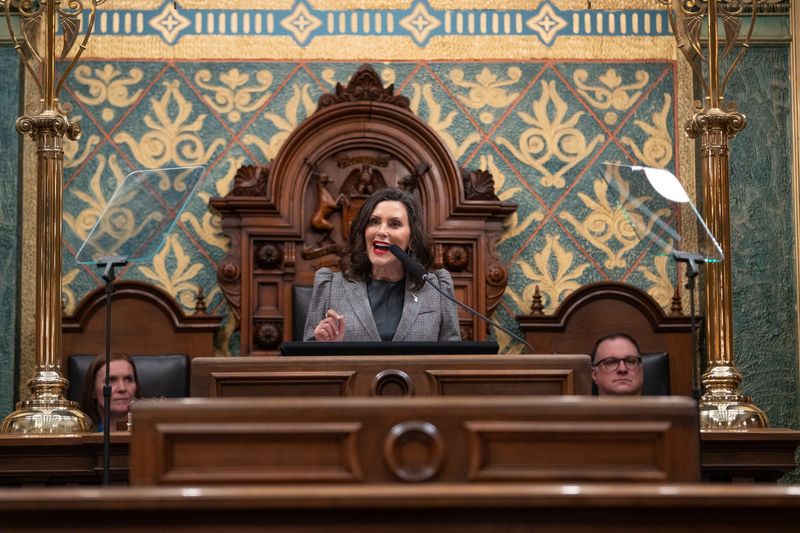
Gov. Gretchen Whitmer supported the concept in her State of the State address after she introduced her budget recommendation. “Every February, after I propose the budget, the Legislature adds earmarks. Now, these can be important: fire stations, roads, schools. Some of them? Not so much,” she said. “I know Speaker Hall is passionate about bringing accountability to the process, and I agree. In this year’s budget, let’s have total transparency on all earmarks, because if you want to invest taxpayer money, you should put your name on it.”
Whitmer in a statement Nov. 18 noted the promise she made in her speech. “Less than a year later, I’m proud to sign these two bills that require lawmakers to put their names on any projects they propose. I’ll keep working with anyone to serve Michiganders and increase transparency in our government,” she said.
What earmark transparency bills do
The new law requires that within five business days of a lawmaker asking for funding, the Michigan House and Senate would publicly post on their websites information on the request, including the name of the sponsoring lawmaker, the proposed recipient and the purpose of the spending amount. The information must be posted for at least 45 days before lawmakers in both chambers approve the spending requests. The funding proposals must be presented at a legislative hearing.
Unless lawmakers hold a leadership position, they cannot request an earmark for a recipient or population outside of their district or a county not located in their district.
Information posted online following approval of the spending must include the state department or agency responsible for administering the funds, status of the spending and whether any changes have been made to the spending agreement.
Under the new law, for-profit entities can’t receive such funding. Nonprofits can receive earmarks if they have operated in the state for at least three consecutive years with a physical office in Michigan for at least a year. They must also have a board of directors. And local governments can continue to receive funding through legislatively directed spending items.
When seeking the funding, lawmakers will have to certify that no immediate family members or legislative staff members have a financial interest in their request. Earmark recipients would be banned from using state funds to pay off tax delinquencies and they would be required to repay funds not used for their intended purpose.
The new law requires Michigan’s auditor general to evaluate how state departments administer the spending as part of their annual financial audits.
Earmarks in previous budgets prompt criminal investigations
The changes come after past earmarks prompted criminal investigations. Attorney General Dana Nessel’s Office, in an ongoing probe, is looking into how metro Detroit businesswoman Fay Beydoun spent part of the $20 million grant in the state budget approved in 2022. Her nonprofit Global Link International wasn’t incorporated until 10 days after lawmakers approved the funding, according to a state filing. No criminal charges have been brought.
Meanwhile, Nessel’s office charged a former legislative aide with embezzlement, alleging he misused a state grant intended for a central Michigan health park to buy cars, firearm accessories, gold, silver and platinum bars, among other personal expenses.
Contact Clara Hendrickson: chendrickson@freepress.com or 313-296-5743.
This article originally appeared on Detroit Free Press: Michigan establishes disclosure requirements for earmarks in state budget
Reporting by Clara Hendrickson, Detroit Free Press / Detroit Free Press
USA TODAY Network via Reuters Connect