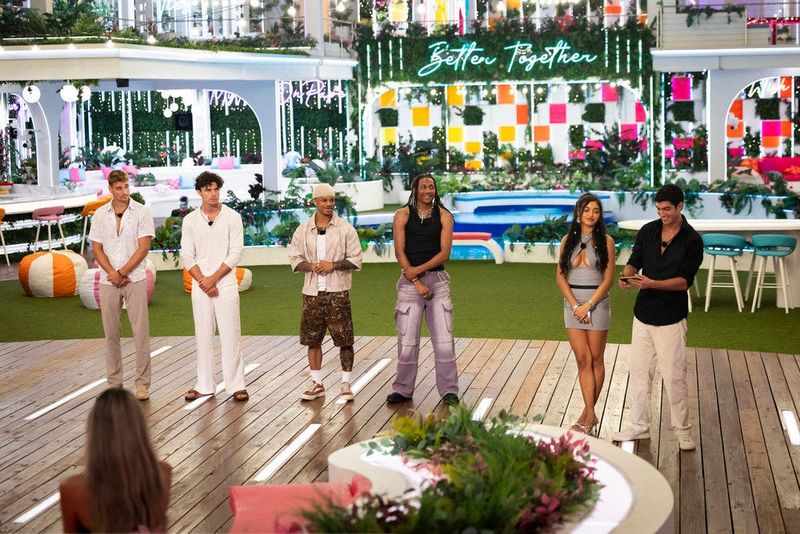
If you’re new to watching “Love Island USA” this summer, you might get a little lost with some of the lingo.
Since the debut of the first version of the show “Love Island (UK)” in 2015, there’s been a steady stream of lingo born from the show, like “bombshells” and “hideaway.” And after seven seasons of “Love Island USA,” there’s now an ever-growing list of words that sound funny if you aren’t familiar with the show.

Here’s how the show works and a (non-exhaustive) “Love Island USA” glossary to help you keep up with your reality TV fan friends or familiarize yourself with the vernacular as you become a fan.
How does the ‘Love Island’ process work?
While “Love Island USA” is not exactly live, it is filmed in real time with a delay of a day or two before it airs.
On “Love Island,” a group of single men and women, called “Islanders,” “couple up” from week to week and live in a big villa together all summer. In the first episode of each season, each of the women in the villa chooses to couple up with a man, based only on a brief first impression.
Each islander sleeps in a bed with the person they’re coupled up with every night, in the same room as the other couples. There’s a massive bedroom with beds lining each wall and surveillance cameras in the bedroom, as well as throughout the villa.
Viewers watch the islanders spend their days lounging by the pool, talking amongst themselves and sometimes participating in challenges that can win them opportunities for alone time with the person they’re coupled up with.
There are “recoupling” ceremonies, in which the men and women take turns choosing to either stay with the person they are coupled up with or choose someone else. Since the initial coupling is up to the women, the men get the upper hand in the first recoupling ceremony. Any islanders who are single after the recoupling leave the villa.
Viewers also get a chance to vote on their favorite and least favorite islanders and couples from week to week, giving them the power to have a say in who’s eliminated from the villa.
Bombshells
“Bombshells” refer to the new contestants that arrive at the villa at random times throughout the season, often testing the relationships of the couples already there.
Many islanders will tell the person they’re with if their “head could be turned” or not, referring to the likelihood that they would or wouldn’t fall for a bombshell that is their type.
Example: “Another bombshell has entered the villa.” A classic.
Casa Amor
If you think “Love Island USA” is already messy this season, wait until the return of Casa Amor.
A part of the show that’s existed since season three of the OG Love Island, Casa Amor is another villa that some islanders are sent to halfway through the season, aiming to test the islander’s loyalty to their partners.
“It involves separating the couples and sending either the girls or boys to Casa Amor whilst their partners remain in the main villa. Two batches of 5-6 new islanders then enter either villa,” according to Love Island Wiki.
This usually lasts three to four episodes, with a special recoupling ceremony afterwards. The islanders have two options: to stick with their original partner or to couple up with one of the new islanders.
Example: “I hope Chelley finds love during Casa Amor, I don’t like Austin or Ace for her.”
Hideaway
“The Hideaway” is a bedroom separate from the one big bedroom all the islanders share. It’s a private bedroom with an attached patio with a jacuzzi, reserved for established couples to be intimate away from the rest of the group (but never fully away from the cameras).
Speakeasy
“The Speakeasy” is new to “Love Island” this season. It’s a room that’s secluded from the rest of the villa but is less private than the hideaway, as it’s a lounge, not a bedroom. It’s the perfect place for islanders to duck into when they want a steamy makeout away from prying eyes.
The ‘Ick’
“The ick” isn’t as much a “Love Island” term as it is a pop culture term used to describe a sudden and often unexpected feeling of disgust toward a romantic partner that you’ve never felt before, usually triggered by watching them do a trivial task, make a face or even make a weird noise.
Example: Leah told the girls last season that she got the ick from seeing Rob cry.
‘Got a text!’
On “Love Island,” the contestants aren’t allowed to be connected with the outside world, but they do have villa-provided phones that the producers use to communicate with them. When one of the islanders gets a text from the producers telling them about their next challenge, party or date, they yell, “I’ve got a text!” or “Got a text!” to let the other islanders know that there’s news.
Example: When Nic said he got a text, the islanders came racing over from across the villa.
‘My type on paper’
Islanders use “my type on paper” to describe someone with all of the superficial physical attributes they’re attracted to. It’s a description of their dream partner in terms of looks and initial attraction.
Example: Pepe told both Cierra and Hannah that they are his type on paper, but their personalities are completely different.
‘Pull for a chat’
While it may seem obvious what “pulling for a chat” means, there’s more to it than just conversing with a fellow islander.
According to Love Island logic, pulling someone for “a chat” means you are interested in them and want to pursue a connection. When new bombshells enter the villa, cast members can get heated seeing their partner get pulled for a chat — or possibly, seeing them be the ones to pull the new islanders.
Example: Did you see Jeremiah tell Iris she can pull him a chat? Huda is not going to like that.
Recoupling
A “recoupling” ceremony, which usually happens once a week, is the islanders’ opportunity to choose to stay with the person they’re coupled up with or pick a different partner. Many of the “Love Island” drama stems from recouplings. The men and women switch turns choosing, so if the women choose the first time, the men choose the second time. Sometimes, the audience votes play a part in the recoupling.
Example: Last night’s recoupling was so dramatic, I can’t believe Huda and Jeremiah were separated.
Soul ties
Outside of “Love Island,” “soul ties” is a meaningful and sometimes religious phrase that refers to a deep, spiritual connection between two people.
In the show, much like the Speakeasy and Hideaway, “soul ties” is a designated place where couples can go for deep conversation and connection. It’s essentially a secluded daybed in the villa that has a neon sign that says “soul ties” hanging over it.
Example: Can you believe he was talking in Soul ties with her, but then he kissed a bombshell?
Water bottle
It’s not so much a term but an iconic franchise staple.
The cast always carries personalized white water bottles to stay hydrated. Fans can purchase their own on the Love Island website.
Where can I stream ‘Love Island USA’ season 7? How often does ‘Love Island USA’ air?
You can watch “Love Island USA” live on Bravo and Peacock every night except Wednesdays.
Watch ‘Love Island USA’ on Peacock
You can stream new episodes the night they air on Peacock at 9 p.m. ET. A premium monthly plan costs $7.99 or $79.99 for one year. The premium plus plan, which is ad-free, costs $13.99 per month or $139.99 a year.
You can also catch up on seasons four, five and six of “Love Island USA” on Peacock.
How do you win ‘Love Island USA’?
Each season’s winner is the couple that gets the most viewer votes as the favorite couple in the villa.
During the finale, the winning couple with the most votes get envelopes. One envelope has prize money and the other is empty. The person who receives the prize money can choose to keep it for themselves or split it with their partner
This article originally appeared on Palm Beach Post: ‘Love Island USA’ glossary: What do ‘soul ties,’ ‘bombshell,’ ‘recoupling’ mean?
Reporting by Lianna Norman and Samantha Neely, USA TODAY NETWORK – Florida / Palm Beach Post
USA TODAY Network via Reuters Connect