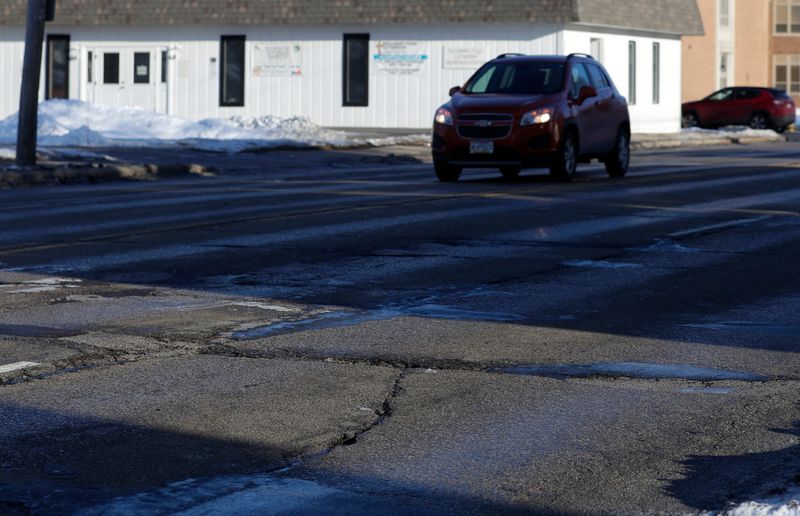
The Wisconsin Department of Transportation has put forth five proposals for how to repair Shawano Avenue, one of Green Bay’s most notoriously rough rides.
Meant to address “significant pavement wear and cracks” from Hudson Street to about 300 feet west of Oakland Avenue, WisDOT’s estimated $5.5 million project for the major thruway will enter its next phase Oct. 21, opening to the public for feedback on the options.

City officials have already begun lobbying WisDOT to speed up the timeline ― currently a six-year plan with construction not anticipated to start until 2031 ― as well as to address the intersection at Shawano and Oakland avenues for safety reasons.
Here’s what to know before getting involved.
How bad is Shawano Avenue, really?
While the transportation department intends to improve Shawano Avenue all the way from Taylor Street, only the portion between Hudson Street and Oakland Avenue will be completely rebuilt.
It’s this section that scores a 4 on the PASER road rating scale, with pavement blowups and severe cracking. WisDOT’s description of the road with 7,500 cars that drive it daily is that the “pavement is showing signs of distress and deterioration.” The department noted the last time work was done on this portion of Shawano Avenue was in 2005.
“It’s probably, objectively, the worst road with the most traffic on it,” said Mayor Eric Genrich to the City Council on Oct. 7.
The previous Department of Public Works director Steve Grenier long advocated for WisDOT to repair this stretch, and WisDOT first began the project design process in fall 2024.
What kind of work is proposed to be done?
Of WisDOT’s five proposals, two would keep the road much as it currently exists.
The department is offering a “No build/do nothing” option that would fix the pavement, fill in potholes and redo markings, but would not rebuild the road from scratch.
A similar outcome would happen under WisDOT’s proposal to rebuild the road exactly as it is, with four lanes. New curb ramps would also be installed where needed for ADA compliance.
The department’s other three alternatives would see more substantial changes.
Under the proposal called “Typical Section 4,” WisDOT suggested a 6-foot terrace, or buffer, between the sidewalk and the road that would distance pedestrians from vehicular traffic. The department also noted this space would allow for power lines, streetlights and utilities.
With the proposal named “Typical Section 2,” the department outlined a plan to add 5-foot bike lanes on both sides of the road, as well as turn the road from four lanes into three, with the middle lane specifically dedicated to left-turning traffic. The department noted that such a lane, called a “road diet,” lowers the chance of vehicle contact points, lowering the number and severity of crashes.
The alternative labeled “Typical Section 3” would have the most changes of all, with the road diet, bike lanes and terrace all rolled into the project.
No matter the alternative where the road will be rebuilt, though, WisDOT will replace the concrete pavement, curbs, curb ramps, gutters, sidewalks and driveway aprons, according to the project description. Traffic signals would also be replaced, as well as the storm sewer infrastructure underneath the road. Restoring the water mains and sanitary sewers would be the responsibility of the city.
Except for the option to not rebuild anything, WisDOT touted benefits under all alternatives: less vehicle wear-and-tear from having a smoother surface; saved tax dollars from fewer maintenance costs; replacement of aging utilities; improved accessibility for pedestrians; and, in the case of road diets, reducing the number and severity of crashes.
When would the reconstruction of Shawano Avenue start?
The project is currently scheduled for 2031, though city officials have told WisDOT that they would prefer a faster timeline with constant resident complaints about the road.
City Council President Brian Johnson and council member Alyssa Proffitt, along with some city staff, met with WisDOT representatives on Oct. 7, telling the department that the 2031 date was “not desirable,” said Johnson to the City Council later that day. Though no action was immediately taken to change the construction date, the city officials expressed a desire to either move the construction date sooner or have the road resurfaced to tide the city over until 2031.
Genrich told the City Council that he recalled “some commitment on elements of our state government that this project was going to be moved forward before the decade was out, more so in the 2028, 2029 timeframe.”
WisDOT project manager Joshua Lang told the Green Bay Press-Gazette, “Highway construction projects may shift within the six-year plan, and the project team is evaluating whether it might be possible to advance this particular project.”
Johnson also said he advocated for and would continue to push WisDOT to redesign the intersection of Oakland and Shawano to prevent future crashes, a request that Lang said the transportation department was aware of. The intersection is just east of the current proposed reconstruction area.
When and how can I give input?
Fitting for the Shawano Avenue project, WisDOT will host a public meeting Oct. 21 from 5 to 6:30 p.m. at West High School, 966 Shawano Ave.
The department plans to have a brief presentation at 5:15 p.m. with the rest of the time being an open house for people to mill around the proposed designs and ask questions of the WisDOT representatives.
Comments can also be emailed to Lang at joshua.lang@dot.wi.gov or project leader Megan Scherer at megan.scherer@dot.wi.gov.
What will happen after the public input meeting?
WisDOT expects to choose an alternative in spring 2026, and secure environmental approval for the project by fall 2027, according to the project description. A preliminary design is expected to be completed the winter of 2027 into 2028, and necessary land and rights-of-way acquired between 2028 and 2030. The department anticipates the city will replace sanitary sewer and water lines in 2030, a year before anticipated construction in 2031.
Jesse Lin is a reporter covering the community of Green Bay and its surroundings, as well as politics in northeastern Wisconsin. Contact him at 920-834-4250 or jlin@gannett.com.
This article originally appeared on Green Bay Press-Gazette: WisDOT proposes several ways to rebuild Shawano Avenue, and asks for public input to choose
Reporting by Jesse Lin, Green Bay Press-Gazette / Green Bay Press-Gazette
USA TODAY Network via Reuters Connect