At the bottom of the staircase of the Milwaukee Art Museum, as the contemporary wing fades into the Herzfeld Center, a hypnotic triptych by Widline Cadet plays tricks on the mind as it slowly rises into view.
The three photographs, themselves arranged like a staircase, are a fitting introduction to the avant-garde experimentation and ode to Black femininity that are central to the artist’s first solo museum exhibit in the country, “Currents 40: Widline Cadet,” on view at the Milwaukee Art Museum through August 9.

Born in Haiti, raised in New York and based in Los Angeles, Cadet has spent most of her life straddling the nation’s two artistic powerhouses.
Still, she’s chosen to make a continental debut of sorts in Milwaukee.
A prominent national voice in photography, Cadet has quickly become a must-know contemporary artist, and she’s on her way to becoming a household name.
Her first photography book, “Seremoni Disparisyon (Ritual [Dis]Appearance),” which is making its gallery debut at the Milwaukee Art Museum, was shortlisted for the Paris Photo-Aperture First Photobook Award last year. In 2020, she was selected as the Studio Museum in Harlem’s Artist in Residence, and her photographs have been featured in The New Yorker, Aperture Magazine, The New York Times Magazine and several other publications.
Her photographs and other works have been acquired by museums across the country, permanently living in The Whitney Museum of American Art in New York, The Los Angeles County Museum of Art, The Museum of Photography in Chicago and here at the Milwaukee Art Museum.
Her budding reputation and experimental style were not lost on Kristen Gaylord, Herzfeld Curator of Photography and Media Art at the Milwaukee Art Museum. When Gaylord, a native of Southern California with ancestral roots in the Caribbean, went home to visit family, she scheduled a studio visit with Cadet to discreetly gauge their professional compatibility.
Gaylord pitched the show to museum staff and Cadet soon after. While Cadet’s talent is reason enough for the exhibition, the themes of her work nicely complement the museum’s extensive Haitian art collection.
Cadet’s oeuvre reflects the journey of a young Haitian immigrant who has come of age in two distinct cultures.
At times deeply personal, her photographs capture the universal experience of a young woman coming into her own. Other times, her work experiments with Haitian folklore and what she remembers from her childhood in Pétion-Ville.
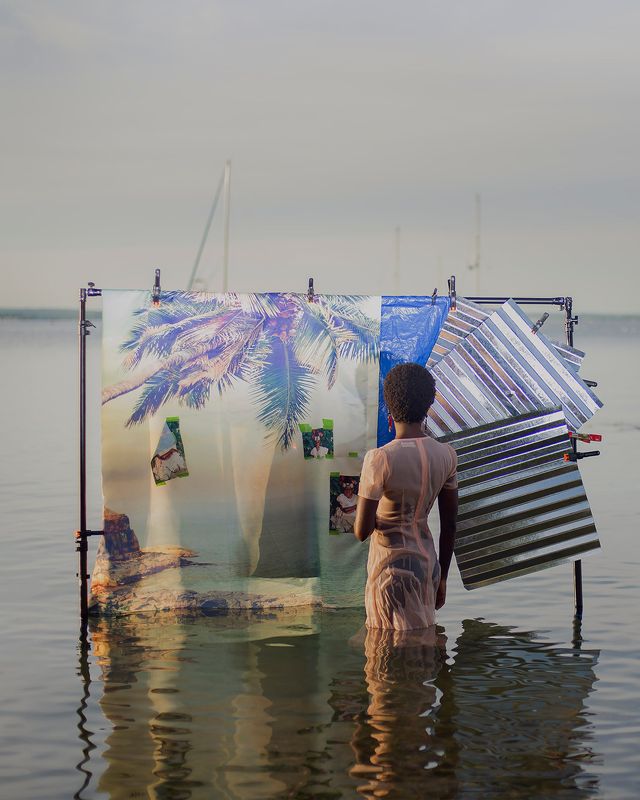
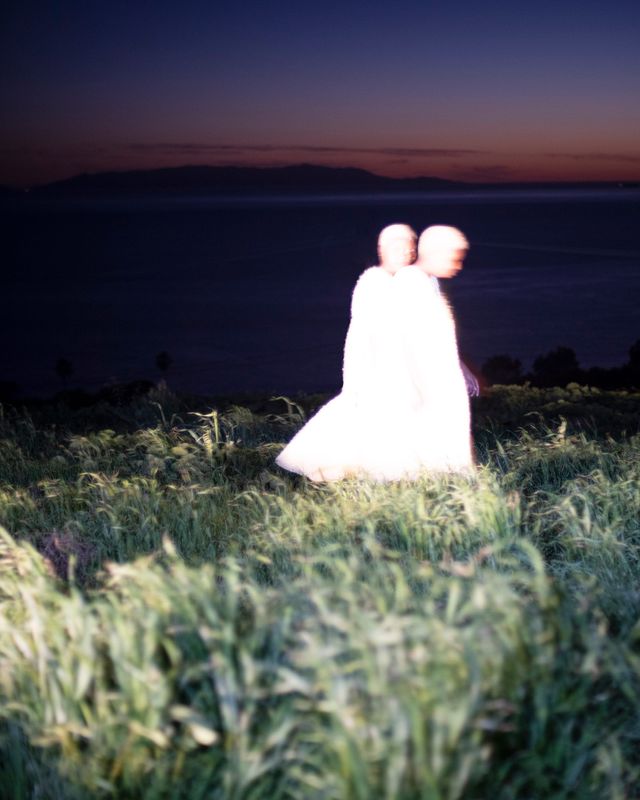
Photographs like “Nan Letenite (In Eternity)” pluck the gingham uniform Cadet wore to school and place it on two faceless girls lying somewhere that could be anywhere. Her breeze-block installations replicate the facades of her youth in Haiti. And experimental shoots like “Manyen Distans (Touching Distance)” attempt to capture the Haitian folklore passed down to her.
Gifted to the museum in 1991 by Richard and Erna Flagg, the Haitian collection is largely 20th century paintings. Colorful and bold in nature, it is an extraordinary archive of Haitian culture, folklore and artistic technique. In 2025, the collection was reinterpreted with new audio guides, family exploration cards and short videos to bring more context to the work.
“[It] all felt like sort of an institutional marriage,” Gaylord said. “I got to love [Cadet’s] work, but then I also got to make the argument for why we were the best museum to platform her in this way.”
Cadet, affirming every word, admitted that while she wasn’t likely to turn down an offer for a major solo museum exhibition, the Haitian collection brings a compelling symmetry to further contextualize her work.
Thrilled by experimentation
Working across photography, installation, video and ceramic, Cadet creates reverent images that honor Black diasporic life and archive memories of migration from Haiti to the United States. It’s evident that Cadet makes art for the sincere love of it – being someone who is as thrilled about the prospect of experimentation as she is thoughtful about the narrative substance of her work.
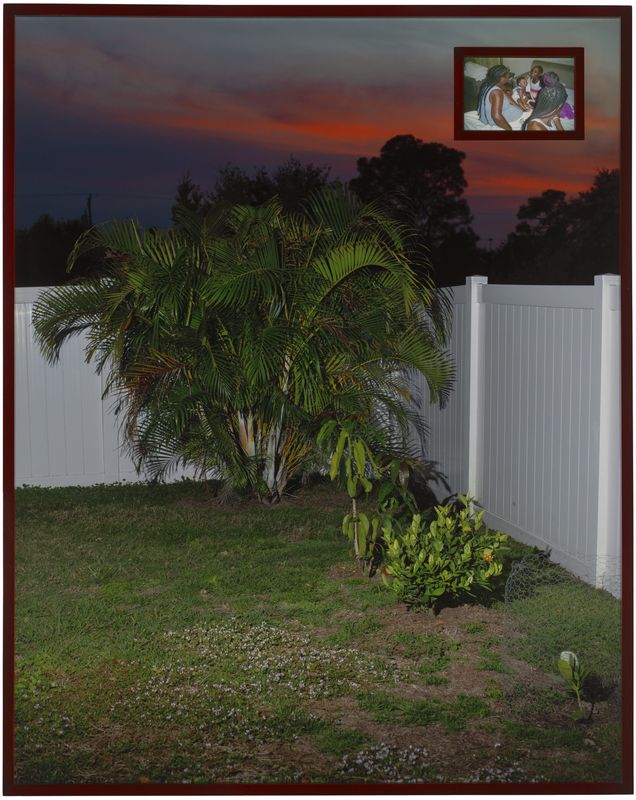
Disrupting the traditional expectation of a photograph, Cadet installed video monitors into the glass casing that covers a few of her photographs. In one such case, a large photograph of her parents on their wedding day is superimposed by footage from her grandmother’s 2016 wake, the last time the artist was in her homeland.
Recently, she’s explored printing photographs in silver semicircle frames. Some photographs, originally shot for a traditional rectangular frame, depict what appears to be an unfinished scene. Cadet’s photographs ask viewers to consider what something looks like when it’s been stripped of its context.
Photography is Cadet’s first love, but sometimes her vision transcends the limits of the discipline.
With two of her installations, Cadet worked with Gaylord and exhibition designer David Russick to transform sections of the gallery into lifelike domestic spaces. Printing enormous archival photographs of her parents from the ’90s, Cadet used them as a kind of wallpaper to create living room and porch-like scenes around them.
Where the photographs themselves honor the importance of Cadet’s parents in her memory and upbringing, this rendering makes them literally larger than life. Evidently, both of her parents were sacred in Cadet’s life; here she honors them with installations entitled “Altar #1” and “Altar #2.”
It is this ambitious, experimental and bold penchant that make Cadet’s work one-of-one. It’s almost as if traditional notions of fine art exist simply for her to beautifully disregard them.
One such one-of-a-kind work is tucked in a small, dark room at the far left side of the exhibit, where Cadet installed an 11-minute compilation of videos and audio from her personal archive. Embedded with Snapchat videos, vertical iPhone shots and voice notes the artist collected, the film seems to represent where the art world may be heading, as new forms of media become vital archival tools.
The footage, largely captured during the COVID-19 pandemic, reflects on life, loss and connection during quarantine. Videos depict Zoom birthday celebrations and voicemails from loved ones delivering the news that a relative oceans away had died. She didn’t know she would make the film as she was recording all of the footage. Cadet picks up her camera to capture moments that speak to her all the time, whether or not she plans to make art with the footage.
“You’ve called yourself a digital hoarder,” Gaylord said to Cadet in the art museum. They said the last word together, nodding and laughing in agreement.
A love letter to Black women
Cadet has spent her career honoring the communities that have made her who she is.
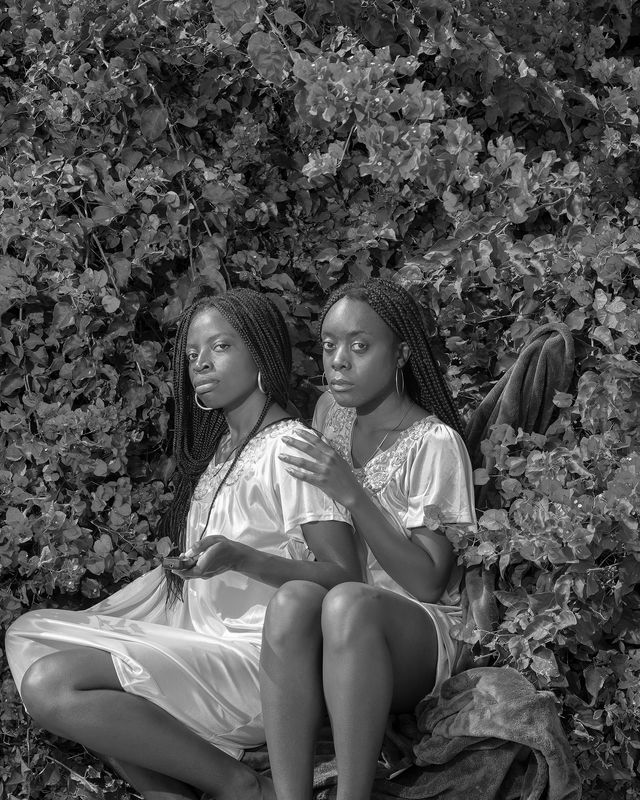
Chief among them: Black women. Like love letters to the Black female body, Cadet’s photographs celebrate their sisterhood, sensuality and radiance.
Where some photographs are posed and predetermined, others capture candid moments where even Cadet was transfixed by her subject’s beauty – like the first triptych that catches viewers’ eyes as they descend the stairs into the exhibit.
It depicts a Black woman reclining in the sand, wearing a white slip dress. In the photos, viewers see how a large snake tattoo running up her leg is slowly revealed as the dress falls from her knees to her hips. Basking in the sun, her once closed eyes gaze directly at the camera in the last photograph.
Many of the models Cadet photographs are Black women she met on the street, whose first glances brought her some comfort. In a sea of difference, these women represented something like coming home for Cadet. At one time strangers to her, some of these models have become Cadet’s most intimate friends.
If you go
The Milwaukee Art Museum is open 10 a.m.-5 p.m. Friday-Sunday and Wednesday, and 10 a.m.-8 p.m. Thursday. Admission is $27 for adults; $20 for students, seniors (65 and older) and military; free for kids 12 and under and Wisconsin K-12 teachers, with school ID or pay stub; and pay-what-you wish for everyone from 4 to 8 p.m. every Thursday.
The museum will host interactive programs to bring more rich understanding to Cadet’s work before the show’s Aug 9 close, including gallery talks on June 26 and Aug 1, an artist talk on July 16, and a guided tour on May 14. From 6:15 to 7:15 p.m. August 6, the museum will host “Haberman Local Luminaries: Currents 40: Widline Cadet,” a discussion featuring local panelists from the arts, Black diaspora and immigrant communities. On June 5, in the museum will host Present Music’s season finale, featuring Grammy-nominated Haitian American artist Nathalie Joachim. Joachim will perform her score “Ki moun ou ye,” which explores identity, diaspora and cultural memory. For the full list of programs, visit mam.org/events.
Anya Sesay covers arts and culture for the Milwaukee Journal Sentinel. Send her story ideas, things to see and people to meet at asesay@usatodayco.com. Follow her on Instagram @anyanic0lette.
Anya’s reporting is supported by the Richard and Ethel Herzfeld Foundation, the Maine-based Rabkin Foundation, and reader contributions to the Journal Sentinel Community-Funded Journalism Project. Journal Sentinel editors maintain full editorial control over all content. To support this work, visit jsonline.com/support. Checks can be addressed to Local Media Foundation (memo: “JS Community Journalism”) and mailed to P.O. Box 85015, Chicago, IL 60689.
The JS Community-Funded Journalism Project is administered by Local Media Foundation, tax ID #36-4427750, a Section 501(c)(3) charitable trust affiliated with Local Media Association.
This article originally appeared on Milwaukee Journal Sentinel: Widline Cadet brings first solo U.S. show to Milwaukee Art Museum
Reporting by Anya Sesay, Milwaukee Journal Sentinel / Milwaukee Journal Sentinel
USA TODAY Network via Reuters Connect