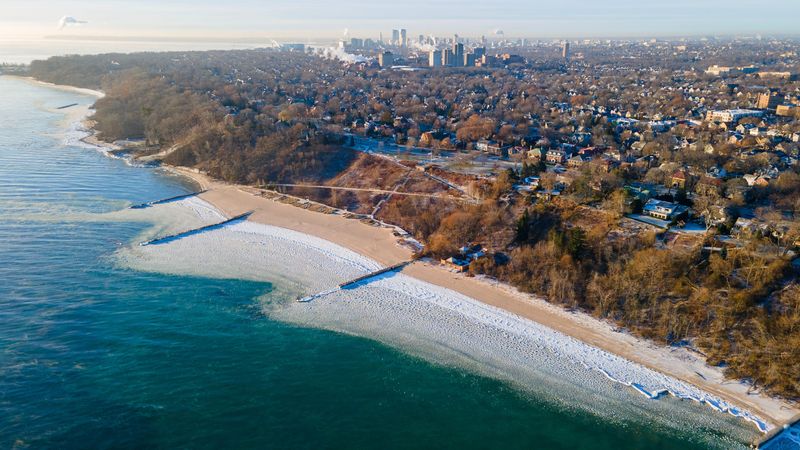
The outcome of a municipal court trial in Shorewood could become a decisive flashpoint over public access to Lake Michigan’s shoreline – a battle other Great Lakes states have settled, but hasn’t been litigated in Wisconsin.
On Dec. 2, Paul Floresheim, a Shorewood resident and professor at the University of Wisconsin − Milwaukee, argued in municipal court that a ticket issued for trespassing by Shorewood police was unlawful. More than 30 residents filled the courtroom for the nearly four-hour-long trial.

In July, Floresheim was walking his two dogs along Lake Michigan’s shoreline at Shorewood’s Atwater Beach, heading north below the homes on North Lake Drive. It’s a route he said he’s walked for decades.
During that walk, he said a property owner, Daniel Domagala, flagged him down and accused him of trespassing. Domagala later called the police, and Floresheim was issued a $313 ticket − one that he is fighting out of principle.
Floresheim argues Wisconsin’s public trust doctrine that applies to navigable waters allows the public to walk on the land between the water’s edge and what is known as the ordinary high water mark – a boundary line left by the continuous presence of water. Examples of this include a wet mark on the sand, erosion lines or where the sand ends and vegetation begins.
It’s a legal boundary that separates public water and shoreline access from private property.
Meanwhile, Village Attorney Kevin Landgraf argues that Shorewood private property owners own everything down to the water, citing a 1923 Wisconsin Supreme Court ruling in Doemel v. Jantz. That conflict, however, pertained to Lake Winnebago.
Municipal Judge Margo Kirchner said she will issue a written decision on the case by the end of 2025.
There hasn’t been a Wisconsin court case or administrative rule relating to walking up below the high water mark on Great Lakes shorelines, according to Melissa Scanlan, director for the University of Wisconsin Milwaukee’s Center for Water Policy.
Both Michigan and Indiana have taken this issue up to their respective Supreme Courts, ultimately protecting the right to walk on Great Lakes beaches below the high water mark.
“This is potentially Wisconsin’s chance to also settle this issue,” Scanlan said.
‘A waterway that belongs to all of us’
Throughout the trial, the village and Floresheim, who represented himself, went back and forth about what constitutes the ordinary high water mark and which specific activities the public trust doctrine protects on Wisconsin’s waterways.
Citing guidance from the Wisconsin Department of Natural Resources, Floresheim argued the ordinary high water mark extends to the vegetation at the edge of a landowner’s property. The public trust doctrine, enshrined in the Wisconsin Constitution, says the public has access to waterways up to the high water mark.
“The village is acting unconstitutionally by trying to deny me and others access to walk on a waterway that belongs to all of us,” Floresheim said.
As part of his defense, Floresheim, who lived on North Lake Drive growing up, called his own father to the stand. His father, Thomas Floresheim, testified he considered the beach “common property” and “anything beyond the greenery” as private property when he lived in the area until 2003.
However, Landgraf argues that the public trust doctrine is “not necessarily relevant” in this case, since Floresheim was walking on sand and not in the water. He added that, per Doemel v. Jantz, the area along the shore between the ordinary high water mark and the water’s edge is under “exclusive control” of the property owner.
According to video taken from Domagala’s surveillance cameras and presented at trial, Floresheim was walking several feet from the water on multiple days in late July. In one video, he walks near a building on the edge of the property.
“Whether or not the ordinary high water mark was evident at this time is irrelevant,” Landgraf said. “Mr. Floresheim, in the video, is almost 5 feet away from the auxiliary building in Mr. Domagala’s backyard. This is not close to the shore.”
Domagala testified that he complained to Shorewood police “at least 50 times” over the past summer about people on the beach by his house. In July, said he called police after he pointed out the signs prohibiting pets and trespassing to Floresheim, but Floresheim continued insisting the area was public property.
“Just imagine somebody’s in your house telling you this is not your house,” Domagala said, adding that people sometimes “camp out” by his house or sit on the porch.
Floresheim said he agrees lingering on the beach or building campfires would not be allowed, but argued that walking is a form of “navigation on waterways” that the public trust doctrine protects.
Judge Kirchner said she is taking several more weeks to issue a decision as to determine whether walking can, in fact, be considered a form of navigation.
“You’re asking me to interpret Wisconsin law more broadly than anyone has before,” Kirchner said.
A larger trend in property owners excluding public access
Walking along beaches is a part of a historic public trust tradition that dates back to England, where Scanlan said the right of passage along the shore was recognized.
This practice has continued for generations – often without objection – which is why it may not have been litigated in Wisconsin sooner. Scanlan believes this reflects a broader trend of some private property owners trying to exclude the public from beaches.
But Scanlan said it’s about balancing property owner expectations with public rights.
As it stands now, there are only signs noting where people are trespassing on public property. But Floresheim hopes the village will put up additional signs noting where people can walk according to the public trust doctrine as long as they are respectful of private property.
That way, the people won’t be scared off using public spaces, Floresheim said.
However, for David Strifling, the director of Marquette University’s Water Law and Policy Institute, the core question is whether the public trust doctrine actually guarantees this kind of public access – or, more fundamentally, whether the line should be drawn somewhere else.
“What’s at stake here is the clash between private land ownership and public access,” Strifling said.
Caitlin Looby covers the Great Lakes and the environment for the Milwaukee Journal Sentinel. Reach her at clooby@gannett.com and find her on X @caitlooby. All of her work and coverage decisions are overseen solely by Journal Sentinel editors.
Caitlin is an Outrider Fellow whose reporting also receives support from the Brico Fund, Fund for Lake Michigan, Barbara K. Frank, and individual contributions to the Journal Sentinel Community-Funded Journalism Project. The project is administered by Local Media Foundation, tax ID #36‐4427750, a Section 501(c)(3) charitable trust affiliated with Local Media Association.
Learn more about our community-funded journalism and how to make a tax-deductible gift at jsonline.com/support. Checks can be addressed to Local Media Foundation with “JS Community Journalism” in the memo, then mailed to: Local Media Foundation, P.O. Box 85015, Chicago, IL 60689.
This article originally appeared on Milwaukee Journal Sentinel: Where can the public walk along Lake Michigan? Shorewood case may settle the issue
Reporting by Caitlin Looby and Maia Pandey, Milwaukee Journal Sentinel / Milwaukee Journal Sentinel
USA TODAY Network via Reuters Connect