It has been eight years since Democrats in Wisconsin had a contested primary for governor.
A lot has changed since then, including Democratic voters themselves.

The candidates fighting for the Democratic nomination in 2026 will face a different electorate than they did in the 2018 primary won by Tony Evers, the current and outgoing governor.
The most striking difference is that the party’s voters are a much more liberal group today than they were eight or 10 years ago, based on their own description of their politics.
The share of Democrats in Wisconsin who call themselves moderates or conservatives has dropped from 42% in the late 2010s to 31% today, according to extensive polling by the Marquette Law School.
The share of Democrats who call themselves liberal has risen from 55% to 68%.
And within that large liberal group, the share who call themselves “very liberal” has risen from 17% to 27% of all self-identified Democrats in the state. These “very liberal” Democrats are not only growing in number, but they’re “on fire” politically. By every polling measure, they are the most engaged and mobilized voters in Wisconsin right now.
All of this has implications for the high-stakes, open-ended primary Aug. 11, when Democrats pick their 2026 nominee for governor. (The expected GOP nominee, U.S. Rep. Tom Tiffany, faces no major opposition within his party).
The two top Democrats in early polling are both especially popular and well-known among the party’s most liberal voters: former Lt. Gov. Mandela Barnes and Madison state lawmaker Francesca Hong, a democratic socialist.
Barnes’ prominence in the race is no surprise; he has the highest name ID in the field and lost a narrow November election for U.S. Senate in 2022. But Hong has been the biggest surprise in the early stages of the campaign. She’s clearly benefiting from the leftward shift among the party’s voters. It’s hard to imagine her creating the same level of attention and enthusiasm from the Democratic voters of 2014 or 2018.
“I think these shifts are substantial and significant, and I think they explain a lot,” says Charles Franklin, who conducts the Marquette poll. “I think the growing share of very liberal voters in the party is pushing candidates in primaries to be more attentive to what the interests are of that liberal wing in the party.”
Marquette’s polling suggests that this shift to the left among Democratic voters in Wisconsin began more than a decade ago, when Republican Scott Walker was governor and before Donald Trump was first elected president in 2016.
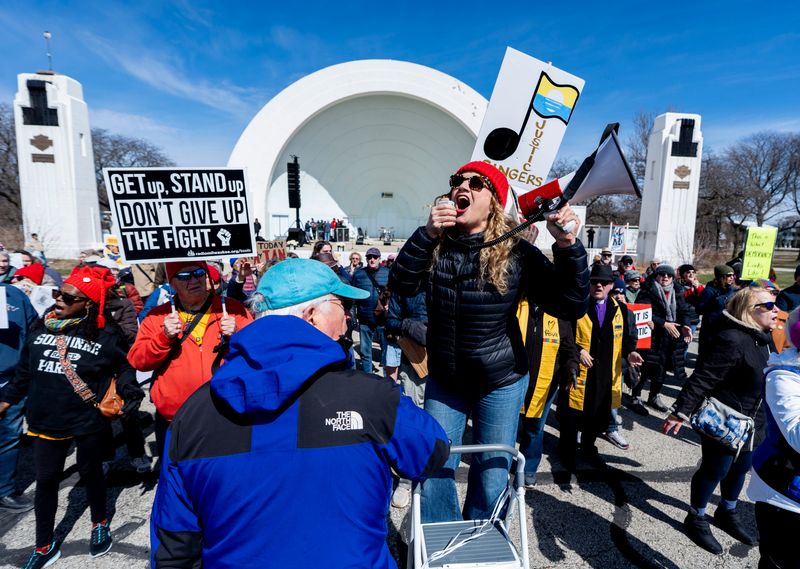
But most of the change has occurred in the Trump era, when outrage over the two-time president has made Democratic voters more militant and restive and frustrated with their own party’s failure to marshal more resistance. Almost a third of “very liberal” Democrats have a negative view of their own party – a much higher figure than among other voters in the party.
What follows is a closer look at what the polling tells us about the politics of today’s Democratic voters in the state.
For this analysis, Franklin examined survey data in Wisconsin going back to 2012, the first year of the Marquette poll. Because Marquette conducts fewer surveys in non-election years, Franklin lumped some years together to get bigger samples. In addition, he combined Marquette’s more recent polls to explore the issues that currently unite or divide Democrats across ideological lines.
First, let’s take a closer look at how the political mix within the party has changed, going back roughly 15 years. The numbers below reflect voters who identify in polls with the Democratic Party; they do not include the views of so-called “leaners” – people who identify as independents but “lean” toward the Democratic Party.
Self-identified ‘conservative’ and ‘moderate’ Democrats on decline in Wisconsin
Here is the changing share of Wisconsin Democrats who call themselves “conservative:”
2012-14: 17%
2015-16: 15%
2017-20: 11%
2021-24: 7%
2025-26: 5%.
A little more than a decade ago, about 1 in 6 Wisconsin Democrats considered themselves conservative. Today, only 1 in 20 do. By contrast, about 80% of Wisconsin Republicans call themselves conservative, a number that has risen slightly over the past decade.
Here is the changing share of Democrats who call themselves moderate:
∎ 2012-14: 33%
∎ 2015-16: 33%
∎ 2017-20: 31%
∎ 2021-24: 29%
∎ 2025-26: 26%.
The percentage of moderates in the party has declined, but not as steeply as the share of conservatives. Even with that decline, moderates still make up a larger share of Democrats in Wisconsin (26%) than they do of Republicans (18%).
Meanwhile, the share of ‘liberal’ Democrats rise, including self-identified ‘very liberal’
Here is the changing share of Democrats who call themselves liberal:
∎ 2012-14: 46%
∎ 2015-16: 50%
∎ 2017-20: 55%
∎ 2021-24: 63%
∎ 2025-26: 68%.
This is a very big change. Liberals used to be outnumbered within the party by the combined population of moderates and conservatives. Now, liberals as a group are more than twice as large.
Here is the changing share of Democrats who call themselves not just liberal but “very” liberal:
∎ 2012-14: 13%
∎ 2015-16: 14%
∎ 2017-20: 17%
∎ 2021-24: 21%
∎ 2025-26: 27%.
Important note: these “very liberal” voters are a subset of the broader “liberal” group cited above – not a separate group. What these numbers tell us is that within the broad category of “liberal” Democrats, a much bigger share than before identifies as “very liberal.”
That distinction underscores how much the political balance within the party has shifted. In 2012-14, the “very liberal” group within the party was about one-quarter the size of center-right Democrats (moderates plus conservatives).
Today, the “very liberal” group is almost as big as the moderate-to-conservative group. (Likewise, the Republican coalition in Wisconsin includes a rising share of “very conservative” voters, who have gone from 20% to 27% of the GOP over this time frame).
While their numbers have grown, “very liberal” Democrats remain a distinct minority in the party. And Wisconsin’s open primary system and lack of party registration means independents and even people who identify with the opposing party can vote in partisan primaries.
‘Voter intensity among highest among ‘very liberal’ Democrats
But on both sides, the most ideological voters are the ones most likely to turn out in a primary. And these “very liberal” Democrats are currently more engaged and enthusiastic about voting than just about anyone else in the Wisconsin electorate.
The Marquette poll has used a variety of questions to gauge voter intensity. In recent months, it has asked Wisconsin voters how enthusiastic they were about voting in the state’s big April court election, how certain they were to vote in that race, how closely they follow politics in general and how much attention they’re paying to the governor’s race. By all four measures, “very liberal” Democrats lead the pack.
“They are substantially more engaged than Republicans, or even MAGA Republicans,” Franklin said. “They’re more engaged than [less] liberal Democrats, and a lot more engaged than moderate Democrats, who are actually less engaged than almost any other group.”
The changing ideological mix in the party has coincided with demographic changes that have become familiar markers of the nation’s partisan realignment.
White non-college voters are now a smaller chunk of the party. They have gone from making up 47% of Wisconsin Democrats in 2012-14 to 41% in 2025-26. White college grads have increased as a share of self-identified Democrats, from 31% to 40%. (The share of Democrats who are non-white has remained steady at around 15% in the state).
In short, blue-collar whites are still a very big slice of the Democratic Party in Wisconsin, a state with a higher share of white blue-collar voters than any other top battleground. But while non-college whites used to easily outnumber white college grads in the Democratic coalition here, these two groups are now the same size.
This trend goes hand-in-hand with the changing political makeup of the party. In Marquette’s polling, “very liberal” Democrats are twice as likely to have a college degree as moderate-to-conservative Democrats.
Another big change is how “secular” the party has become. Voters who say they have no religion have gone from 17% of Wisconsin Democrats in 2012-2014 to 39% today.
This change isn’t confined to Democrats. Independents are also increasingly non-religious. The share of Democrats who attend church weekly or monthly has also plunged from 46% in 2012-14 to 18% in 2025-26. (Republicans are much more likely to go to church, but church attendance has also declined sharply among GOP voters).
One thing the polling doesn’t tell us: Are Democrats a more liberal group today because the mix of people in the party has changed or because some Democratic voters have moved to the left over time? The answer is probably both: some conservative or moderate working-class voters have left the party; some younger Democrats have a more progressive bent, and some voters in the party are reacting to Trump by tacking left.
Where Democrats are united, and where they differ
Has this created new fault lines in the party?
In some ways, Wisconsin Democrats are exceptionally united, especially by what they’re against. They are extraordinarily, uniformly anti-Trump: 99% disapprove of the president, and 96% “strongly” disapprove of him.
They almost unanimously oppose Trump’s handling of the economy, tariffs and the Iran war. In Marquette’s last Wisconsin poll, ICE (the Immigration and Customs Enforcement agency) had a 1% positive rating among Democrats in Wisconsin. Vice President JD Vance had a 1% positive rating. And the state’s Republican U.S. senator, Ron Johnson, had a 0% positive rating from Democrats.
But there are some differences within the party, too. As mentioned above, there is more frustration on the left toward the party’s leadership. About 10% of center-right Democrats and liberal Democrats in Wisconsin have a negative view of the Democratic Party. But roughly 30% of “very liberal” Democrats do.
On immigration, anywhere from a quarter to half of moderate and conservative Democrats support deporting people who are in this country illegally, depending on how you ask the question. By contrast, “very liberal” Democrats are 99% opposed to that.
Democrats are heavily negative toward artificial intelligence and data centers (as are a lot of Republicans). But within the party, “very liberal” Democrats are the most negative.
Finally, the Marquette poll also asks people whether cutting property taxes or increasing public school spending is more important to them. Moderate-to-conservative Democrats are almost evenly divided on this question. But 94% of “very liberal” Democrats say increasing school spending is more important than cutting property taxes.
The debates Democrats are having among themselves aren’t solely about policy, however. They are also about rhetoric, tone, electability and strategy. The frustration with the Democratic Party on the left reflects a hunger for candidates and elected officials who will draw sharper lines, channel Democrats’ anger and outrage, and show more “fight.”
What do these shifts mean for the 2026 governor’s race?
What does all this mean for the 2026 governor’s race? The Democratic primary contest is still early and open-ended. The field is huge; at least nine candidates have filed.
The shifting climate in the party has already helped Hong raise her profile, but Barnes remains the best-known Democrat with the highest positive ratings among party voters. The growth and energy of the party’s left flank is probably a challenge to the more moderate candidates in the field.
As for November, the questions are even bigger. By every traditional political measure, this has been shaping up nationally as a good midterm election for Democrats and a bad one for Republicans.
One possibility is that Democrats move too far left and squander a golden opportunity to extend their eight-year run in the governor’s office in Wisconsin. Another is that the combination of Trump’s unpopularity, the energy on the left, and a surge in turnout among angry Democratic voters makes almost anyone the party nominates the favorite in this election.
This article originally appeared on Milwaukee Journal Sentinel: What Wisconsin Democrats’ leftward shift means for midterms | Gilbert
Reporting by Craig Gilbert, Special to the Journal Sentinel / Milwaukee Journal Sentinel
USA TODAY Network via Reuters Connect