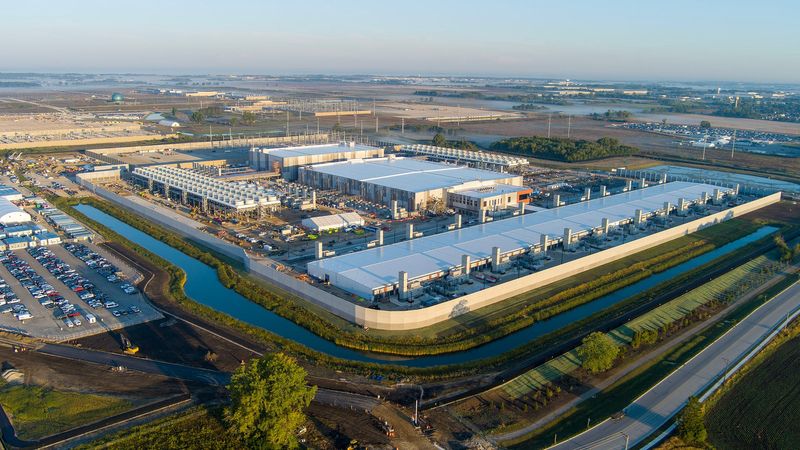
“Fairwater” is defined in the Merriam-Webster Dictionary as a boat device, a streamlined bridge, and a submarine’s conning tower.
It’s also the name of Microsoft Corp.’s artificial intelligence data center network – which some data center critics might find ironic.

When Microsoft announced it was building a second southeastern Wisconsin data center, a small detail went overlooked: its Fairwater name.
“In addition to our Fairwater datacenter in Wisconsin, we also have multiple identical Fairwater datacenters under construction in other locations across the US,” Scott Guthrie, executive vice president of Cloud and AI for Microsoft, said in September.
The second Fairwater data center is in Atlanta. It was announced in November, and Microsoft stated in a blog post the two data centers are connected.
“This enables Fairwater sites located in different states to work together as an AI superfactory to train new generations of AI models far more quickly, accomplishing jobs in just weeks instead of several months,” the post reads.
As for why the name “Fairwater”?
Microsoft says it was an internal code name the company decided to make public.
Water usage has been a key focus of data center critics. Microsoft has tried to calm anxiety around that issue.
“Lake Michigan has nothing to fear from our data center,” Microsoft President and Vice Chair Brad Smith said during a September announcement of the second Mount Pleasant data center.
“We build data centers in the desert, that’s because we’ve figured out how to run them without using a lot of water,” Smith said, adding the company uses a closed-loop cooling system.
Closed-loop systems reuse most of that water, but they still need occasional flushing and refills.
The Fairwater data center is expected to use 2.8 million gallons of Lake Michigan water in 2026.
But that’s more of a floor than a ceiling. Microsoft is planning to build 15 more data centers in Mount Pleasant during the next decade or longer.
Microsoft could use up to 8.44 million gallons of water annually with that expansion, according to the City of Racine, which provides water to the development site. Roughly 6 million gallons are to be returned to Racine.
But even those projections might fall short of reality.
Microsoft’s internal forecasts expects its annual water usage for roughly 100 data center complexes world wide to be around 28 billion liters in 2030, according to the New York Times.
In a comment given to the Times, Microsoft said it now expects to use about 18 billion liters of water by 2030. That’s roughly 4.8 billion gallons.
Environmental advocate Milwaukee Riverkeeper has pushed for more transparency and action on data center water issues.
“This conversation shouldn’t be about branding – it should center on impact, accountability, and the long-term stewardship of our local waters,” said Jennifer Bolger Breceda, executive director of Milwaukee Riverkeeper.
“Data centers place significant demand on water resources, and in a region defined by the Great Lakes, that should require careful consideration and thoughtful implementation,” Breceda told the Milwaukee Journal Sentinel.
“When an out-of-state corporation proposes a project of this magnitude, there must be full transparency around water use, clear and enforceable safeguards, and a rigorous review process to ensure our people and waters are protected.
“We also need to take an honest look at the tradeoffs, including whether the long-term community benefits truly match the scale of resource use,” Breceda said.
This article originally appeared on Milwaukee Journal Sentinel: What is Fairwater? The name of Microsoft’s AI data center network
Reporting by Ricardo Torres, Milwaukee Journal Sentinel / Milwaukee Journal Sentinel
USA TODAY Network via Reuters Connect