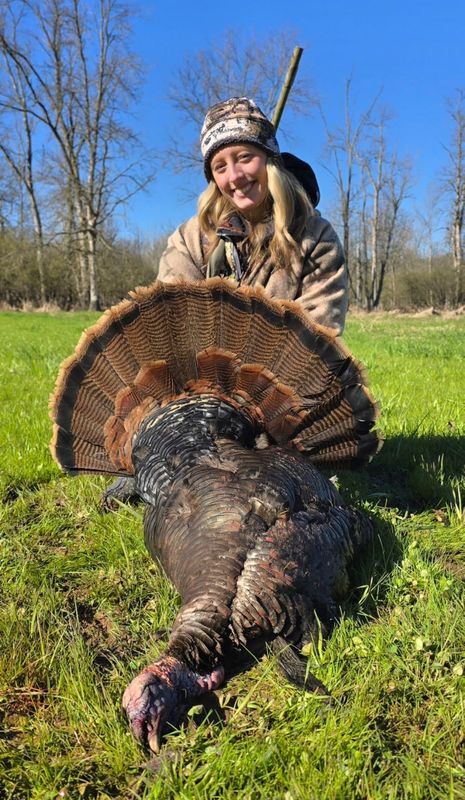
Hunters registered 47,704 wild turkeys in the 2026 Wisconsin spring season, according to preliminary registration information from the Department of Natural Resources.
The data represent a 5% drop from the previous year but when finalized will likely be the sixth highest spring turkey harvest in state history, adding an exclamation point to the 50th anniversary of the species’ highly successful reintroduction to the Badger State.

The 20.8% hunter success rate in 2026 also compares favorably with the 19.6% average over the previous 10 years.
The season opened with Learn to Hunt events in March and included a youth hunt April 11 and 12 and six, week-long normal hunting periods from April 15 through May 26.
The preliminary data for the 2026 Wisconsin spring turkey hunting season show Zone 1 had 13,330 turkeys registered, followed by Zone 3 with 11,048, Zone 2 with 10,541, Zone 4 with 8,026, Zone 5 with 2,524, Zone 6 with 1,389 and Zone 7 with 749 and Fort McCoy with 97. In addition 3,480 birds were taken during the youth hunt and 381 during various Learn to Hunt programs.
The total includes 42,157 adult toms, 5,176 jakes (1-year-old male turkeys) and 371 bearded hens. The 2026 harvest composition of 88% adult toms compares to the 10-year average of 86% in the Wisconsin spring turkey harvest, according to DNR data.
The DNR made 254,227 harvest authorizations available for the 2026 spring turkey hunting season and 228,844 were purchased, including 146,770 awarded to hunters through a December drawing and 82,074 sold beginning in mid-March.
Since the 2006 spring hunting season when the DNR began issuing at least 200,000 harvest authorizations, or tags, the turkey harvest has ranged from 37,266 (in 2021) to 52,880 (2008).
Harvest information in Wisconsin is obtained through mandatory registration of harvested turkeys.
Wisconsin manages its spring turkey hunting seasons by regulating hunting pressure across seven geographical zones and six time periods.
The number of tags offered in a zone is set to allow maximum recreational opportunities while limiting the impact on the turkey population and minimizing hunter interference, according to the DNR. Harvest authorizations levels reflect the amount of turkey habitat, turkey population densities and distribution in each zone.
The 2026 season fits the pattern in recent decades of a healthy turkey population that has occupied the available habitat statewide and shows annual fluctuations within a range. Weather during spring and early summer is a primary factor in nesting success and poult survival.
Wild turkeys are native to Wisconsin but were extirpated by unregulated hunting and habitat loss in the 1800s.
After several unsuccessful attempts in the 20th century, a restoration effort started in 1976 took hold in southwestern Wisconsin. The project was a partnership of the DNR, the Missouri Department of Conservation and the National Wild Turkey Federation. The University of Wisconsin-Madison also provided assistance.
The work involved trapping wild birds in Missouri and transferring them to the Bad Axe watershed in southwestern Wisconsin. Several additional turkey shipments from Missouri and dozens of trap-and-transfers of the growing Wisconsin flock helped seed more areas of the state. The birds are now found in all 72 Wisconsin counties.
Only bearded turkeys may be legally hunted in Wisconsin’s spring season. The rule is designed to focus the majority of the harvest on male turkeys and protect female birds as they nest and rear poults; a small percentage of hens have beards.
Turkey hunters in Wisconsin are required to purchase a Wild Turkey Stamp for $5.25. Stamp sales bring in about $750,000 annually, according to the DNR, and all funds generated from the sales goes directly to turkey management in the state.
The 2026 spring turkey harvest data released by the DNR is preliminary; the numbers are subject to change upon further harvest data analysis.
Wisconsin’s 2026 fall turkey hunting season opens Sept. 12. For license or other information, visit dnr.wi.gov or gowild.wi.gov.
This article originally appeared on Milwaukee Journal Sentinel: Turkey hunters register another strong spring season in Wisconsin
Reporting by Paul A. Smith, Milwaukee Journal Sentinel / Milwaukee Journal Sentinel
USA TODAY Network via Reuters Connect