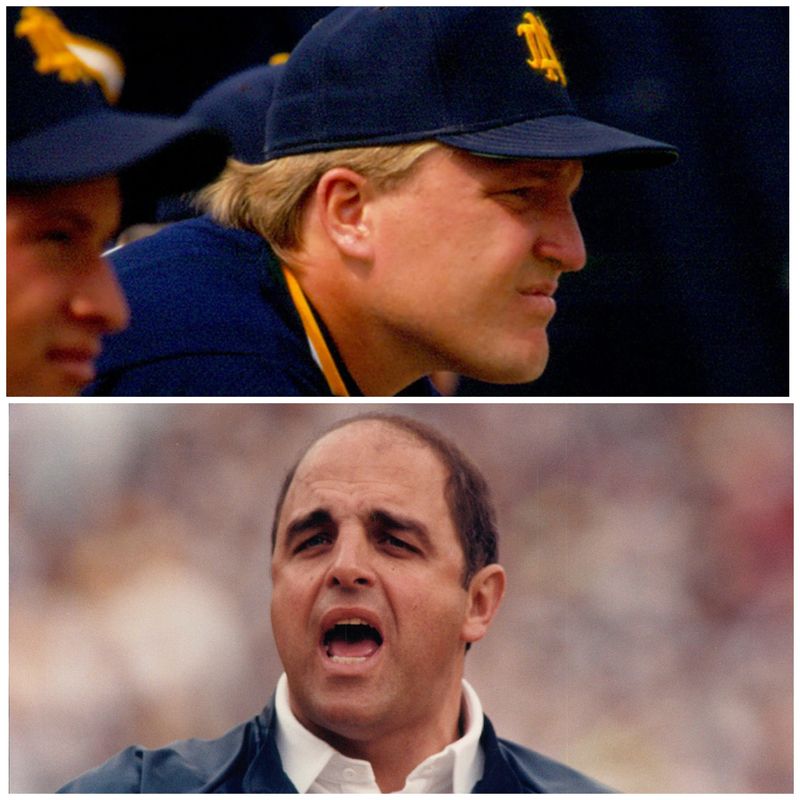
Back before anyone in America’s Dairyland was familiar with the concept of pocket pancakes or winning Rose Bowls, before they even knew who Pat Murphy or Barry Alvarez were, there was a corner office in South Bend, Indiana, where the lights were on late.
Both Murphy and Alvarez would go on to massive success as prominent coaching figures in the state of Wisconsin, the former as manager of the Milwaukee Brewers and the latter as the godfather of Wisconsin Badgers football. But four decades ago, they were little-known coaches in different sports with no clue what lay ahead.

There, in the back of a hallway at Notre Dame where they often gathered to talk shop, Alvarez would plop down with a bottle of whiskey and Murphy would turn from coach into therapist.
“Barry needed a sounding board,” Murphy said. “He’d bring the Jack Daniels up, put it on my desk, midnight, just sit there and let it rip.”
Murphy, in his late 20s at the time, didn’t coach football, and perhaps that’s what made him a perfect compatriot for Alvarez. Murphy, then recently hired as Notre Dame’s baseball coach, knew football and could talk about it from a 1,000-foot view.
More importantly, he knew coaching.
“We had a great relationship,” Alvarez said. “We really did. We spent lots of time with one another, visiting each other’s offices and just talking.”
Murphy’s long-held dream always was to coach at Notre Dame – just not necessarily baseball. Growing up, Fighting Irish football was his favorite thing in the world. Murphy’s first memory is huddling around the radio with his father somewhere in upstate New York, listening to legendary Ara Parseghian’s teams through a fuzzy speaker.
In the early years of his career, Murphy would write Gerry Faust, then the Irish head football coach, each year begging for a job.
“It was all I ever wanted,” Murphy said. “’I’ll just be on your staff and I’ll help out. I can help you. You don’t even have to pay me.’ He’d write back every single time, a beautiful letter saying thanks for your interest and we’ll keep you in mind. I started thinking, ‘How am I going to pay for anything?’ But I didn’t care. I was just so passionate.”
Murphy, to this day, has the letters from Faust at his house, a reminder of the ambition that drove him and the career path that nearly was.
The 67-year-old skipper of the Brewers, you see, began his career as a football coach, working at two colleges over five years before turning full-time to baseball.
He coached both sides of the ball. Created and ran his own offense. Devised his own plays. Cut up film. Played quarterback on scout team.
You name it, he did it.
“I loved it,” Murphy said. “Coaching football, man, it molded me in so many ways.”
Had Notre Dame taken him up on his pleas to coach football instead of ultimately hiring him for baseball, he probably still would be stalking the sidelines with a whistle somewhere.
“I don’t see why not,” said Alvarez, who served as Notre Dame’s linebackers coach when Murphy arrived in 1987. “He’s a coach. He understood football. He chose baseball, but if he had chosen football, there’s no doubt in my mind that he would have been an excellent football coach.”
To know the story of Murphy’s background in football is to understand his one-of-a-kind managerial style for the Brewers, yet there is little documentation of Murphy’s football days. A line in the media guide or a Wikipedia sentence is about all you’ll find.
Until now.
Diet Cokes and diabolical fake punts
Alvarez wasn’t the only Notre Dame coach bringing a beverage for after-hours chats with Murphy, whose office was just down the hall from football headquarters.
Skip Holtz, son of the late Lou Holtz, was − like Murphy − single, in his 20s and a night owl. He would grab a couple of Diet Cokes from the staff fridge, walk down the hall and plant one on Murphy’s desk.
“Those Diet Coke evenings are some of my favorite memories,” Holtz recalled. “I would go down and pick his brain. ‘How do you do this? How do you discipline this situation? When is it too much?’ I learned as much from coaching from Pat as I did anyone that I was around.”
The conversations typically centered on general coaching topics – “I was a sponge,” Holtz said – but often devolved into football strategy. When that would happen, Murphy turned into a mad scientist.
“He’d go, ‘OK, I got one for you. We’re going to throw the ball here, and then back this way,’” Holtz said. “Almost all the time, I’d say, ‘Pat, we can’t do that.’”
But not every time.
In 1994, during Holtz’s first year as head coach at Connecticut, he stood back one day by the punt returner during a special-teams drill, and a lightbulb went off in his brain.
One of Murphy’s trick plays might actually work.
On fourth down in pooch-punt territory, instead of the punter booting the ball, he would heave it up as high as he could toward the end zone. The defending jammer on the boundary, with no eyes on the punter, would theoretically have no idea it’s a pass and wouldn’t try to catch it. The returner, whose view of the actual kick was obstructed by the offensive line, would let it sail over his head for what he thinks is a touchback. The gunner could then catch it uncontested for a touchdown.
“I thought, ‘This is stupid. This sounds great on a napkin at a bar,’” Holtz said. “I thought it was crazy.”
And yet, it won a football game.
In Connecticut’s final game of Holtz’s first season, the Huskies led Massachusetts by 1 with 6 minutes to go and faced a fourth-and-long at the opposing 35-yard line. Holtz called for the fake punt.
Somehow, it connected. With a wide receiver lined up at punter, the high-arcing throw landed perfectly in the hands of the gunner for a game-sealing touchdown.
“To this day, I still can’t believe it worked,” Holtz said.
Murphy recently watched the clip of the touchdown for the first time in 32 years, a wide smile coming across his face as every little detail of the play came back to him in real time. He watched it another time or two, all without uttering a word. And then:
“Genius,” he said. “Isn’t it?”
Murphy’s early days in football
A former high school tight end and linebacker whose chances of playing in college were ended by a compound fracture in his shoulder that left his humerus bone popping through the skin, Murphy’s first-ever coaching job was as an assistant at Boca Academy in Boca Raton, Florida.
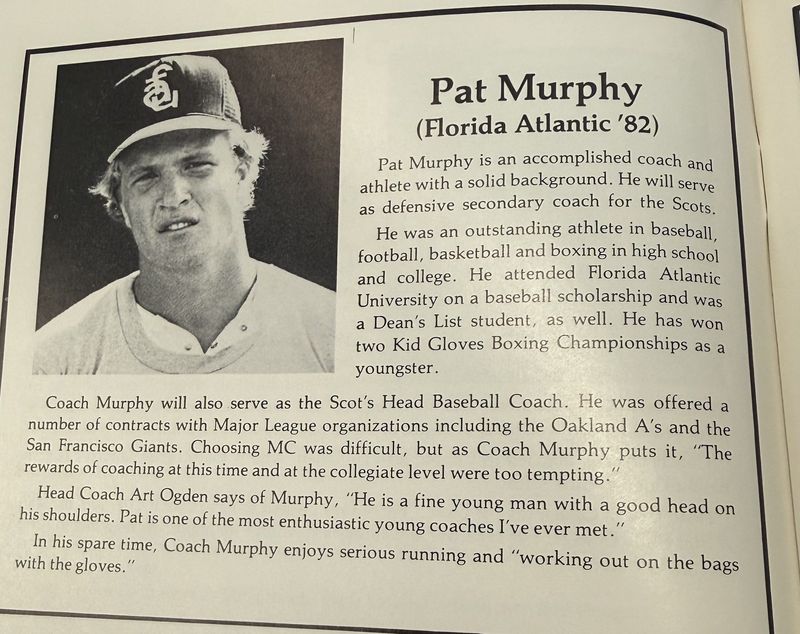
Murphy quickly realized coaching was his passion. He loved it so much that even after signing a minor-league deal with the San Francisco Giants in 1982, he quit to take a job as assistant football coach and head baseball coach at Division III Maryville College in Tennessee during the middle of his first season.
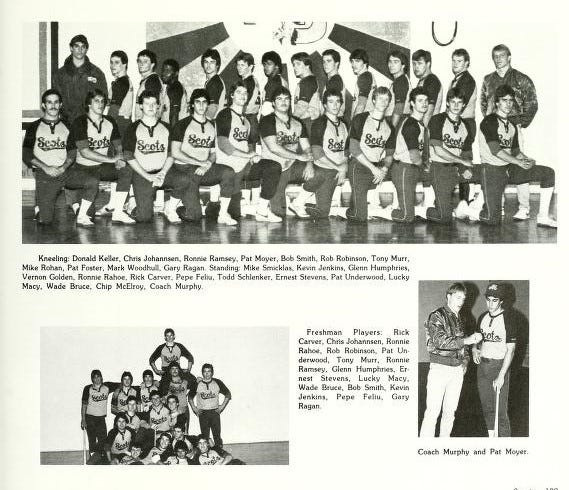
“From what I can remember, he was driving through on his way back [home] to Syracuse and saw something where Maryville College wanted a coach who can coach football and baseball,” said Pat Moyer, who played football and baseball there under Murphy. “He got hired on the spot.”
Murphy worked with defensive backs and special teams in his first year at Maryville, and he was, unsurprisingly, quite intense.
“Murph is a little more carefree today than he was then,” Moyer said. “He was more tense. He’s 24 years old, and it’s a different world when you play 10 games instead of 160. There’s this urgency that you got to improve tonight and be better by tomorrow.”
Following Murphy’s first year at Maryville, he went back to playing baseball, signing with the San Diego Padres organization. That fall, he returned to Maryville, where the teams were not particularly great, winning only two games both years.
After that, Murphy spent the next two seasons as a baseball assistant at Florida Atlantic while working toward his Master’s degree, taking breaks in 1984 to be a player-coach in Australia – the last time he drank, he’ll tell you – and in 1985 to play independent ball.
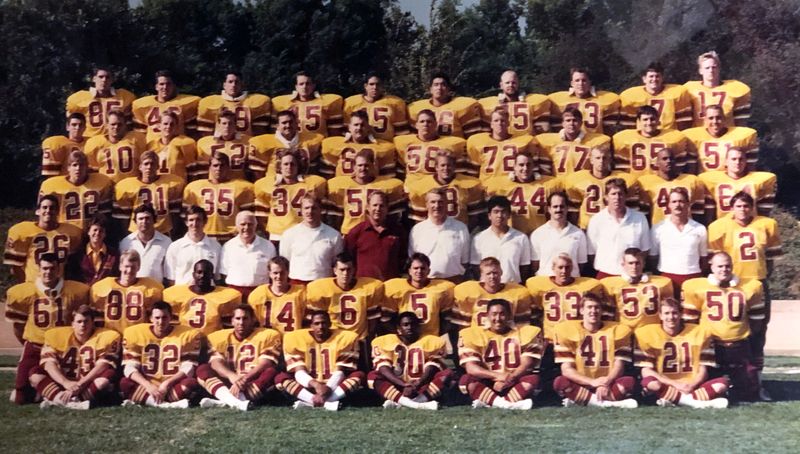
By that point, Murphy realized his playing days were dwindling. Football itched at him. And when an opening at the combined athletic department for Claremont-Mudd-Scruggs in California popped up, Murphy scratched back.
Title-fight intensity at Claremont
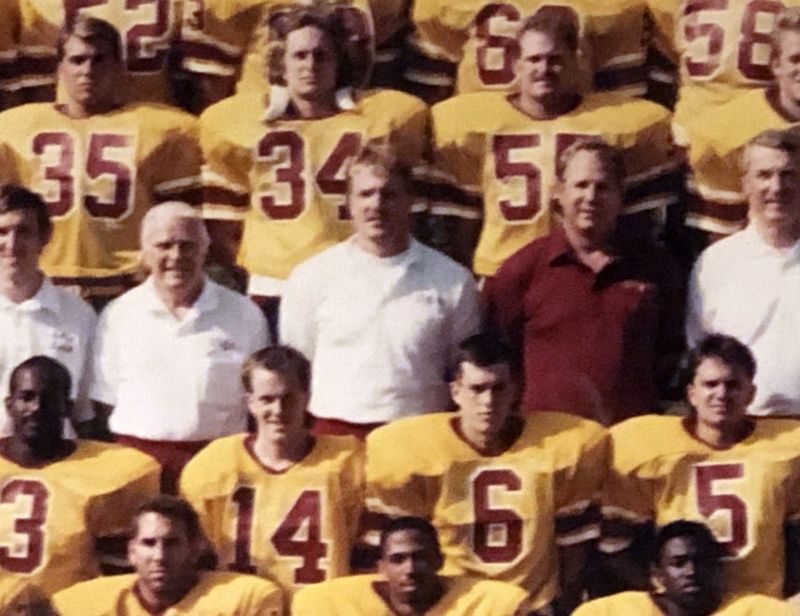
Suddenly making a robust $20,000 a year, Murphy also served as the head baseball coach for CMS, but his work as quarterbacks coach and offensive coordinator quenched his competitive side.
Case in point: When the Stags needed a scout team quarterback because of injury, Murphy stepped in.
“No helmet, no pads,” Murphy recalled. “They’d come and blow me up. They loved it.”
Not Mike Maynard, though. The defensive coordinator at the time remembers Murphy mercilessly carving up the defense with both his arm and legs, much to the dismay of a coach trying to get his team in the proper mental headspace.
“I’m like, ‘Murph, calm down. It’s Thursday,’” Maynard said. “‘We’re supposed to be gaining confidence.’ He wasn’t just a good coach, but he would compete. He’s a world-class competitor. He’s over the top. He was the best QB we played all year long.”
On Friday nights before home games, Maynard and Murphy would head to the boxing ring on campus. Maynard was simply trying to get a workout in and burn off some nervous energy ahead of the game. Murphy, a championship-level boxer as a kid in upstate New York, behaved like he was trying to win a world heavyweight title fight.
“I’d have black eyes every Saturday for the game,” Maynard said. “That’s the kind of tenacity he has.”
Murphy’s influence extended well beyond his competitiveness.
As offensive coordinator, he designed an offense along with head coach John Zinda that mirrored many of the modern concepts being run in college and the NFL now. Called “Gunslinger,” he used a two-tight end, one-running back set that featured various backfield looks, lots of motion and run-pass options for the quarterback.
Murphy helped on the other side of the ball, too.
“I would go into Pat’s offense and he would ask me 10 or 12 questions,” Maynard said. “He’d say, ‘I see that they run this,’ and I’d give him our scouting report and he’d say, ‘I see these formations, the tendencies you have. I would be running this. You need to be ready for this.’”
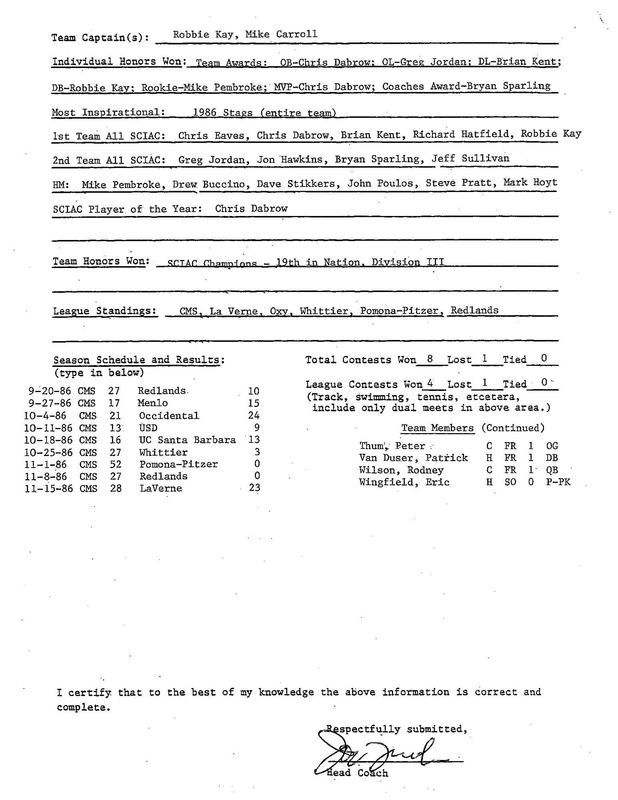
During one game in their 1986 conference-championship run, with the ball at the Claremont goal line and the game on the line, the Stags’ opponent ran a speed option on fourth down. It was a play they hadn’t run all year out of the formation they were in. It should have caught Claremont by surprise.
It didn’t.
The Stags had installed a defense to stop that specific play in a short-yardage situation on Friday before the game, wholly because Murphy was so adamant they may see it Saturday.
Claremont stuffed it and won the game.
“He was a great football mind in his ability to see what might be coming next,” Maynard said.
The Gunslinger
Murphy’s passion, though, was offense, even dating back to his days in Syracuse scheming up entire playbooks as a young kid.
“Not just plays,” Murphy said. “Systems. This play off of this play. Run this play, come back with this. I have books of them sitting around my house.”
The Gunslinger didn’t overwhelm opponents with different formations, but had multiple counters for the opponent based on each look. Take, for instance, the halfback motion. Murphy loved to utilize it, and most often it led to a dive in the opposite direction or pass to the back in the flat. But it was also the perfect set-up for his beloved halfback pass.
“This man had hundreds of trick plays,” Holtz said. “If you could draw up plays in baseball, he would have been a great coordinator. He’d run a trick play every play.”
At Claremont, the Gunslinger was the embodiment of Murphy’s Madden mind. The formations were standard, but the concepts of the offense were ahead of their time, giving the quarterback what effectively came to be known as an RPO 30 years later on most plays.
“The quarterback would take off and read the defensive end,” Murphy said. “He could throw it over his head, he could pitch it, he could tuck it up or we could run an inside handoff off of it. We could flip a reverse. We could reverse and then throw. It wasn’t terribly successful, but the thought of it was. It was fascinating doing it.”
Except it was successful. In Murphy’s first season, the Stags were burned by a large graduating class of seniors the year prior and went 1-8. The next season, they shifted the offense ever so slightly, becoming more run-heavy and taking more snaps under center. They went 8-1, winning the conference championship and churning out a school record for rushing yards.
“Pat was one of the biggest reasons why we won a championship,” Maynard said. “He was pretty much the whole offense.”
A fit for football
That’s how Murphy went out as a football coach – a champion. The next summer, he cold-called Notre Dame after finding out the baseball position was open, told them they were speaking to the next head coach and later got the job.
After years of pleading to be a part of the football staff, he was finally South Bend-bound.
But had Murphy not talked his way into the gig at the school of his dreams, chances are he may have found himself working the way up the football coaching ladder instead.
“I think he would’ve been a great football coach,” Holtz said. “High college, NFL, whatever. It’s a hands-on sport. I think Pat gets dirty. He gets in there and rolls his sleeves up and is passionate about what he does. I definitely think he would have been a great football coach.”
In many ways, Murphy’s demeanor would have been a perfect fit for football.
Murphy has a Red Bull-and-smelling-salts intensity that is unusual for Major League Baseball, where 162 games typically demands a calmer approach. Murphy doesn’t do that. Playing against him is the equivalent of having to stop nine innings of fullback dives.
“He’s a good guy like a T. rex is a good guy,” Maynard said. “He is intense beyond what most people know. I’ve seen that side. It’s not an angry mad. Excellence is just so important to him, just like it would be for an NFL head coach. He has the ability to influence people and get along with people. And football is a people business.
“He would have thrived.”
Murphy’s former football comrades will tell you it’s not intensity alone that would make him a good football coach.
“It’s people,” Moyer said. “He’s about the development of people. He could have done any team sport and been successful. He’s about bringing the best out of players. That’s a formula for success regardless of team sport.”
There’s a reason why the Brewers take on the identity of their manager – why, when they’re at their best, they force you through 27 outs of hell.
Maynard recalls the insane schedule Murphy kept even at a small D III school working the coaching job where he supposedly had fewer duties.
“His desk would be one notepad, and he was on that notepad all day, writing ideas, going back, rechecking ideas, drawing plays,” he said. “That’s all he did. He always thought about it. He didn’t take time for lunch. We worked out in the morning and then he was all-in, all the time. Off the charts.
“He didn’t know any other way.”
This visual sounds a lot like Murphy’s desk inside the manager’s office at American Family Field now, sheets and scouting reports strewn everywhere and hardly legible chicken scratch covering entire packets of blue notepad paper.
It’s the type of chaotic scene that makes you remember Murphy was a football coach – and in myriad ways, still is.
“He’s a coach, first and foremost,” Alvarez said. “And that never stops.”
This article originally appeared on Milwaukee Journal Sentinel: The untold football story of Milwaukee Brewers manager Pat Murphy
Reporting by Curt Hogg, Milwaukee Journal Sentinel / Milwaukee Journal Sentinel
USA TODAY Network via Reuters Connect