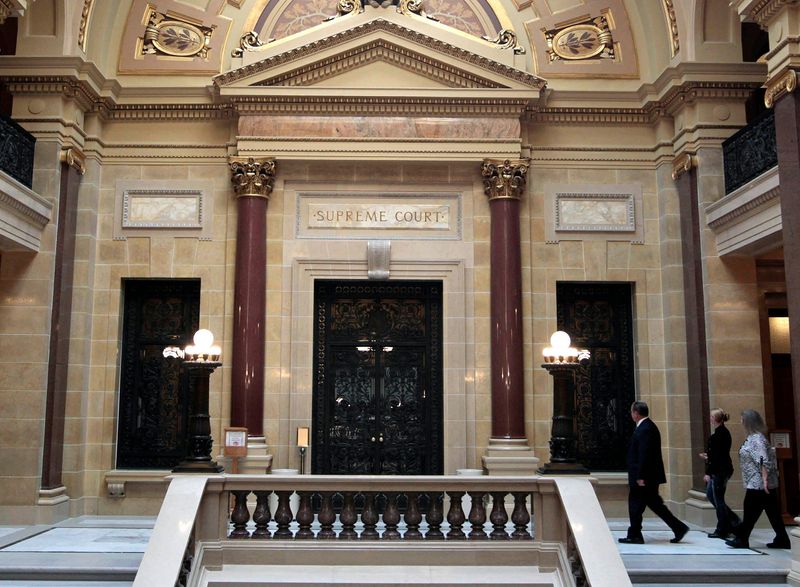
MADISON – Wisconsin judges could be required to step aside from cases where previous campaign spending raises questions about their impartiality under a proposed rule up for consideration June 4.
The state Supreme Court will hold a public hearing on the petition, filed by a group of retired circuit court judges earlier this year, on June 4.

Under the proposed rule, judges would be required to recuse themselves in a case where they know (or reasonably should know) that support for their candidacy, whether through direct contributions or through independent expenditures or issue advocacy groups, “raises a reasonable concern about the judge’s ability to be impartial.”
The state’s high court – under a different ideological composition – has rejected previous efforts to implement recusal rules for judges on cases involving their financial backers.
In 2010, a 4-3 conservative majority adopted rules written by the Wisconsin Realtors Association and Wisconsin Manufacturers & Commerce that say a judge “shall not be required” to recuse based solely on an endorsement or campaign contribution.
The following year, the court’s conservative majority ruled that if a justice is accused of bias and asked to recuse, only the justice can decide whether to stay on the case.
In 2017, the conservative-controlled court voted 5-2 to reject a proposal from 54 retired jurists to establish campaign contribution thresholds that would force a judge or justice off of a case involving the donor, arguing it would impede free speech.
As a result, the 2010 rules have remained in place.
The new petition under consideration was filed Jan. 30 by retired Dane County Circuit Judges Richard Niess, Sarah O’Brien and John Markson and retired Monroe County Circuit Judge J. David Rice.
The proposed rule change also includes factors to be considered in determining impartiality and a procedure for addressing recusals.
When asked about recusal at an Oct. 23 WisPolitics event, Chief Justice Jill Karofsky said the court should have formal rules and guidelines in place, and they should be discussed in a public hearing.
Karofsky is one of several liberal justices on the court who advocated stronger recusal rules in their campaigns, along with Justice Rebecca Dallet in her 2018 race and Justice Janet Protasiewicz in 2023.
Hearing comes following record-setting spending in Wisconsin judicial races
The issue has come up in recent elections as spending broke national records in 2023 with the election of Protasiewicz and again in 2025, when spending exceeded $100 million in liberal Justice Susan Crawford’s victory over Elon Musk-backed Brad Schimel.
Protasiewicz last year rejected calls from Republican legislative leaders to recuse herself from a case challenging Act 10, the state’s law restricting collective bargaining. While she’d protested the law in 2011 and called it unconstitutional on the campaign trail, she said those past criticisms didn’t meet the threshold for stepping away from the case.
Conservative Justice Brian Hagedorn, at the same time, did recuse himself from the Act 10 case, because he provided legal counsel in creating the legislation and later defending it once it became law.
Hagedorn said in his order last year that recusal from a case “should be rare — done only when the law requires it.” But he added that recusal “is not optional when the law commands it.”
Protasiewicz also rejected calls in 2023 to step away from lawsuits before the court involving the state’s legislative maps.
Protasiewicz has said she would recuse herself from cases brought by or against the Democratic Party of Wisconsin because of the millions of dollars the state party funneled into her campaign. Crawford has said she would need to know the specifics of any litigation involving the Democratic Party before she would decide if she “could be fair and impartial in such a case or not.”
The question came up again during the most recent Supreme Court election, which liberal Justice-elect Chris Taylor won with a blowout 20-point margin. Taylor, a former public policy director for Planned Parenthood of Wisconsin, rejected the notion she should recuse from cases involving her former employer. Taylor said she would make recusal decisions on a case-by-case basis.
While in the Legislature, Taylor sponsored legislation that would have required judges to disqualify themselves from a case if they received campaign donations of $1,000 or more from a party to a case.
Taylor’s victory secured a 5-2 majority for liberals on the court – and just a week later, liberal Clark County Circuit Judge Lyndsey Brunette launched her campaign for the 2027 race to replace retiring conservative Supreme Court Justice Annette Ziegler. Taylor joins the court in August.
Jessie Opoien can be reached at jessie.opoien@jrn.com.
(This story was updated to add new information.)
This article originally appeared on Milwaukee Journal Sentinel: Supreme Court to consider election-related recusal rules for judges
Reporting by Jessie Opoien, Milwaukee Journal Sentinel / Milwaukee Journal Sentinel
USA TODAY Network via Reuters Connect