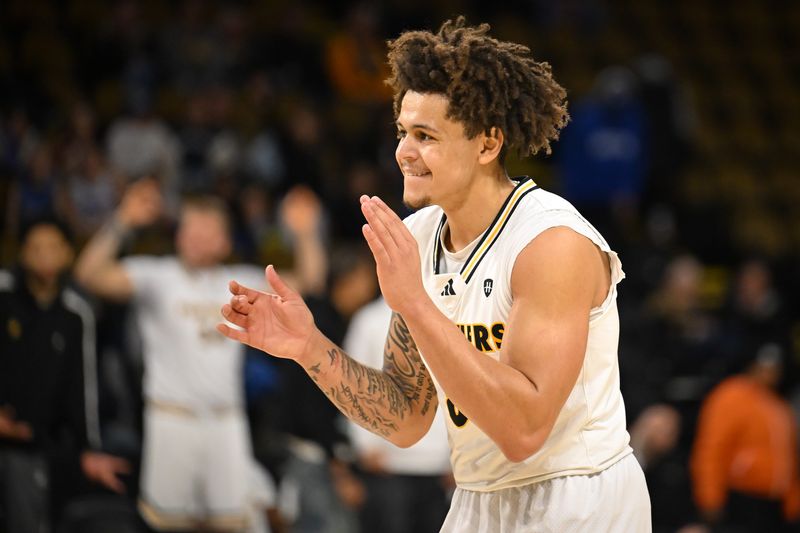
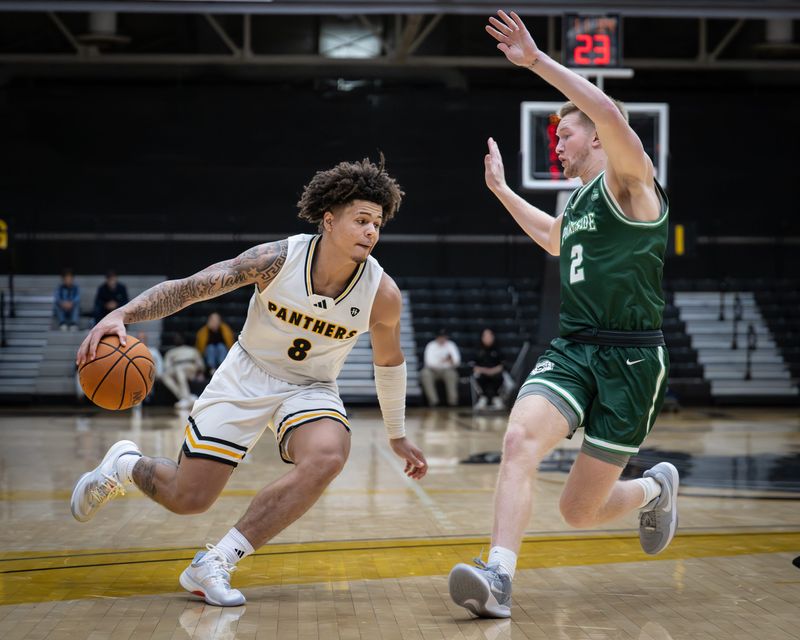
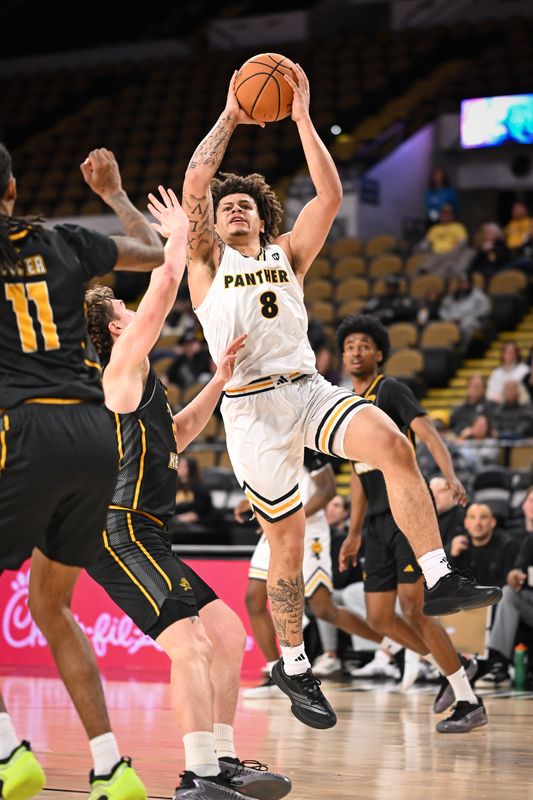
At 19, Stevie Elam is a talented freshman playing mid-major Division I college basketball with pro aspirations and, according to his coach, NBA potential.
But forget about the long-range forecast or his post-hoops plans in real estate for now. The first fact alone – playing at a DI university – puts Elam in the 99th percentile.

Not that the odds have ever fazed him.
An uphill climb has been his reality since he was 3. Elam has made that climb with just one kidney.
“It’s easy to overcome like smaller stuff now,” said the Milwaukee Panthers guard from Adrian, Michigan. “It’s just like a bump in the road, but you just get through it and just learn how to keep going.
“It made me stronger and tougher. Being able to get through this and just persevere, and I just kept that same mindset of working hard, working hard, and ultimately getting into my dream of playing Division I.”
Straight to the University of Michigan Hospital
As far as Grady and Amy Elam knew, Stevie was fine when Amy took him to his pediatrician on the afternoon of Aug. 31, 2010, for a regular checkup.
Sure, he’d been to the doctor a couple of times over the summer, but a little stomachache is hardly out of the ordinary for a 3-year-old boy who only knows full speed until he drops.
“The doctor kept feeling in the abdomen area and he said, ‘There’s something here,’” Amy Elam recalled. “‘… There’s something here and I’d like to order an ultrasound.’”
Grady took Stevie the next day and then dropped him off at preschool. Not long after, the doctor called Grady and asked him and Amy to come back together.
“Basically the doctor said, I think that this is what’s called Wilms tumor, and it’s a childhood kidney cancer, and it’s very treatable,” Amy said.
They prayed together.
“He said, I’ve already contacted U of M because I feel that’s where the two of you would want to go. And I think that you need to go and pack a bag for Stevie and you guys and head on up there. They’re expecting you.”
The University of Michigan Hospital in Ann Arbor is 40 miles up Highway 12 from Adrian. Within two hours of their first inkling of a serious problem, Stevie was admitted.
“Yeah, I don’t know what’s going on, really,” Elam said of his memories. “I just saw my parents and my sister [Sydnee] just stressed out, and they knew what was going on, but I really had no clue until I was at the hospital and it was just like a lot of needles and stuff, and I was like … OK, something’s off, probably.”
More than a 3-year-old could understand. Almost more than his parents could grasp.
Wilms tumor is the most common form of kidney cancer in children with about 600 cases per year diagnosed, most of them in children aged 3-4, according to the American Cancer Society. Four-year survival rate is around 90%.
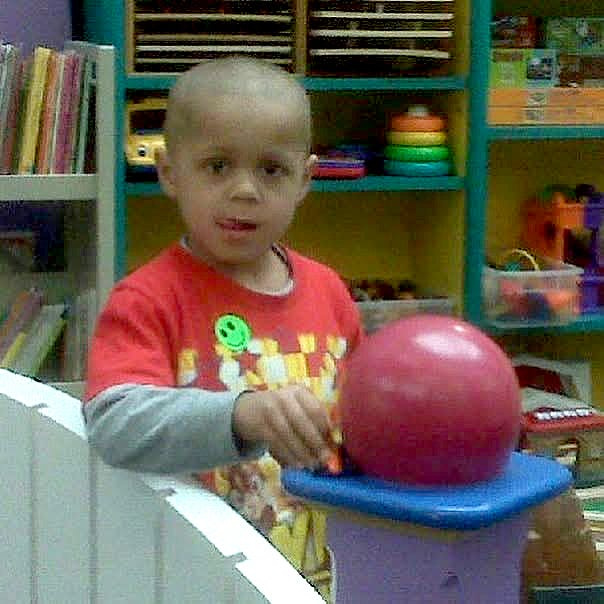
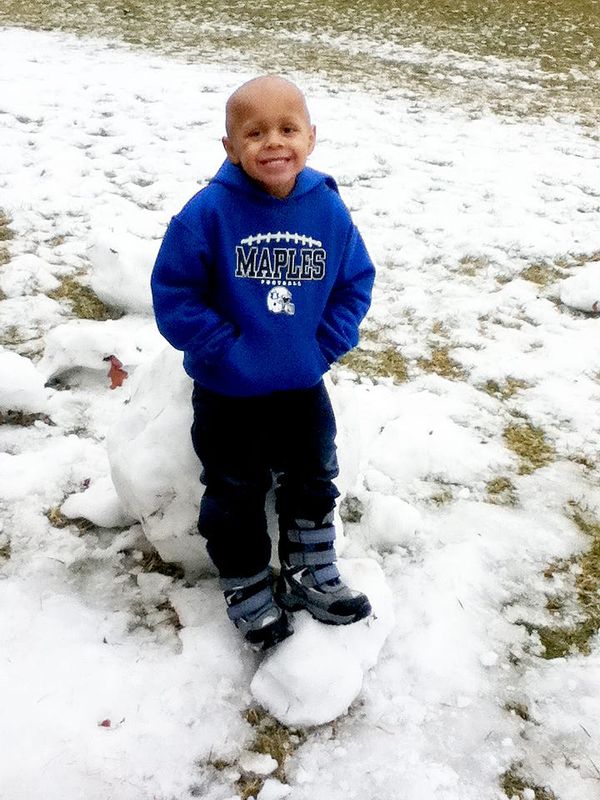
That said, Elam’s was diagnosed as Stage IV, and beyond the removed kidney, cancer cells had infiltrated some lymph nodes. That required radiation beginning about a week after his initial release from the hospital following surgery and then chemotherapy that ran through the next March.
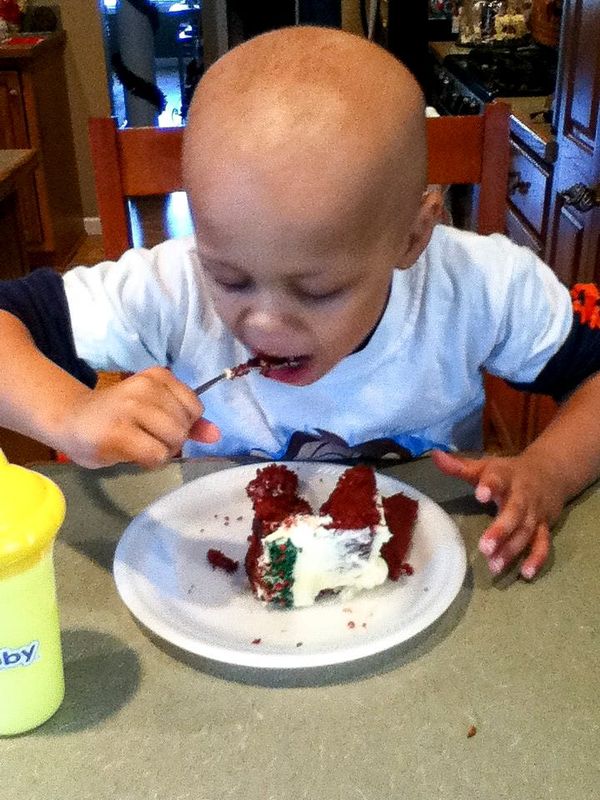
Three-year-old Stevie Elam trusted his caregivers
“The best that we could do was to explain to a 3-year-old that there’s something going on in your body and we need to take care of it and we’re going to take care of it and it’s going to be OK,” Amy Elam said.
“And Stevie, even when he was little, his personality is he very much goes with the flow. And he’s very trusting and he’s very loyal and he trusted his parents and his sister and he trusted his doctor and his nurse and they made it very fun at U of M for him.
“He had an IV that was attached to him, and so he would literally run down the hallways with – they called it his buddy – with that little IV attached to him on wheels and he would play in the hallways.”
Friends from Adrian and their old neighbors from Ypsilanti brought treats and coloring books. Elam’s pediatrician, Dr. Koye Adenuga, delivered a remote controlled car he drove in the hospital hallways.
“And Grady and I and his sister really tried hard not to show anxiety or worry while we were there,” Amy Elam said. “And if we needed to cry, we would go in the hallway and cry, or in the bathroom.”
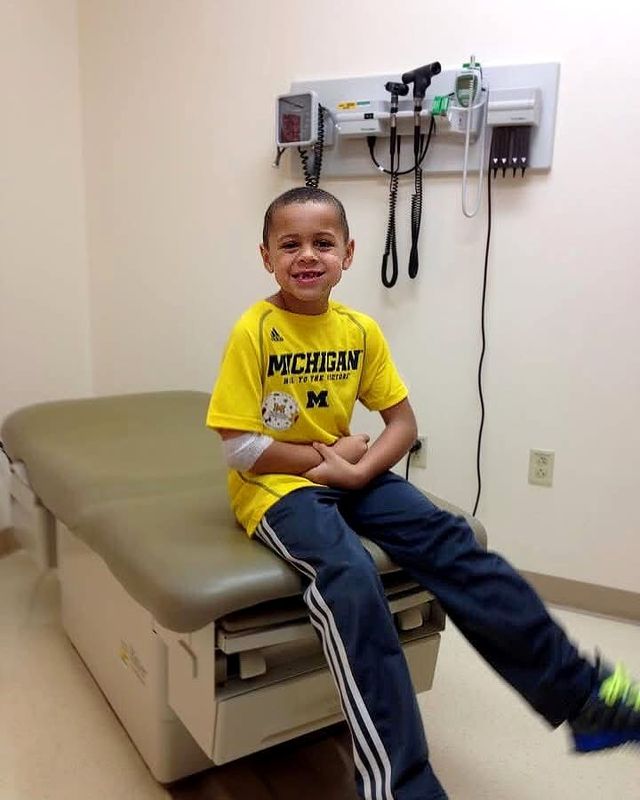
In addition to MRIs, CAT scans and ultrasounds, Elam underwent echocardiograms to check for long-term heart damage related to the chemotherapy and radiation, and he took part in a research study at the university.
Still, he was soon back in preschool.
“To this day, I still find out from the teachers there, I’ll run into them in the community or at the school I work at … they will tell me bits and pieces of, ‘Well, we always knew when Stevie needed extra sleep and when his chemotherapy appointments were, and we would just let him sleep,’” Amy Elam said.
“And there was one teacher there that was also going through chemotherapy and unbeknownst to us until later on, she would lay with Stevie and they would nap together. We just had really fantastic community support.”
About five years from diagnosis, Elam was declared cancer free.
Stevie Elam has always been an athlete
Elam figures he was probably dunking on his Little Tikes basketball hoop by the time before the cancer struck.
Grady Elam played football at Eastern Michigan and Amy was an NAIA All-American track athlete at Siena Heights. Stevie followed into both of their sports and also took up baseball and basketball.
Naturally Elam’s illness, surgery and the effects of his treatments were a concern.
Would he be able to participate? Could contact endanger his remaining kidney? How much might he be limited?
“The oncologist [Jim Connelly, then a pediatric resident] looked at us and said, ‘Do you think you’re going to be able to keep him down? I’ve seen him in the hallways,’” Amy Elam said. “And my husband and I looked at each other and were like, no, we don’t think that we’re going to be able to do that. And he goes, ‘Well, then don’t.’”
Elam just needed protection for his kidney, they’d have to monitor his health and he’d need to reconsider football as he got older and the game became more violent, which he did midway through high school.
“My parents were just like, you’re gonna have to drink more water, stay hydrated and eat better food, more vegetables and fruits,” Elam said. “And when I started going to the doctor for wellness visits, like every year, they were telling me the different things I have to do in order to keep on in sports.”
When Stevie Elam realized kidney cancer ‘was a pretty impactful part of my life’
For those who didn’t know or didn’t notice the flexible kidney pad he wore, Elam showed no signs of limitation.
And it didn’t affect him psychologically. Having been affected so young, this was the only reality he really knew.
“It’s like, just play through it,” Elam said. “That’s my mentality: Play through it.”
Baseball may have been Elam’s best sport. At the very least it helped Elam begin to understand his story was a little different from those of his teammates.
“We went to this tournament … Northville, Michigan,” Elam recalled. The Orange Crush Northville Early Bird Tournament, it was called, a fundraiser for kidney cancer research.
“Everyone put on orange shoelaces,” – the color associated with kidney cancer awareness – “and I just knew, like, OK, what I went through was a pretty impactful part of my life, and it was a big piece.”
The 8-year-old shortstop cleared the fence in his first at-bat and his 8-and-under Adrian Dirtbags went on to win the tournament.
Soon after, Elam began to gravitate toward basketball.
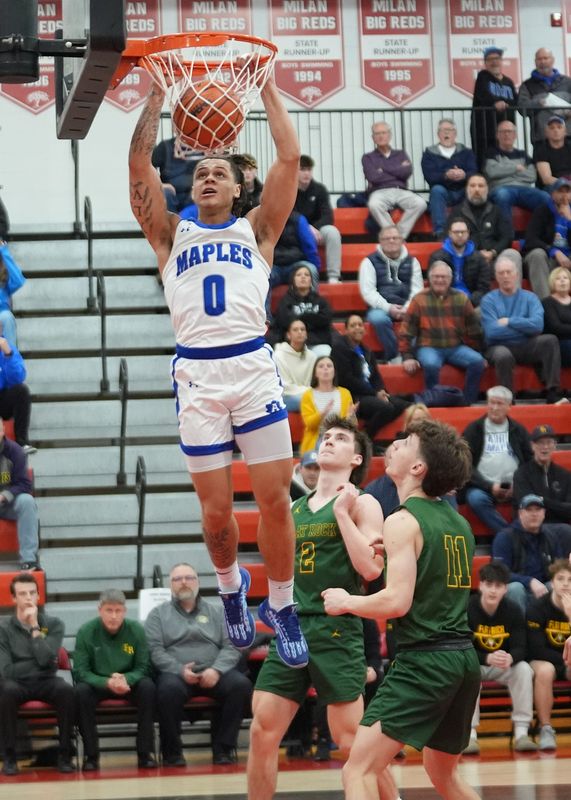
By the time he graduated from Adrian High School, he had broken the Lenawee County boys scoring record with 2,112 points, putting him inside Michigan’s all-time top 20 leading scorers.
Elam averaged 24.8 points, 10.0 rebounds, 4.0 assists and 2.5 steals per game as a senior, was picked as the player of the year in his conference and a first-team all-state selection.
Although doctors had been concerned Elam’s development and physical growth could be stunted, he made the honor roll in high school and entered UW-Milwaukee listed at 6-foot-3 and 200 pounds.
UWM ‘didn’t have much pause’ in recruiting a childhood cancer survivor
Elam didn’t talk much about his health during the recruiting process.
In fact he didn’t actually mention it to coach Bart Lundy. By the time his mother did, Lundy and his assistants were already well aware of Elam’s condition and the medical staff had checked into it. Lundy was happy to sign one of the most prized 2025 recruits from Michigan.
“There were some articles out there that discussed it, so part of what they liked about our staff is we already knew,” Lundy said. “We had talked to our trainers and our staff about what does this do?
“So we didn’t have much pause. We knew that he had support and a great family, and they had a handle on what the challenges were.
“As a coach, you’re responsible for all these young men, and it’s scary. I’ve seen a lot of things, but Stevie’s kidney, as long as we’re aware of the challenges, I think we’re capable of handling it.”
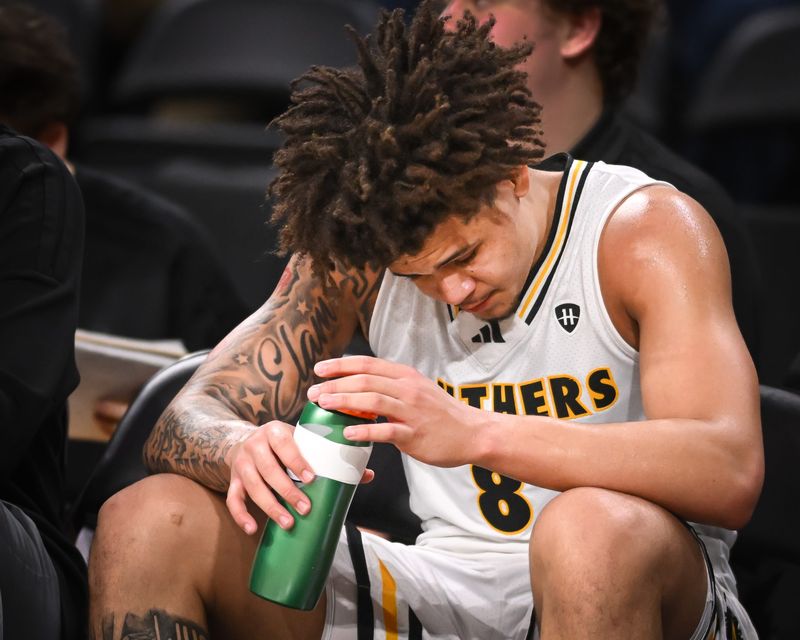
Elam had been handling life with one kidney for 15 years, and the biggest challenge always has been hydration. To keep his remaining kidney as clean and healthy as possible, he pushes water and electrolytes by the gallon.
A surprising development: ‘I can’t walk’
Elam couldn’t recall any problems due to his kidney through high school sports, and he’s never been on a minutes restriction in college because of it.
The elevated level of conditioning and more physical play did show Elam, though, what happens when he gets behind.
In the Panthers’ exhibition game against UW-Parkside, Elam dropped to the Klotsche Center floor with cramps.
“Like, dang, my legs, I can’t walk,” Elam said. “So I had to come off the court. I was like, yeah, I got to drink more water and hydrate better.”
Then he pulled himself out twice against Indiana State at the UWM Panther Arena when his knotted-up calves left him to only walk uncomfortably to the bench. He was 4 for 4 from 3-point range in the first half and had 13 points but went scoreless the rest of the way in a disappointing two-point loss.
Then a stress fracture in Elam’s right foot took him out of action for nearly four weeks. He wasn’t in peak game shape when he returned, but the time did allow him to focus more on his overall health.
That could serve him and the injury-ravaged Panthers (9-13, 5-6 Horizon League) well down the stretch.
“I think he was well on his way to being [conference] freshman of the year before the injury,” Lundy said. “I expect by the end of this that he’ll be one of our best players.”
Stevie Elam beginning to blossom on college court
Elam played a season-high 34 minutes in the Panthers’ Jan. 24 victory at Youngstown State and finished with 14 points, including the winning basket set up by his own steal.
In three games heading into a Jan. 30 matchup with Wright State at the UWM Panther Arena, Elam has averaged 32 minutes, 11.7 points and 5.2 rebounds, connected on 5 of 13 3-point attempts (.385) and gone 10 for 10 from the line.
While the grade on his first season of college basketball remains an incomplete, Elam’s work is showing.
“I think I’ve made a decent transition from high school to college,” he said. “The game is way faster. But once you adjust to it, it just slows down and you just become a little comfortable. It’s just basketball, so it’s really fun.
“I’ve got a lot of older guys around me, so they just teach me a lot of stuff. Coaches do a really good job of helping me, explain the game and slow it down for me exponentially.”
Lundy has nothing but praise for Elam, from his attitude to his aptitude, from the growth he has shown since arriving in Milwaukee to the potential he has after he leaves.
“He soaks everything up,” Lundy said. “He’s always been good offensively. He’s coming around defensively. He’s a great rebounder. Obviously, he’s beyond his years with his body. His trajectory is straight up. Straight up.
“I don’t think there’s a limit on how good he could be. He could play in the NBA someday. He’s just scratching the surface now in how good he can be.”
Stevie Elam eager to share a positive message
Elam also is just beginning to scratch the surface on how influential he can be.
Connections to his childhood remain.
Elam kept in contact with Rhonda McDougall, his favorite nurse on the pediatric oncology floor, and over the years they talked more about Michigan Wolverines football than cancer.
Adenuga, the pediatrician who found Elam’s tumor, is still his primary doctor, and they celebrate about how far he has come.
Elam became a small-town celebrity as a successful and popular high school athlete in a city of 20,000 does, and he learned to give back through coaching and teaching basketball.
But particularly since leaving home, Elam also has begun thinking more about what he can do on a grander scale. He has an inspirational story to share with frightened, young cancer patients and their parents. He can give his time to help raise money for research.
“He’s focused more on his journey with cancer and that he was able to achieve a lot of things through determination and hard work and that he is defying the odds,” Amy Elam said. “It’s very hard to become a DI athlete to begin with, but that he is here and he’s healthy and he surpassed his growth.
“He’s beat all of the odds. All of the odds.”
This article originally appeared on Milwaukee Journal Sentinel: Stevie Elam beat kidney cancer to reach DI college basketball in Milwaukee
Reporting by Dave Kallmann, Milwaukee Journal Sentinel / Milwaukee Journal Sentinel
USA TODAY Network via Reuters Connect