GREEN BAY – Recent history tells you that Green Bay Packers general manager Brian Gutekunst is going to kill it in the second round of the 2026 NFL Draft.
Or he’s going to blow it.

Since 2005, when newly hired general manager Ted Thompson conducted his first draft, the second round has been more boom than bust for the Packers, but, boy, have there been some whiffs, a couple of which could have been game-changers for the perennial playoff contenders.
This year, Gutekunst’s second-round pick likely will be his first selection because he dealt his 2026 and ’27 first-round picks to Dallas last year for star edge rusher Micah Parsons and doesn’t have much capital to move up 20 or more slots from his No. 52 overall.
If Parsons returns to form from a torn ACL suffered in Week 15, the exchange will have been more than worth it. Parsons was a difference maker in every way and, given more than 70% of Hall of Famers selected in the first round were top-10 selections, the Packers weren’t likely to nab a generational player with either of the two picks they dealt.
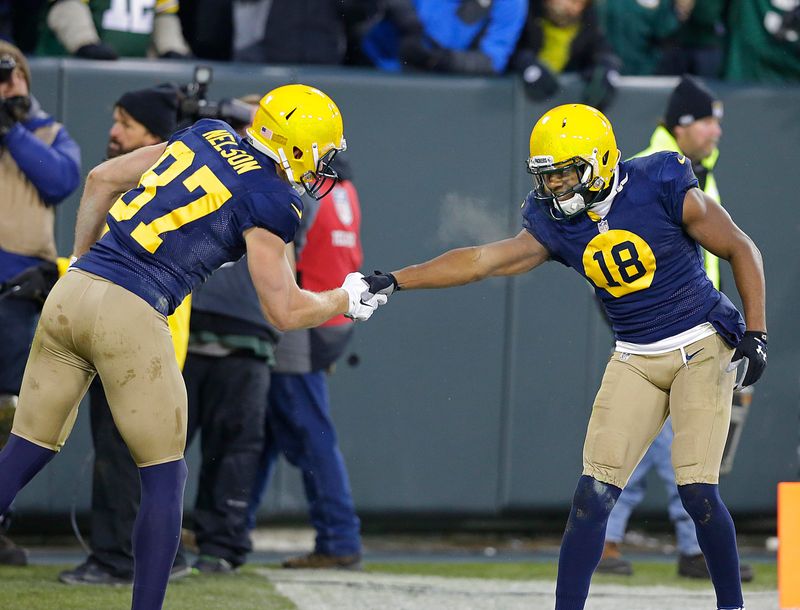
They have selected three Hall of Famers in the second round – Jim Taylor in 1958, Forrest Gregg in 1956 and LeRoy Butler in 1990 – but they will be doing just fine if they can connect the way they did with Nick Collins (2005), Greg Jennings (2006), Jordy Nelson (2008), Randall Cobb (2011), Casey Hayward (2012), Eddie Lacy (2013), Davante Adams (2014) and Elgton Jenkins (2019).
All but Jenkins were Thompson selections, and without the first three, the Packers don’t win Super Bowl XLV.
To say Thompson dominated the second round is a slight overstatement because he swung and missed in 2010, 2015 and 2016 and then made the worst mistake of his career by trading out of the first round (No. 29 overall) with Wisconsin’s T.J. Watt on the board and selecting cornerback Kevin King with the No. 33 pick he got from the Cleveland Browns.
For Gutekunst, there’s a lot to digest there.
He was a scout, then director of college scouting and then director of player personnel under Thompson before becoming general manager in 2018.
He was there when Thompson was drafting like a triple-crown winner in the second round. Thompson joked after selecting Adams that he guessed he had done pretty well picking impact players in the second, but he didn’t reveal any secret other than he liked receivers who didn’t drop passes.
“Athletically, they’re similar in some respects and different in others,” Thompson said of those receivers. “Again, if you get back to it, their ball skills are all remarkable, Jordy and Randall [and] Greg and those guys. And that’s the first and foremost thing we look for. If I was going to get stuck on one thing, it would be that.”
The three straight seasons of striking out in the second round (he did it twice in ’17 with King and then safety Josh Jones), were damaging to the Packers’ prospects. He took cornerback Quentin Rollins in ’15, tackle Jason Spriggs in ’16, and King and Jones in his final year as GM.
He might have also changed the club’s trajectory if instead of taking Lacy in ’13, he had selected Cincinnati tight end Travis Kelce, who went to Kansas City two picks later.
Thompson got away from his knack for picking good football players and took chances with Rollins and Spriggs, who were more athletes than football players. Rollins had played just one season of football at Miami (Ohio), playing basketball his first four years there, and Spriggs won with athleticism at Indiana but wasn’t sound with his technique.
Both bombed out.
Thompson gambled that King wasn’t injury-prone – he was – and that the big, strong and fast Jones could do all the things required of a safety in Dom Capers’ defense – he couldn’t. It’s not known why Thompson missed those flaws because he still applied good wisdom in taking nose tackle Kenny Clark in ’16 and Jamal Williams and Aaron Jones in ’17.
As much as Gutekunst learned from Thompson about evaluating talent and running a scouting department, he didn’t always know what Thompson was thinking when he made his decisions. Thompson kept his thoughts to himself on who interested him the most because he didn’t want anyone to know what the Packers might do in the draft.
“I don’t know if there was any one thing, something like, ‘OK, this is something we did differently than anybody else in the league,” Gutekunst said of the hot streak in the second round. “We always talk about Ted and the subterfuge, where he had all kinds of guys in the second round that he thought none of us knew that he loved. He did that all the time.
“But I do think that it was a little bit of a different time. Those guys had spent [time in college]; they were just really good college football players, really productive. They were able to produce early and well for us.”
Gutekunst didn’t get off to a very good start in the second round. After making a pair of trades that netted him cornerback Jaire Alexander and a future first-round pick in the ’18 draft, he selected Iowa cornerback Josh Jackson. He was right that Jackson was a good college football player, but he misjudged how badly his lack of speed would affect him in the NFL.
The following year, he hit it big with Jenkins and in 2020 he selected running back AJ Dillon. Hardly anyone who drafted in the latter part of the second round in ‘21 did well. He passed on Wisconsin linebacker Zach Baun and Ohio State lineman Jonah Jackson, but hardly anyone else in that part of the draft panned out.
It was in ’21 that Gutekunst made his biggest mistake, probably as big as Thompson passing up Watt. Instead of selecting Alabama center Creed Humphrey with the 62nd pick, he chose Ohio State center Josh Myers. Humphrey is a four-time Pro Bowl selection and two-time All-Pro and is considered by some to be the best center in the game.
Myers wasn’t re-signed after starting four straight seasons. The Packers were forced to move Jenkins to center after letting Myers go and, after Jenkins was let go, re-signed former college tackle Sean Rhyan to be what they hope is a long-term answer in the middle.
Gutekunst bounced back by trading up to the second pick in the second round to select receiver Christian Watson in ‘22. Though Watson has been dogged by injury, he has been dynamic when healthy and will go into the ’26 season as the team’s No. 1 receiver.
In ’23, Gutekunst selected tight end Luke Musgrave and receiver Jayden Reed in the second, and in ’24, he selected linebacker Edgerrin Cooper and safety Javon Bullard. Reed has shown more than Musgrave, but both need to have better years in ‘26, while Cooper and Bullard are mainstays on defense who should be in line for second contracts in two years.
Last year, he drafted tackle Anthony Belton, who took over the starting right guard position in the middle of last season and is expected to be there or somewhere else in the starting lineup when the ’26 season starts.
Entering the draft this year, Gutekunst and his staff have looked closely at a variety of players who might deserve to be taken at 52. Some don’t have much of a chance of making it to the Packers’ spot, but they should be able to choose a cornerback, edge rusher, defensive tackle or running back who can make a difference.
Gutekunst has experienced the good and bad of the second round. He’s currently on a nice run and keeping it going will be critical with no first-round pick to lean on.
“Certainly picking higher is always better as far as finding talent,” Gutekunst said. “But I’d rather pick 32 every year, you know? And I think when you look at it, you know there’s good players to be found throughout the draft. There’s great players to be found throughout the draft.”
This article originally appeared on Packers News: Packers drafting history in the second round? Not much middle ground
Reporting by Tom Silverstein, Milwaukee Journal Sentinel / Packers News
USA TODAY Network via Reuters Connect