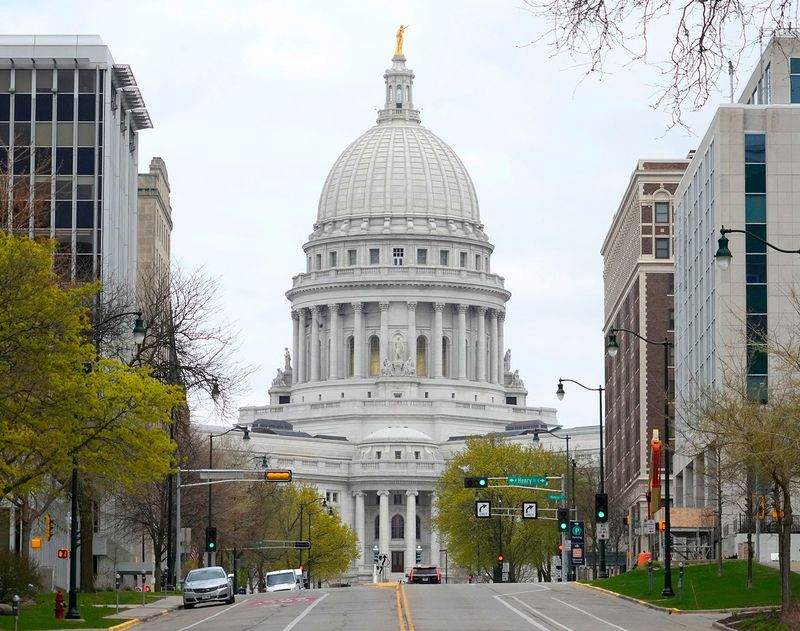
MADISON – Leaders in the state Capitol are implementing increased security measures after two Minnesota lawmakers were gunned down in their homes in recent days.
Assembly Speaker Robin Vos is requesting increased security for an upcoming floor session, and the Senate Sergeant at Arms’ office announced “enhanced security protocols” on June 16.

The new measures come after 11 Wisconsin lawmakers were named in a manifesto written by a gunman suspected of killing a Democratic Minnesota lawmaker and her husband and shooting another lawmaker and his wife.
“We have requested an increased security presence for session on Wednesday,” Vos’ spokesman Luke Wolff said in a statement.
Senate Sergeant at Arms Timothy La Sage said his office has coordinated with Capitol Police to implement additional safety measures “effective immediately,” including “increased situational awareness practices, strengthened access control points, and updated emergency response protocols” while maintaining the building’s “tradition of public accessibility and civic engagement.”
La Sage said specific details would not be shared publicly.
“The safety of those who serve, work, and visit the Capitol is my top priority,” La Sage said in a statement. “We remain vigilant and prepared. These enhancements are part of our ongoing commitment to security and public service.”
A spokeswoman for Democratic Gov. Tony Evers declined to comment on whether any new security measures were being implemented.
Wisconsin has one of the most accessible statehouses in the country, with a full-time police force based in the building but no metal detectors or requirements to show security badges to enter during work hours. The Capitol building is open to the public seven days a week.
Security inside the state Capitol building was last under scrutiny in 2023 when a Madison man visited the statehouse twice in one day demanding to see the governor, first carrying a handgun and later returning with an assault-style rifle.
Evers and Vos said at the time that the state’s Capitol should not be locked down, arguing such rules would restrict the public’s access to government. But then-Senate President Chris Kapenga, R-Delafield, said at the time that he would consider adding safety measures to the chamber he oversees.
Reached on June 16, Kapenga told the Milwaukee Journal Sentinel he looked at a few security systems after the 2023 incident and put together a proposal to implement a weapons detection system used by the University of Wisconsin.
“There was not enough support in my caucus to get that put in place, unfortunately, but I hope this opens their eyes to the real, unfortunate threat that’s out there,” Kapenga said. “We live in a different world.”
But beyond enhanced building security, Kapenga said, people need to examine their behavior online, where they can feel empowered to express things they wouldn’t to someone’s face.
“You’ve got these people who are a little off, they continue to read a hundred comments and their anger just builds and builds and builds,” he said. “The public has to start taking responsibility for the words they put on social media and stop the inflammatory stuff that goes way beyond what you would say to somebody’s face.”
“What we don’t want to have happen is … things like this keep happening, and we’ve got people who say, there is no way I’m stepping into public service, because there is too high of a risk,” Kapenga said.
In 2011, Capitol officials installed metal detectors at building entrances on a temporary basis during the massive protests over former Gov. Scott Walker’s collective bargaining measure known as Act 10. The detectors were removed after the protests had disappeared.
Senate and Assembly leaders have control over security rules in their respective chambers and assigned rooms. Evers has control over much of the rest of the Capitol building. However, a set of laws passed by Republicans in December 2018 limiting the powers of the then-incoming governor and attorney general includes a provision requiring the governor to get permission from lawmakers in order to change any Capitol security provisions.
In 2019, Evers vetoed a provision in the two-year state budget plan passed by Republicans that would have directed state officials and the Madison Police Department to assess security vulnerabilities at the state Capitol.
“While I strongly support ensuring the safety of visitors and employees who come to the State Capitol, I object to releasing information about potential security vulnerabilities in a public report as it would negate the very efforts of this study,” the governor said in his veto message.
The governor said he would be directing the Capitol Police Department to “review and update, if necessary, its existing plans for the security and safety of the State Capitol, including input from the Madison Police Department.”
It’s unclear whether that review took place.
An audit by the state’s nonpartisan Legislative Audit Bureau of the Capitol Police last year found that Wisconsin is one of 11 states that do not have metal detectors in their Capitol buildings and one of 19 that do not have X-ray machines to scan personal items and packages.
People visiting or working in the state Capitol are allowed to carry concealed firearms with a permit, except in the state Supreme Court chambers and Capitol Police office, where they are prohibited. Wisconsin is one of seven states that allow concealed carry in their Capitol buildings. Six states allow guns to be carried both openly and concealed, while one only allows for open carry. Thirty-six states ban guns in their Capitol buildings.
Capitol Police receive alerts from two alarm systems in the building: one for areas occupied by the Legislature and another for other areas and other state-owned buildings.
The audit does not report the response times of police to those alarms, citing safety protections. However, auditors found that Capitol Police responded 4.3% faster to legislative duress alarms than they did on average to all types of incidents in fiscal year 2022-23.
The LAB audit followed a separate audit in 2022 by the University of Wisconsin-Madison Police, which was requested after Capitol Police failed to respond to an active duress alarm in a state senator’s office.
Sen. Tammy Baldwin’s name was on assassin’s target list
Wisconsin Democratic U.S. Sen. Tammy Baldwin’s name was among those on the assassin’s reported target list, Baldwin’s office told the Milwaukee Journal Sentinel Monday morning.
A spokesman for Baldwin said the Madison Democrat “is grateful for law enforcement’s swift action to keep the community safe” and said she is focused on honoring the victims, praying for the attack’s survivors and “condemning this abhorrent, senseless political violence.”
When asked, however, if Baldwin planned to seek increased security either in Washington or in Wisconsin, Baldwin’s spokesman said only that the office does “not disclose details on the Senator’s security measures.”
Lawrence Andrea and Mary Spicuzza of the Milwaukee Journal Sentinel contributed to this report.
Molly Beck and Jessie Opoien can be reached at molly.beck@jrn.com and jessie.opoien@jrn.com.
(This story was updated to add new information.)
This article originally appeared on Milwaukee Journal Sentinel: Minnesota shootings, Wisconsin hit list prompt increased security in state Capitol
Reporting by Molly Beck and Jessie Opoien, Milwaukee Journal Sentinel / Milwaukee Journal Sentinel
USA TODAY Network via Reuters Connect