SUAMICO – Ten years have done nothing to dull Tom Prestby’s memory of a momentous piping plover event on Cat Island in Green Bay.
In fact it’s as clear as the image of the live bird that recently scurried across the sand 40 yards from him at the same site.

Let’s turn back the calendar to May 24, 2016.
Prestby, then a UW-Green Bay graduate student, was on Cat Island to gather data for his master’s thesis on habitat use by various bird species.
The restored island chain was proving to be a bird magnet, including for shore birds. In 2016 Prestby had even seen a piping plover, an endangered species, on one of Cat’s sand and cobble sections.
On that fateful day he was sitting in his vehicle watching a piping plover through binoculars and periodically taking photos with a digital camera and telephoto lens.
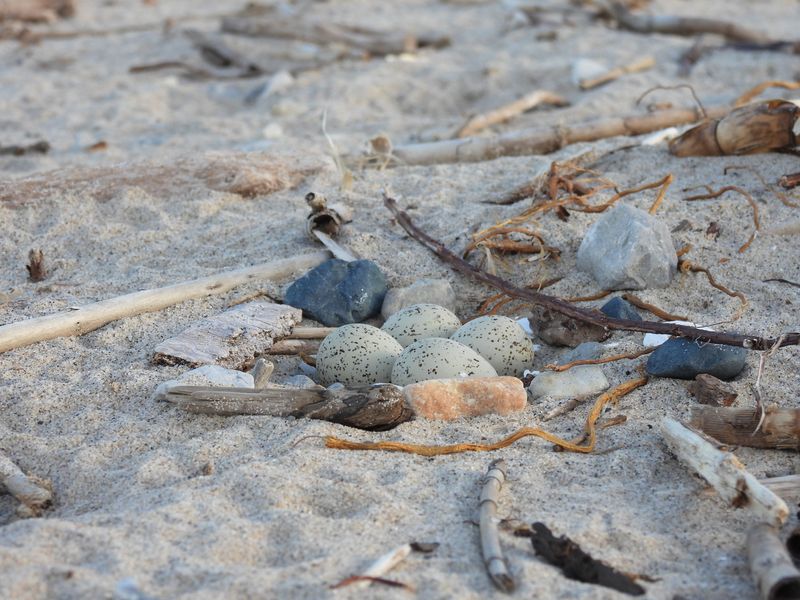
“She was acting strange,” Prestby said of the female plover, identified by colored bands on its legs. “And when I zoomed in on an image and looked at it on my camera’s display, I saw why. She was on an egg!”
Prestby immediately phoned his mentor and advisor, UWGB’s Dr. Bob Howe.
“Bob was as excited as I was,” Prestby said. “When he heard the news, Bob said ‘Oh my god Tom, this changes everything! This changes everything!'”
Piping plovers were native to Wisconsin but had declined through the 1900s and had not been documented to nest in Green Bay in more than 70 years.
The finding helped substantiate the value of the Cat Island restoration and reinvigorated efforts and resources to find and protect plover nesting sites in Green Bay.
A decade later, things have indeed changed for piping plovers in Wisconsin as well as the Great Lakes region. And it’s for the better.
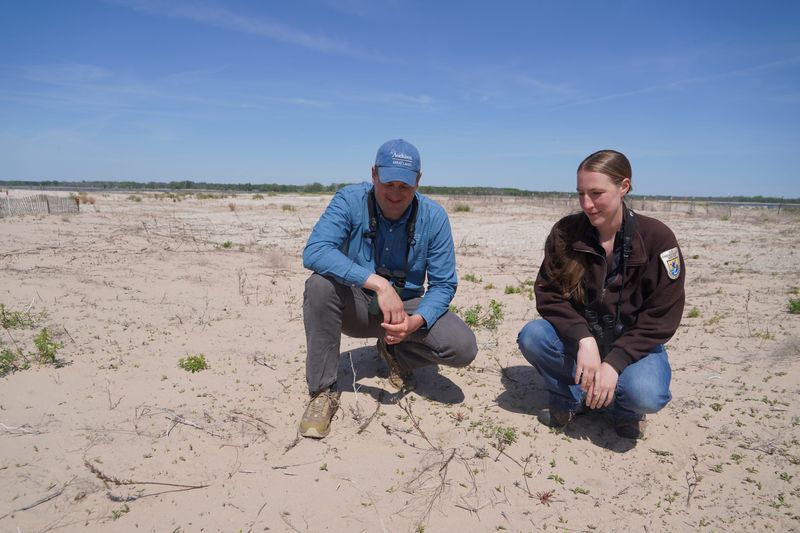
On May 22, 2026 I joined Prestby, now Wisconsin conservation manager for Audubon Great Lakes, and Jade Arneson, biologist with the U.S. Fish and Wildlife Service, along with Audubon’s Michelle Parker and Nicole Minadeo, to view the current piping plover situation on Cat.
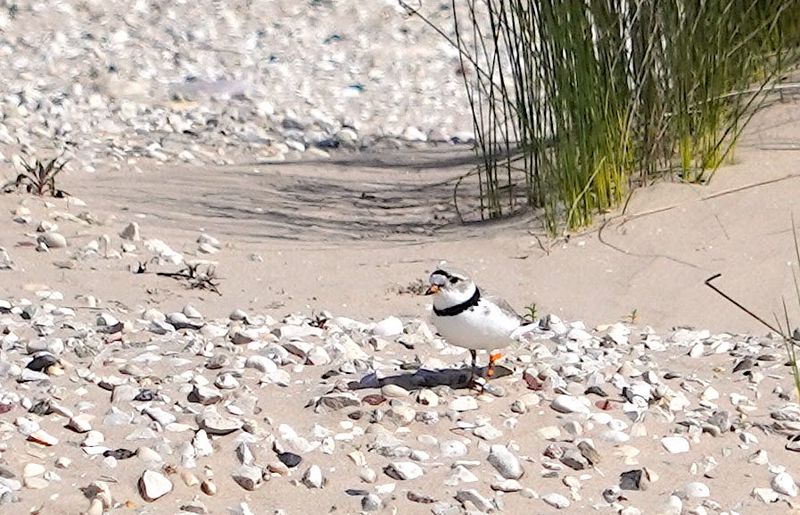
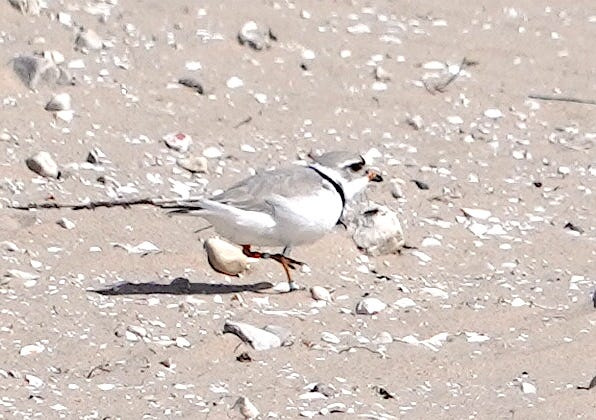
Piping plovers are small shore birds, about the size of an American robin, with plumage colored like sand. This bird of the beach is named for its melodic, plaintive whistle.
As with most shore bird species, its numbers suffered over the last century, mostly from loss of habitat but also rising water levels.
Bird experts estimate from 500 to 800 pairs of piping plovers historically nested in the Great Lakes but by 1990 had declined to about a dozen pairs, all in northern Michigan, according to the Great Lakes Piping Plover Conservation Team.
Since its 1986 listing under the federal Endangered Species Act, a team of agencies, organizations and individuals has worked together to bring piping plovers in our region back from the brink of extirpation.
The piping plover conservation partnership in Wisconsin has included the U.S. Fish and Wildlife Service, Audubon Great Lakes, Wisconsin Department of Natural Resources, U.S. Department of Agriculture – Wildlife Services, University of Minnesota, Port of Green Bay and Brown County.
Their work received a significant boost from a major habitat restoration in southern Green Bay.
The Cat Islands near Suamico eroded away in the mid-1970s due to severe storms and high water damage. A few wetlands remained, but much of the habitat for aquatic animals, shorebirds, and 13 different species of colonial nesting birds was lost, according to the U.S. Geological Survey.
The changes also left the remaining coastal wetlands in lower Green Bay unprotected from high-energy waves and storms.
In 1988, The Cat Island Chain Project was developed as part of the Lower Green Bay Remedial Action Plan. The first phase of Cat Island reconstruction began in 2012.
The total cost of the project is approximately $19 million, according to the U.S. Department of Interior.
Funding has mostly come from Environmental Protection Agency Great Lakes Restoration Initiative grants, but also from the U.S Fish and Wildlife Service, Wisconsin DOT Harbor Assistance Program and the Port of Green Bay.
The funds have contributed to the restoration of 272 acres of islands, 2.5 miles of shoreline and 1,225 acres of backwater habitat, according to the U.S. Geological Survey.
In short order, the newly-constructed islands became a magnet for shorebirds, Prestby said.
Since the 2016 sighting, piping plovers have nested at Cat annually and have fledged a total of 68 wild hatched chicks, according to Great Lakes Audubon.
As the local nesting population increased, the recovery team observed birds radiating out from the site to other suitable habitat, including nearby Long Tail Point.
Wisconsin also has a nesting population of piping plovers on the Apostle Islands in Lake Superior.
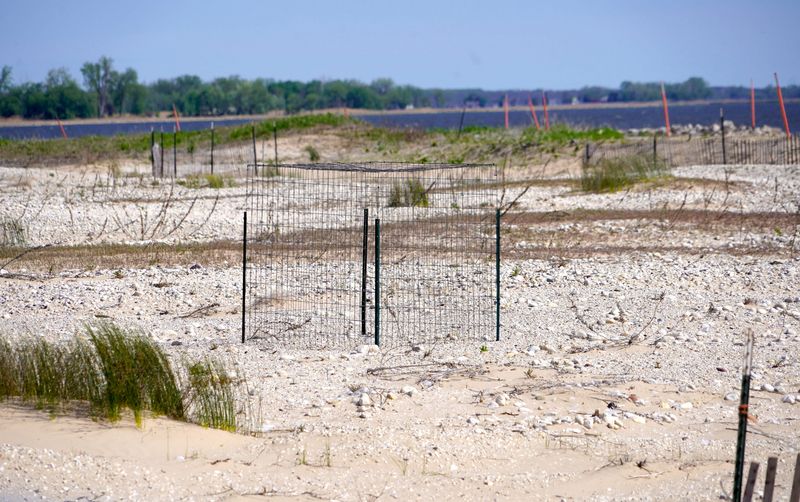
The piping plovers nest on sandy cobble areas peppered with quagga mussel shells. To help prevent predators from taking the eggs and increase the odds of successful hatching, the USFWS places wire cages over the nests. The openings are large enough to allow piping plovers to pass through but small enough to keep most predators, including raccoons, crows and gulls, out.
Cameras are also placed adjacent to the nests to record activity.
The cages have provided substantial help to the nesting plovers. But they are not perfect – Prestby recorded a common grackle eating piping plover eggs on a nest in lower Green Bay, the first time such an event had been documented.
But the overall picture is still positive. And the increasing plover population in Green Bay is part of a regional rise.
In 2025, there were 88 breeding pairs of piping plovers across the Great Lakes basin, a record high number of pairs in the modern era, according to the piping plover partnership.
Most of the pairs were in Michigan but in addition to the recent successes in Wisconsin the species has also been breeding in Illinois, New York, Pennsylvania, Ohio and Ontario.
Most of the Great Lakes population winters from North Carolina to Florida.
The species’ small size and its dependence on shorelines makes its recovery challenges fairly easy to understand.
There is no shortage of enthusiasm for the species, however.
“It’s amazing to think about how things have changed in 10 years,” Arneson said. “It used to be ‘will one come back?’ Now we anticipate several to return and expect to have nesting here each year.”
Arneson said the plovers have shown strong site fidelity, including one pair that has been returning to an area on Cat about the size of a football field each year to nest. Another pair is nesting in the vicinity this year.
And there are two unpaired males in the area, waiting for females to show up.
The sand was dredged from the Green Bay shipping channel and deposited to help form Cat Island. The USFWS added rock cobble, a preferred ingredient for plover habitat, Arneson said.
The plovers gather other items, including quagga mussel shells, to form their nest.
The area is spiked with sparse vegetation such as stalks of evening primrose. On the day of our visit, midges hatched and flitted over the sandy terrain.
As we watched, a female piping plover relieved her mate at the nest and the male quickly made its way out of the cage and began foraging on the insects.
The goal of the Great Lakes Piping Plover Recovery Team is to have a breeding population of at least 150 pairs for five consecutive years with at least 50 pairs occurring at breeding sites outside of the state of Michigan, the population’s stronghold.
While much work remains, Prestby said the population was trending in the right direction and research was helping to identify strategies to protect the nests of these charismatic shorebirds.
In 2025 Prestby and Arneson were part of a group that leveraged the plover project to honor Howe and Dr. Amy Wolf, both recently retired professors at UWGB’s Cofrin Center for Biodiversity. Piping plover chicks were named “Bob” and “Amy” and the former educators were enlisted to release the young birds after banding.
What will 2026 hold? As of May 29, 68 piping plover pairs and 69 nests were reported in the Great Lakes region, according to the Great Lakes Piping Plover Conservation Team. Three nests have been lost so far, one each from egg predation, the loss of the breeding female and a nest washout.
The Captive Rearing Center at the University of Michigan Biological Station is incubating three plover eggs from one clutch.
But there are still at least 17 potential pairs out there so plover advocates are hoping for another record year.
The first chicks are due to hatch in late May or early June.
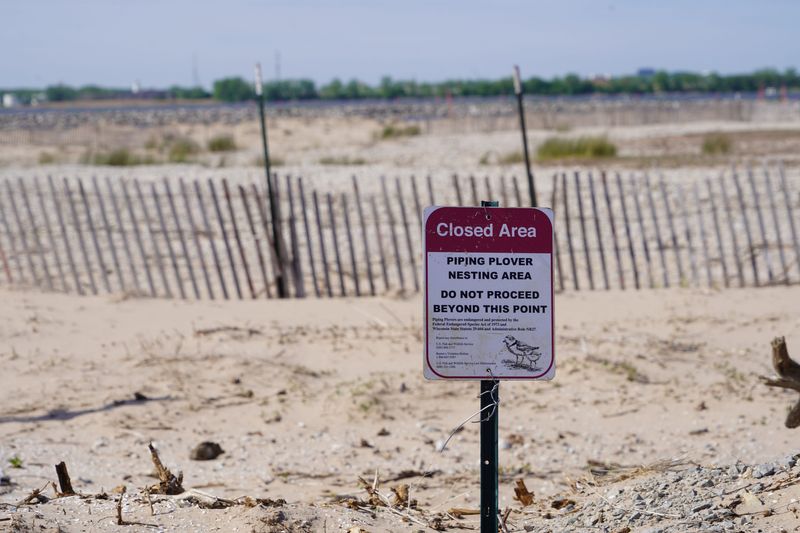
Educational efforts are also raising awareness among the public. A “Share the Shore” campaign reminds beachgoers to be on the lookout for piping plover nests and to avoid disturbing the birds.
It’s been an eventful ten years since Prestby saw the first piping plover egg in Green Bay in more than 70 years.
“We’re ready for more,” Prestby said. “Each year we continue to learn, too, so we’re hopeful for the future of this charismatic little bird.”
This article originally appeared on Milwaukee Journal Sentinel: Smith: Ten years in, piping plovers still loving Cat Island
Reporting by Paul A. Smith, Milwaukee Journal Sentinel / Milwaukee Journal Sentinel
USA TODAY Network via Reuters Connect
By Paul A. Smith, Milwaukee Journal Sentinel | USA TODAY Network