OCONOMOWOC – As the sun rose July 28 through the Silver Lake treeline, it was a spectacularly, uncommonly deep red.
Chris Terry of Wauwatosa and I knew the hue was accentuated by wildfire smoke in the atmosphere.

What we didn’t know, but had good reason to suspect, was the color would serve as an apt analogy for the morning’s fishing action.
Terry, 52, is a Wauwatosa resident who grew up fishing the lakes of Waukesha County, including as a guide, and has an encyclopedic knowledge of waters in southeastern Wisconsin.
We have fished often over the years, including spring walleye runs and during the Aug. 2017 solar eclipse.
For this summer outing we decided to target largemouth bass, a common species that is typically very active and provides good catches this time of year.
When we met at 4:45 a.m. July 28 at the Nashotah park-and-ride to discuss where to fish, Terry laid out a handful of options, ranging from most action to highest chance of catching a lunker.
I selected one toward the middle, hoping we could catch a bunch but also have a shot at a couple of big ones.
That description fit Silver, a 222-acre lake near Oconomowoc in Waukesha County.
We were one day removed from the severe weather that hit much of Wisconsin, including the tornado in the Fox Valley. The morning dawned cool, with a light north wind and a nearly full moon hanging in the southwestern sky.
Even through it technically qualified as a cold front, conditions that can give fish lockjaw, Terry was confident we’d find cooperative bass.
“So many lakes to fish within 25 miles of Milwaukee, and so many good largemouth lakes among them,” Terry said. “But remember, if things don’t work out, this was your pick.”
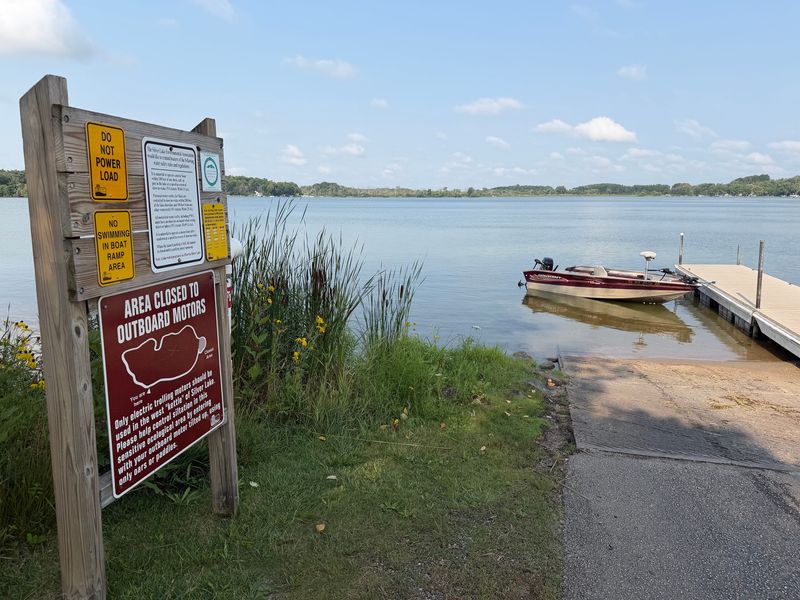
Terry grinned as he turned the key on his outboard and we pulled away from Silver’s public launch.
Our first destination was a point extending into about 10 feet of water on the lake’s southern shore.
Largemouth bass are native to Wisconsin and found in all three drainage basins (Lake Michigan, the Mississippi River and Lake Superior) and in a majority of the state’s inland waters, according to the Wisconsin Department of Natural Resources.
As the decades have passed, largemouth have fared quite well in Wisconsin and most other states. Bass have benefited from a catch-and-release ethic started in earnest about 50 years ago as well as a trend toward warmer, nutrient-filled waters.
The largemouth is classified as a warm water species and thrives in shallow, weed-filled lakes, ponds and slow rivers. The fish spawn in Wisconsin in late spring and early summer, with eggs typically laid when water temperatures are 62 to 65 degrees Fahrenheit, according to the DNR.
Part of their success is also due to their spawning strategy. Like other fish in the centrarchid (or sunfish) family, the largemouth is a nest guarder. The male largemouth selects a spot and builds a nest. After the female deposits the eggs and the male fertilizes them, he sticks around to defend the site and the hatchlings.
Add it all up, and it’s no surprise largemouth are doing well in Wisconsin and expanding their numbers in many northern lakes.
They’ve been in southeastern Wisconsin lakes for as long as people have fished here.
And Terry has had more than four decades of serious attention to where, when and how to find them.
These days, he spends a good chunk of the year in Minneapolis as an associate professor of media ethics and law at the University of Minnesota.
But when he rejoins his family in Wauwatosa, he takes every opportunity to hit the water with his kids and friends.
As he and I agree, life is always better when fishing is a part of it.
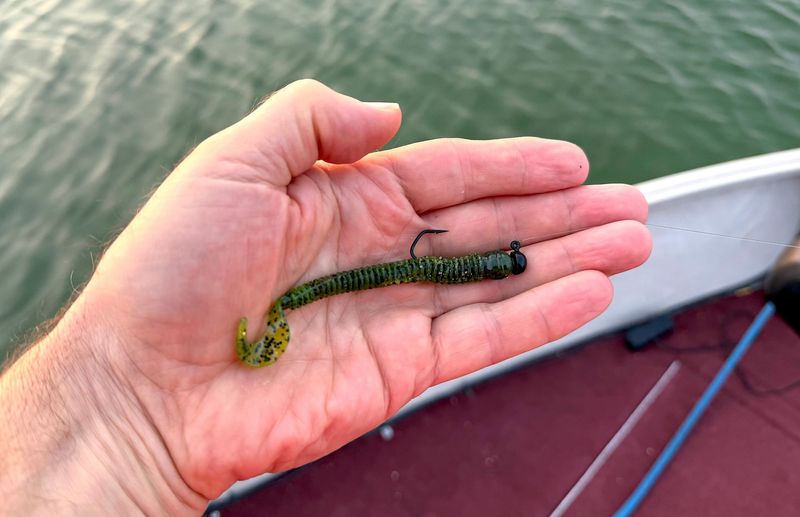
As the sun was rising, we made our first casts. We used open-faced spinning outfits and graphite rods to fish 4-inch soft plastic tails called ringworms on 3/32-ounce jig heads.
Terry said he’d had the best success recently casting the lure out, letting it fall to the bottom or on submerged vegetation and then hopping it.
Hits often came as the jig flicked free from vegetation.
Our first fish came after five minutes when a 14-inch-long northern pike decided my lure was too good to let pass.
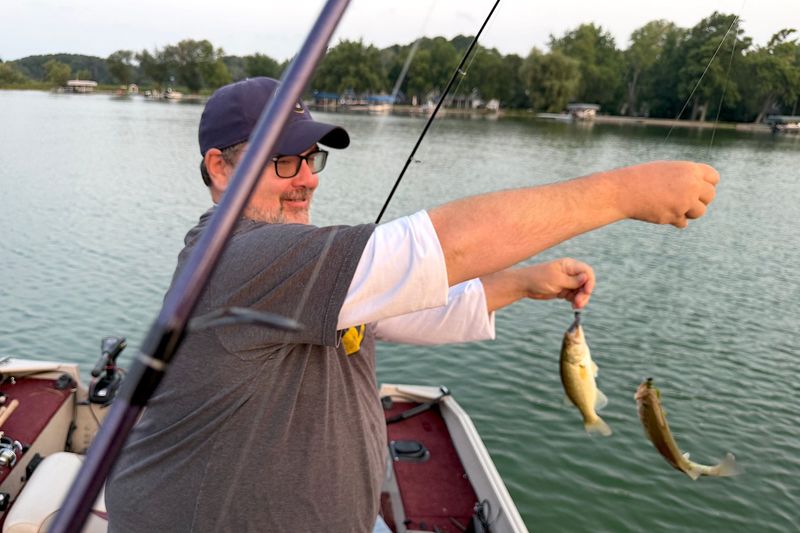
Two casts later, though, Terry had a hit and one of the day’s target species cartwheeled out of the water. He reeled in and released the 13-inch largemouth.
We caught three more bass of about the same size, then moved to the northwestern portion of the lake.
Only one other boat launched and, other than a kayaker working the south shore, we had the lake to ourselves.
Terry positioned the boat over a broad flat, with sporadic submergent vegetation and water from 5 to 8 feet deep, and let the wind drift us south.
We made long casts, let the lure drift toward bottom and slowly twitched it.
As the sun rose higher, the action got hotter.
On the first drift we caught and released 15 bass, ranging from 10 to 14 inches. On two occasions we had fish on simultaneously, or “doubled.”
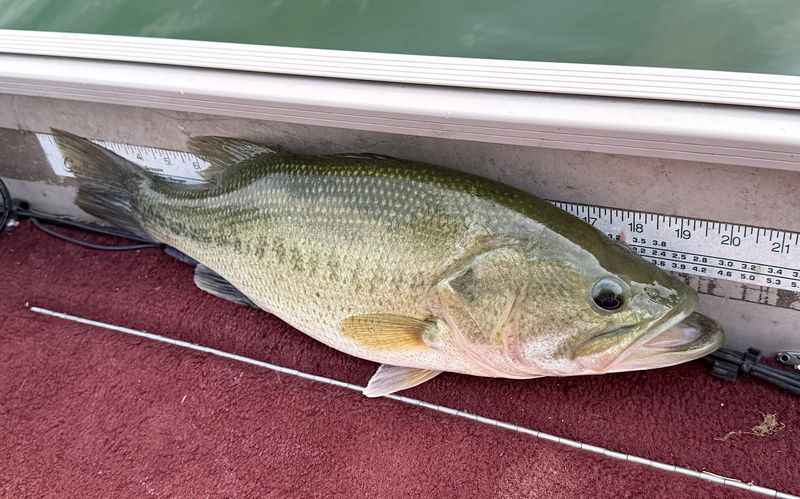
We caught 20 on the second drift, including two more doubles and a hit at 7:45 that put a deep bow in Terry’s rod.
“I think we’re gonna want to net this one,” Terry said.
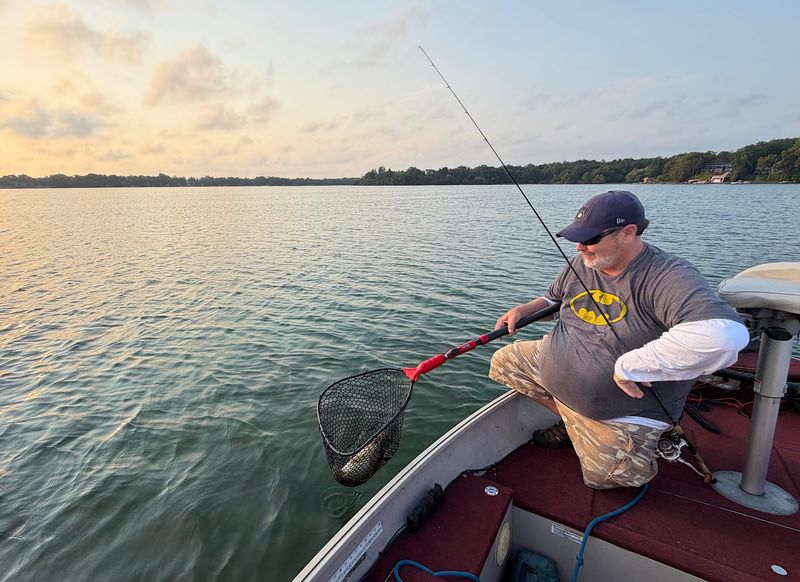
The fish dove deep and got tangled in some vegetation, but eventually Terry worked it boatside and I netted it.
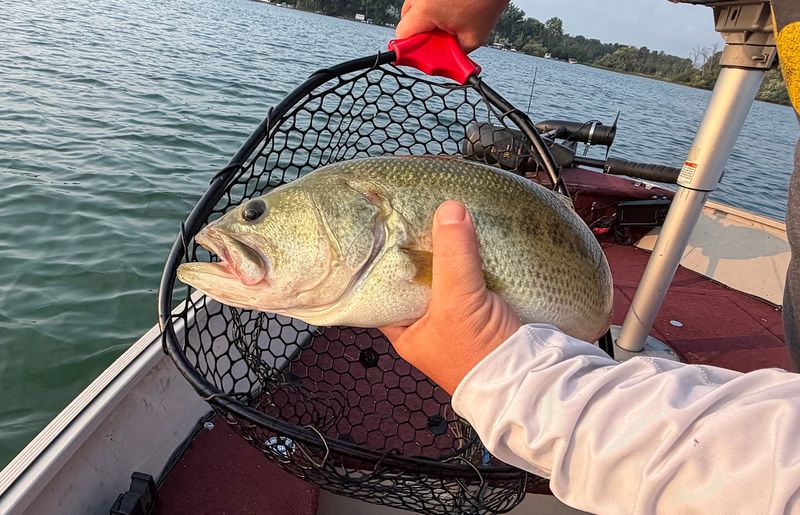
The largemouth stretched the tape to 20 inches and, with its thick build, likely weighed 4 pounds. Like all the fish we caught, it was released.
In a world in which people can fish in $150,000 boats loaded with modern technology such as forward facing sonar, we were having fun and catching fish by keeping it simple.
“We drifting in a glorified row boat and doing just fine,” Terry said.
The wind stayed light, about 8 miles per hour and N or NNE, perfect for moving our boat at a moderate pace across the expansive flat.
Our third drift we caught 15 more bass and again Terry landed a bruiser in the 20-inch class.
We each got bit off once, likely by northern pike, and had several bluegills follow our baits to the boat.
But after the small northern pike to start the day, the following four hours on Silver yielded all largemouths.
If there’s a better species for fishing and catching in southeastern Wisconsin lakes, I haven’t met it. To top it off, our local largemouth fisheries are sustained by natural reproduction and require no stocking.
Silver was a treat to fish but it’s among a long list with good largemouth populations in the region.
“Have any fun?” Terry asked as we ended the last drift. The question needed no reply.
We returned to the public launch at 9:30 to meet other obligations of the day.
It’s good to have options. And even better to have a fishing partner who knows how to make your choice pay off.
This article originally appeared on Milwaukee Journal Sentinel: Smith: Even small, local lakes provide big fishing enjoyment
Reporting by Paul A. Smith, Milwaukee Journal Sentinel / Milwaukee Journal Sentinel
USA TODAY Network via Reuters Connect
By Paul A. Smith, Milwaukee Journal Sentinel | USA TODAY Network