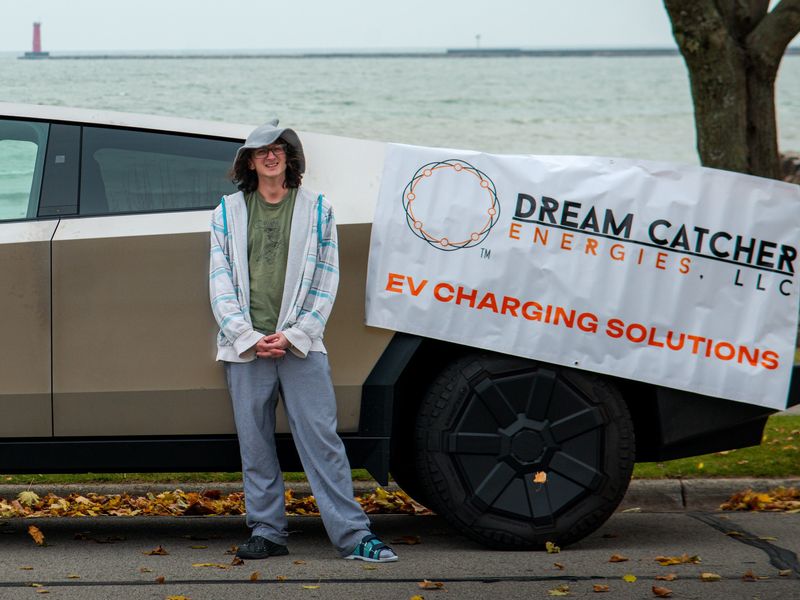
Jared Soto of Sheboygan is serious about getting his business, Dream Catcher Energies (www.dreamcatcherenergies.com), off to a good start. So serious, in fact, that he saved money by living in his car.

“Because of my dislike of fossil fuels, I was the person who told myself I would never drive,” Soto said. “I didn’t get a license until age 18 and only got it then so I could live in my van. Then I lived in a Prius. I was working the whole time and that allowed me to save a lot of money.”
That money would eventually go to his startup. It is a business that he says solves the problem of having too few charging stations for electric vehicles. From personal experience, Soto said that when he was finally able to afford an electric vehicle, he couldn’t get one because he lived in an area where there was only street parking and no place to charge electric vehicles.
He pondered the issue while working and began to think he had a solution.
“I was working third shift at a factory and my mind was wandering and I was thinking, ‘Why isn’t anyone doing something about this?’ It hit me that maybe I could do this,” Soto said. “I started to research what it would take to start a business and develop a business model.”
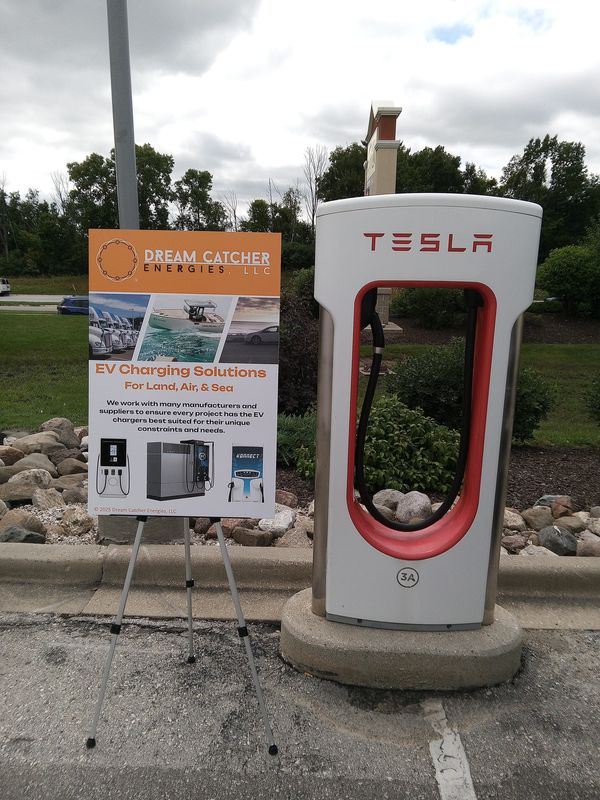
Soto’s idea was to map out hubs of where electric chargers would be most effectively located. In his research, he found that most chargers currently available are for Tesla vehicles. Wisconsin, he determined, was lacking in creating the necessary infrastructure for other brands of electric vehicles.
His first thought was to build a factory and produce chargers, but the estimated cost was prohibitive. Instead, he developed a business model that used chargers produced by other companies and included individualized consultation and planning.
He said, “I started off with this big master plan vision, but I realized it was too ambitious. At that point, I researched chargers and watched videos. I did the research that businesses don’t have time to do. I am now able to provide expertise in this field so other businesses are able to get the right chargers for the right project. Chargers are not one size fits all.”
Soto shares that message as he makes cold calls and markets the business. Every project is customizable and the options are many. When a business hosts the chargers, they can simply be the host, or if preferred, credit cards readers can be installed and the chargers can generate revenue. He said he can take care of as little or as much as the customer wishes.
His target customers include businesses, municipalities, governments, trucking fleets, office and apartment complexes, malls, and entertainment venues. Ideally, chargers are placed in a location that has something for the vehicle owner to do while waiting for a charge.
The business is gaining traction through marketing efforts and networking. He recently participated in the New North Business Pitch Contest and finished in second place, but funding continues to be a challenge.
He said, “I am self-financing to keep afloat. There are website fees, annual government fees, and many other expenses. I don’t keep an inventory in order to keep costs low. When a customer wants a charger, I’ll put together a project and the charger will ship directly from the manufacturer.”
Funding assistance from grants would be helpful, but Soto said Wisconsin is one of the few states that doesn’t offer grants for chargers. There is, however, some national assistance available, administered through the Wisconsin Department of Transportation, and he plans to pursue that.
Without those grants, businesses are hesitant to commit to adding chargers.
He said, “Often, a company won’t do something like this until they are required to. If a company can get away with doing less, they will do it even though sustainability and ecofriendly choices are more popular now.”
But he encourages businesses to add chargers out of a “passion for the environment.” It is that passion that has impacted his life since he was young.
“I remember being in grade school and the teachers would tell us about the environment and why it matters,” Soto said. “At first, it might have been about the threats to the rain forests. As I got older, I started to learn about climate change and how good people are at messing up the earth.”
Those thoughts have kept him on a quest to make a difference. After graduating from high school in Waupaca and working to save money, starting Dream Catcher Energies has been his full-time job for the past 18 months. Although he initially planned to be an engineer, he thought he would be in a better position to start the business if he saved money.
Yet, Soto said he always excelled in math and science and that has helped to understand the complexities of business and how to build a unique model.
“I started the business by making an efficient map of the best places to have clusters of DC Fast Charging in Wisconsin and the surrounding areas,” he said. “I mapped out where the optimal amount of charging hubs should be, the range and usage, and places that would have the maximal impact. When I met with the Department of Transportation and compared our maps, they were pretty much the same.”
Tina Dettman-Bielefeldt is co-owner of DB Commercial Real Estate in Green Bay and past district director for SCORE, Wisconsin.
This article originally appeared on Green Bay Press-Gazette: Sheboygan entrepreneur maps EV charging hubs across Wisconsin
Reporting by Tina Dettman-Bielefeldt, For Green Bay Press-Gazette / Green Bay Press-Gazette
USA TODAY Network via Reuters Connect
By Tina Dettman-Bielefeldt, For Green Bay Press-Gazette | USA TODAY Network