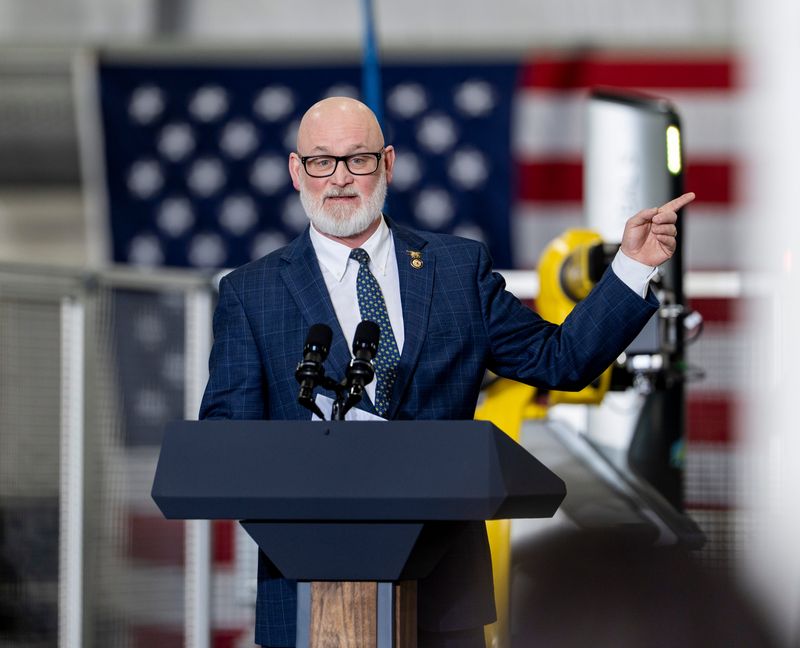
MADISON – U.S. Rep. Derrick Van Orden is denying that he voted for cuts to health care when he backed President Donald Trump’s “One Big Beautiful Bill” last year, legislation that will affect access to Medicare and Medicaid for thousands of Wisconsinites.
In an interview with WXOW of La Crosse, Van Orden responded to protesters outside his May 7 town hall in Sparta who said they were disappointed by his vote for the bill last year, which includes cuts to Medicaid and Medicare.

In the interview, Van Orden said that while protesters had the right to be there, he just wished “they knew what they were talking about.”
“There has been no cuts to Medicare and Medicaid. There’s not going to be cuts to Medicare and Medicaid,” Van Orden said. “What’s going to end, though, is the rampant waste, fraud and abuse present.”
All of Wisconsin’s Republican delegation in Congress supported Trump’s bill. The bill included tax cuts, increased spending on immigration enforcement and the military, and a nearly $1 trillion cut to Medicaid, according to USA TODAY. The cuts are expected to go into effect by 2027.
The Congressional Budget Office estimates more than $900 billion in Medicaid spending cuts under the bill over a decade. Republicans argue measures such as work requirements for able-bodied recipients are in place to ensure Medicaid isn’t cut for those who need it. The CBO estimates more than $500 billion in Medicare yearly automatic cuts over a decade.
The bill requires able-bodied adults to work 80 hours per month to qualify for Medicaid benefits. It freezes the provider tax in states like Wisconsin that have not expanded Medicaid, and it gradually lowers the provider tax rates in expansion states from 6% to 3.5%.
Medicaid, the primary health program for low-income people, is jointly financed by states and the federal government and is known as BadgerCare in Wisconsin.
Last year, shortly after the bill was signed into law on July 4, Wisconsin lawmakers rushed to sign a state budget into effect to avoid the freeze on the provider tax. The budget included a provision that expanded the state’s tax on hospitals from 1.8% to 6%.
Van Orden said after the signing of the state budget that he was responsible for the state’s Medicaid provision, but Gov. Tony Evers’ office denied that the congressman had anything to do with what was signed into law.
According to data from the Joint Economic Committee Minority, about 276,000 Wisconsinites will be impacted by the changes the One Big Beautiful Bill brought about. In the U.S., the committee estimates that about 17 million people will be impacted.
The Wisconsin Department of Health Services estimated in 2025 that an estimated 63,000 people would be at risk of losing coverage.
After passage of the bill last year, Van Orden said Americans would see “integrity and stability restored in critical programs like SNAP and Medicaid.”
In a statement regarding his comments, Van Orden’s spokesperson, Grace Kim said the cuts for those who are able-bodied aren’t extreme, but instead are common sense.
“Democrats are hysterically claiming Republicans are ‘cutting Medicare and Medicaid’ because we believe able-bodied adults should work, train or volunteer 20 hours a week to receive benefits,” she said. “Hardworking Americans fund these programs, and they deserve a system that protects the truly vulnerable while expecting everyone else to contribute something in return.”
Van Orden is running for election in Wisconsin’s most competitive district, in the state’s western counties. He is facing a challenge from Democrats Rebecca Cooke and Emily Berge, who will face off in a primary on Aug. 11. The winner of that race will face Van Orden in the Nov. 3 general election.
Cooke came within 2.8 points of Van Orden in 2024, and Democrats are targeting the district as they seek to flip control of the House of Representatives. This year, the district will be one of most closely watched, with money flowing into both the Van Orden and Cooke campaigns.
In a statement, Cooke slammed Van Orden for his vote on the bill, singling out health care as a major issue in their race.
“The fact is hospitals in West Central Wisconsin have been closing and premiums are exploding, making families drive longer for ever more expensive health care,” she said in a statement. “We need a Representative focused on fixing our problems, not pointing fingers and playing the blame game.”
Wisconsin Democrats criticized Van Orden for saying constituents don’t know what they’re talking about.
“Derrick Van Orden is a liar and treats his constituents like they are fools because he is too afraid to stand by his vote that takes away health care from children, veterans, and the elderly,” said Rachel La Due, a spokeswoman for the Democratic Party of Wisconsin. “He should man-up and take responsibility for his actions instead of lying like a coward.”
The Wisconsin GOP did not respond to a request for comment on Van Orden’s remarks.
Laura Schulte can be reached at leschulte@jrn.com and on X @SchulteLaura.
(This story was updated to add new information.)
This article originally appeared on Milwaukee Journal Sentinel: Responding to protest, Van Orden denies spending bill cut Medicaid
Reporting by Laura Schulte, Milwaukee Journal Sentinel / Milwaukee Journal Sentinel
USA TODAY Network via Reuters Connect