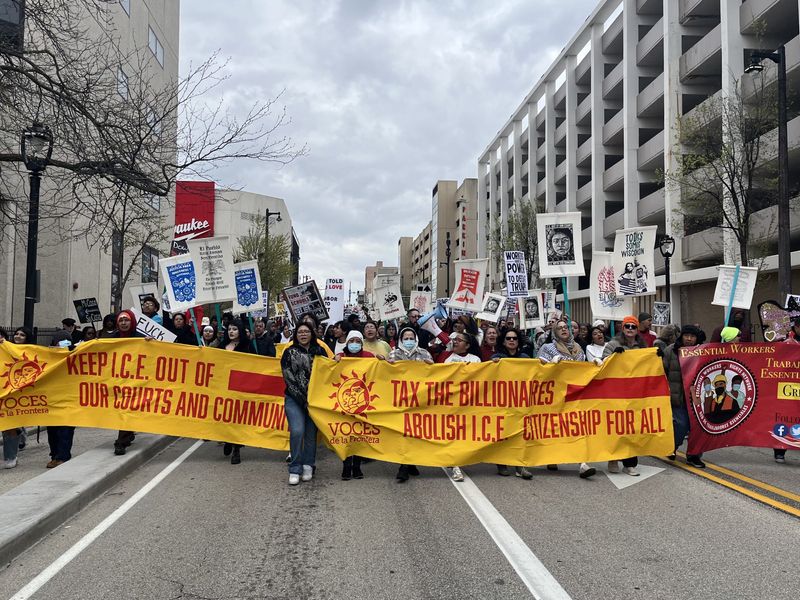
Some skipped school. Others called out of work. They were all among the hundreds of people who marched downtown for the 20th anniversary of Wisconsin’s “Day Without Immigrants.”
Voces de la Frontera, an immigrant rights group based in Milwaukee, hosts the annual protest on May 1 in conjunction with dozens of cities nationwide each year.

May 1, also known as May Day or International Workers’ Day, commemorates the labor movement and efforts to improve conditions for the working class. The tradition began in Chicago in 1886 when workers demanded an eight-hour workday in a strike known as the Haymarket Square Riot or massacre.
In response to the Trump administration’s immigration crackdown in Minneapolis and Chicago, Voces organizers called on people to skip work and school and stop shopping for the day to show the essential role immigrants play in the economy.
Christine Neumann-Ortiz, executive director of Voces, called for state lawmakers to approve driver’s licenses for immigrants and pass a package of bills called Families Together. The bills, she said, would ensure U.S. Immigration and Customs Enforcement agents cannot wear masks and protect hospitals and courtrooms from immigration enforcement actions.
“Immigrants are not the problem,” Neumann-Ortiz said. “They are the solution. The problem is the billionaire class.”
Here’s what other protesters had to say about why they took to the streets:
John Breunissen marched to support immigrants, better pay
John Breunissen, 68-year-old Milwaukee County resident, attended the May Day march for the first time this year due to growing frustration with stagnant wages and what he called the country’s “war on immigrants.”
Breunissen is retired, but he said he’s worried for the people who work minimum wage jobs. Wisconsin’s minimum wage is $7.25. It hasn’t increased since 2009. His hand gripped a double-sided sign that read, “Power to the workers, not for the billionaires.”
Breunissen says the rise in immigration enforcement distracts from the reality that people are struggling to afford to live.
“I don’t see the war on immigrants as being appropriate for our country,” he said. “We have to support each other.”
Ren Bugembe-Kuwahara came to oppose war in Iran, ICE
Ren Bugembe-Kuwahara, 37, wants taxpayers’ money to stop funding wars in the Middle East.
“That doesn’t benefit the average person in the U.S.,” he said.
Meanwhile, he said, things are getting more expensive, and Wisconsin’s minimum wage remains unchanged. Bugembe-Kuwahara, who works in landscaping, said he’d support raising the minimum wage to at least $20 per hour.
Bugembe-Kuwahara, who said he often works alongside immigrants, said he sees the fight for better working conditions and immigrant rights as one. He is from Honolulu, Hawaii, but his grandparents immigrated to that state from Okinawa, Japan. He says many Americans likely have ancestors that are immigrants, too.
“We’re all immigrants,” Bugembe-Kuwahara said.
Vanessa Rosales-Hernandez came to support her community
Vanessa Rosales‑Hernandez, 18, said she skipped class at her Milwaukee private school to support immigrants.
Rosales‑Hernandez’s parents immigrated to Milwaukee from Mexico.
She said she’s seen videos of families treated poorly by immigration enforcement agents and tried to show her support for those criticizing ICE by interacting with their posts on social media, but doesn’t feel like that’s enough.
“I need to be out here doing something, which is why I decided to come here today,” Rosales‑Hernandez said.
Gina Castro is a Public Investigator reporter for the Milwaukee Journal Sentinel. She can be reached at gcastro@usatodayco.com.
This article originally appeared on Milwaukee Journal Sentinel: People march for immigrant rights, higher minimum wage on May Day in Milwaukee
Reporting by Gina Lee Castro, Milwaukee Journal Sentinel / Milwaukee Journal Sentinel
USA TODAY Network via Reuters Connect