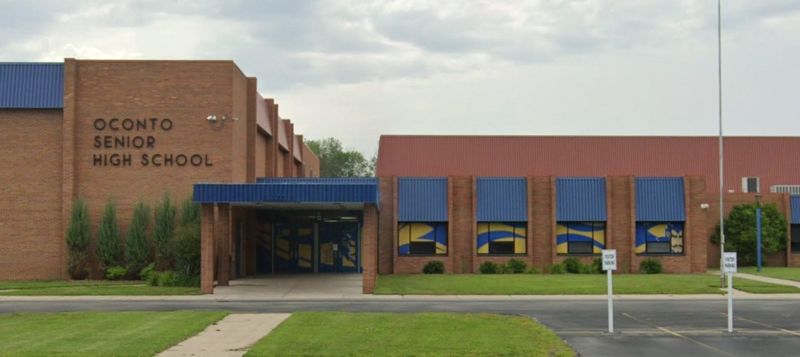
The Oconto Unified School District has continued to trim its budget ahead of the 2026-27 school year on the heels of failed April 7 operational referendum.
The district announced its budget cuts now total about $604,800 through staffing adjustments, retirements not fully replaced, operational reductions, program changes, and internal restructuring.

“These decisions were not made lightly,” Superintendent Emily Miller said in a release. “Our goal has been to reduce immediate impacts on students whenever possible while continuing to responsibly plan for the District’s long-term financial stability.”
The district’s budget reductions include:
District officials said many of these reductions occurred through attrition, restructuring and unfilled positions, making them less visible to the public while still significantly impacting its operations.
The Oconto Unified School Board issued nonrenewal notices to four teachers – three full-time positions plus one part-time – during a special board meeting April 27. The district had considered cutting up to five positions prior to its May 15 deadline.
District will use its fund balance to cover expenses
The budget cuts were necessary after voters rejected an April 7 operational referendum, which failed by a 1,059-918 vote, that asked voters to allow the district to exceed state-mandated spending limits by $1.2 million a year over five years for ongoing, day-to-day expenses to sustain current services and opportunities for its students.
The district has operated under a similar five-year, $800,000-per-year referendum that expires at the end of the current 2025-26 school year.
The district will use its fund balance to cover the additional expenses the next school year as it’s aimed to preserve many student opportunities in the short term.
A school district fund balance functions similarly to a savings account and is used to help manage cash flow, emergencies, unexpected expenses, and short-term financial stability. District officials emphasized that while fund balance can temporarily help bridge financial gaps, it is not intended to serve as a long-term solution for ongoing operational expenses.
District leaders added they continue to monitor discussions surrounding the Wisconsin state budget and potential changes to public school funding. However, the long-term impact of those discussions remains uncertain.
Democratic Gov. Tony Evers and Republican legislative leaders had reached a proposed $1.8 billion deal to provide school funding and tax relief using its budget surplus, but that was voted down May 13 in the state Senate.
Under that proposal the Oconto Unified School District would have received an extra $385,239 in general aid, plus additional special education reimbursement funds – $90,897 in 2025-26 and $245,957 in 2026-27.
Another referendum on the horizon
Amid the state public school funding uncertainty, school officials continue planning for a potential operational referendum in November unless state-level funding changes significantly improve the district’s long-term financial outlook.
In late April, Miller said a referendum would likely ask between an extra $900,000 to $1.2 million per year.
District officials said even if a referendum would pass in November, programs and staffing that were eliminated may not return. It said some reductions were made not only for financial reasons but also based on evaluations of enrollment trends, projected class sizes, program participation, and long-term operational planning.
“Future decisions will continue to be made thoughtfully and strategically based on student needs and the long-term sustainability of the District,” Miller said.
This article originally appeared on Green Bay Press-Gazette: Oconto schools expand its budget reductions after failed referendum
Reporting by Kevin Dittman, Green Bay Press-Gazette / Green Bay Press-Gazette
USA TODAY Network via Reuters Connect