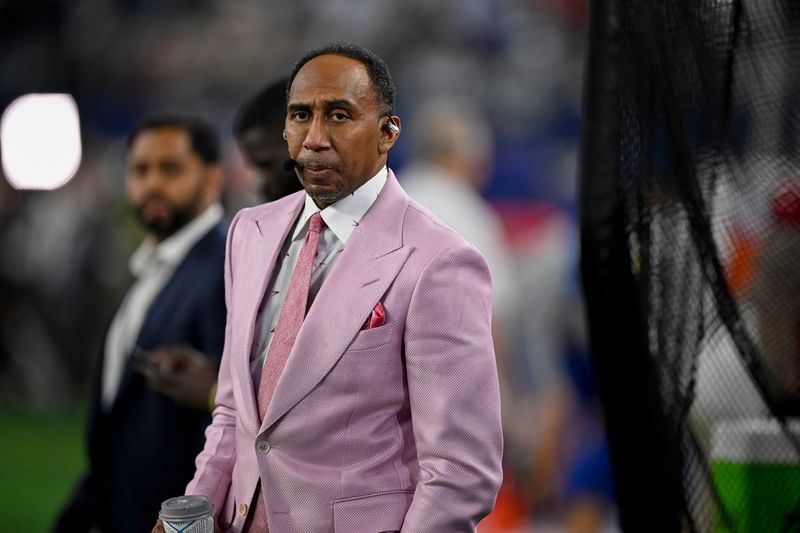
Stephen A. Smith may be the most popular sports commentator in America. He’s smart. Extremely opinionated. Loud. And he knows how to stir up fans just enough to keep them coming back for more.
He’s also done what few sports commentators have been able to do: build a massive multimedia enterprise that extends far beyond simply talking about sports. Yet he has also found himself embroiled in controversy, particularly over his criticism of Black people and, more specifically, women.

His public clashes with U.S. Rep. Jasmine Crockett (D-Texas), political commentator Joy Reid, former First Lady Michelle Obama and former Vice President Kamala Harris helped land Smith on a list no Black journalist wants to make: A 2026 Thumbs Down Award from the National Association of Black Journalists. (Spoiler: I am a long-time NABJ member, but I was not involved in the award.)
NABJ uses the award, established in 1989, to call out individuals, groups and media organizations for reporting, commentary or practices the organization considers insensitive, racist, stereotypical or otherwise contrary to its mission.
I was sitting in the ballroom at NABJ’s convention in Atlanta Aug. 15 when Smith’s name was announced during the 2026 Salute to Excellence gala. I was there because I had been nominated for two journalism awards. Thankfully, neither was a Thumbs Down Award.
When Smith’s name was called, you could feel the reaction. Some journalists sighed. Some laughed. Some clapped. Others seemed genuinely shocked.
I understood why.
Giving that distinction to Smith, a Black journalist who has supported NABJ for decades, was a slap in the face. One of the most prominent organizations of Black journalists was publicly telling one of the most prominent Black voices in media that he had crossed a line.
Depending on where you stood, that line was either long overdue or dangerously subjective.
The award has been around since 1989, and NABJ says it has been issued 44 times to individuals and institutions. Smith said most recipients have been organizations and that he’s only the seventh individual in NABJ history to receive one.
Smith also pointed out that one of those individuals was disgraced former New York Times reporter Jayson Blair, who received the award in 2003. In Smith’s view, NABJ had essentially put him in the same company as a journalist whose career collapsed in one of the most notorious plagiarism and fabrication scandals in modern journalism.
Did Stephen A. Smith deserve NABJ’s Thumbs Down Award?
Smith wasn’t the only recipient. NABJ also gave Thumbs Down Awards to FCC Chairman Brendan Carr, CBS News, The Washington Post and DuJuan McCoy, CEO of Circle City Broadcasting.
But Smith was by far the most famous name. So how does one of the most successful Black journalists in America, a man who has supported NABJ and credits the organization with helping his career, end up receiving one of its strongest public rebukes?
The organization pointed to what it described as a pattern of disparaging commentary about prominent Black women. NABJ President Errin Haines said the organization has a responsibility to hold people accountable, regardless of how prominent or successful they are. She said the goal isn’t to permanently condemn people or organizations, but to push them to do better.
And that accountability, Haines said, has to include NABJ’s friends and allies. If ESPN and Smith support the organization, that shouldn’t make them immune from being called out when NABJ believes they’ve fallen short, in this case a string of comments about Black women, including:
Smith called the award a “personal hit job.” He also blasted NABJ for condemning him without first reaching out to him and giving him an opportunity to respond. He rejects the idea that criticizing prominent Black women means he is disparaging them. His criticism, he argues, has been about their words, politics and public actions, not their race or gender.
I think Smith has a point. As an opinion columnist myself, I believe NABJ went too far.
Of all the examples, Smith’s criticism of Crockett troubles me the most. Describing the rhetoric of an accomplished Black congresswoman as being “for the streets” carries racial and gender implications that Smith should have understood.
But Smith also called Crockett educated and brilliant. More importantly, he apologized. That matters.
Can a Black journalist be especially tough on Black women, of Black people in general, without being accused of tearing the Black race down? And who gets to decide when tough commentary crosses that line?
Here’s another question: Would Smith have received this award if the people he repeatedly criticized had been Black men?
I don’t think so.
Smith goes after Black men all the time. Athletes. Coaches. Executives. Entertainers. He raises his voice, questions their decisions and sometimes says things that make them angry enough to respond publicly.
Sometimes he does go too far, but that’s also Stephen A. Smith.
So, if we’re going to say Smith crossed a line with Black women, NABJ should be able to show us exactly where that line is. Because criticizing a Black woman isn’t the same thing as attacking all Black women.
But what about Smith’s tone?
I’m not going to ignore the elephant in the room. The question isn’t simply whether Smith criticizes Black women. It’s whether his tone changes when he does.
Former ESPN colleague Jemele Hill believes it does. She argues that Smith doesn’t always “keep the same energy,” showing more restraint with some critics while becoming much more aggressive with others.
Hill pointed to President Donald Trump as an example. After Smith criticized the disruption caused by Trump’s security presence at an NBA Finals game at Madison Square Garden, Trump blasted Smith on Truth Social, calling him “dumb as a rock,” an “arrogant fool” and a “low-IQ individual.”
Yet Hill said people didn’t sense the same level of vitriol from Smith toward Trump that they’ve seen him direct toward some Black women.
That’s a fair criticism, and Smith shouldn’t dismiss it. But tone is also subjective. What sounds unnecessarily harsh to one person can sound like Stephen A. being Stephen A. to someone else.
He also needs to recognize that his words carry more weight today than they did 20 years ago. He isn’t just another sports commentator. He’s one of the most powerful Black voices in American media.
That doesn’t mean he should go easier on Black women. It means when he turns up the heat on anyone, particularly people from a community he says he cares deeply about, he should understand the impact his words can have.
NABJ believes Smith crossed the line from commentary to cruelty.
Smith wasn’t in the ballroom when his name was announced. That may have been a good thing.
Because knowing Stephen A., had he been there, he probably would have had plenty to say about NABJ’s decision.
And the president of NABJ happens to be a Black woman.
But that doesn’t change where I come down.
Smith can be abrasive. He can be wrong. And, yes, sometimes he needs to check his tone.
NABJ has every right to hold Smith accountable, just as Smith has every right to criticize Crockett, Reid, Obama or Harris.
If one of the most prominent organizations of Black journalists is going to give one of the most prominent Black journalists in America an award for commentary it considers harmful to Black women, it should be able to clearly show where legitimate criticism ended and disparagement began.
Hold Smith accountable when he crosses the line. Just make sure there’s actually a line before you punish him for crossing it.
Reach James E. Causey at jcausey@jrn.com; follow him on X @jecausey.
This article originally appeared on Milwaukee Journal Sentinel: NABJ says Stephen A. Smith crossed the line. What line? | Opinion
Reporting by James E. Causey, Milwaukee Journal Sentinel / Milwaukee Journal Sentinel
USA TODAY Network via Reuters Connect
By James E. Causey, Milwaukee Journal Sentinel | USA TODAY Network