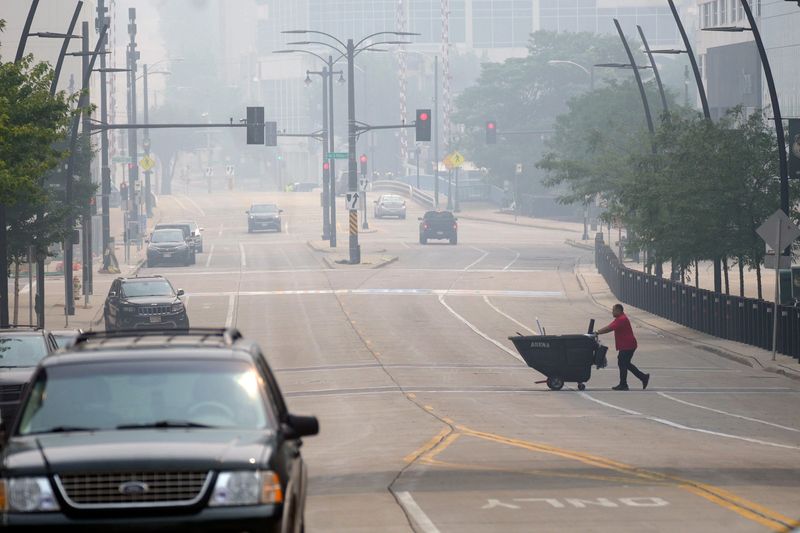
Milwaukee is experiencing record-breaking air pollution Thursday, July 16, with an Air Quality Index level among the worst in the world, and around double the baseline of what is considered hazardous for all.
The pollution comes from Canadian wildfires, which have made the air thick and smoky-smelling, and filled with fine particulate matter, which is a type of pollutant used to calculate the Air Quality Index, or AQI, said Craig Czarnecki, outreach coordinator for air management with the Wisconsin DNR.

“This is defintely an ongoing, widespread, hazardous air quality episode which we have not experienced before,” Czarnecki said.
The AQI across most of Wisconsin July 16 is well above the level considered “hazardous,” the tool’s most dangerous pollution category.
In parts of Milwaukee as of 11 a.m. July 16, the AQI measured higher than 600, according to the United States Environment Protection Agency’s interactive air quality map.
For reference, an AQI of 0 to 50 is considered good air quality; 101 to 150 is “unhealthy for sensitive groups”; 151 to 200 is “unhealthy”; and 201 to 300 is “very unhealthy.”
Anything above 301 is “hazardous,” considered a “health warning of emergency conditions,” according to the EPA. Czarnecki said at this level, sensitive groups including those with asthma, those with heart or lung conditions, children, the elderly and pregnant people, are strongly advised to stay indoors and minimize physical exertion. Everyone is advised against doing any type of outdoor physical activity.
As of 1 p.m., the highest AQI in Wisconsin was in Waukesha, at 663. Areas of downtown Milwaukee measured 644. Green Bay measured an AQI of 538, while far nothern Wisconsin neared 500.
“Really, when you’re in hazardous for this whole state, everyone has terrible air quality,” Czarnecki said. “In perspective, some places have it worse than others, but really nowhere is good today.”
Air Quality across the country on Thursday, July 16
Outside of Wisconsin, other cities across the Upper Midwest and Canada experiencing severely hazardous air quality include:
Czarnecki said the air quality impacts from the wildfires span well over a thousand miles. Millions of Americans are under air quality alerts through the end of the week.
How does Air Quality Index work?
According to the National Oceanic and Atmospheric Administration, the AQI measures five major pollutants regulated by the Clean Air Act: ground-level ozone, particle pollution, carbon monoxide, sulfur dioxide and nitrogen dioxide.
Particle pollution, also known as fine particulate matter or PM 2.5, is the pollution the Upper Midwest is currently experiencing from widespread wildfire smoke.
“These are very small, a mixture of solid and liquid droplets that are suspended in the air,” Czarnecki said. “They can be inhalable, they can get into our lungs and our bloodstream and cause a long list of health impacts.”
Why is the air quality so bad right now in Wisconsin?
Czarnecki said Wisconsin’s record-high AQIs are the result of a perfect storm of factors.
First, Wisconsin is close to the wildfires, which have been burning in southern Canada and parts of northeastern Minnesota for days.
Additionally, he said, hot temperatures, a lack of rain, low humidity and breezy winds created conditions that led to those wildfires being particularly powerful.
“The wildfires that started up there … were about as intense and grew about as fast as a wildfire can possibly do,” he said. “It created a massive amount of smoke in a pretty short amount of time.”
Contact Kelli Arseneau at (920) 213-3721 or karseneau@gannett.com. Follow her on X at @ArseneauKelli.
This article originally appeared on Milwaukee Journal Sentinel: Milwaukee’s air quality among the worst in world due to wildfire smoke
Reporting by Kelli Arseneau, Milwaukee Journal Sentinel / Milwaukee Journal Sentinel
USA TODAY Network via Reuters Connect
By Kelli Arseneau, Milwaukee Journal Sentinel | USA TODAY Network