James Butler was like anyone you might meet in Milwaukee today.
He held a steady job in construction. He enjoyed eating beef. He was conscious of his weight. He felt guilty for going long periods without contacting family. He got sick from the harsh winter weather. He loved talking about his children. He went to church.

We know all this because he says so in letters to his brother, Michael, whom he hadn’t seen since emigrating from Ireland and settling in the Midwest. But he hasn’t lived in Milwaukee for centuries; he immigrated to America in the mid-1800s, when people couldn’t yet fly or text.
Butler’s letters are just two among more than 8,000 in the Imirce Project’s online collection: surviving correspondence written by Irish emigrants who traveled to North America between the mid-1600s and mid-1900s.
The letters, compiled by University of Missouri-Columbia professor Kerby Miller and digitized by the University of Galway, chronicle the joys and hardships of life in the New World, and back home on the other side of the Atlantic Ocean.
A subset of letters will be on display at Milwaukee Irish Fest on Friday afternoon. University of Galway English professor Daniel Carey adapted a handful of the letters into a theatrical piece, which will be read on the festival’s final three days.
“What you get from these letters, is somebody talking about their experience in their own voice, as it was happening,” Carey said.
Irish emigrants play an important role in Milwaukee history
Imirce — rhymes with “burka” — is the Irish word meaning migration.
Like much of the U.S., Wisconsin saw an influx of Irish immigrants in the mid-1800s, as the Great Famine devastated Ireland and killed more than 1 million people. Nearly 1.8 million Irish people left the country during the famine, many boarding ships for North America, leaving behind family for an uncertain future.
When Wisconsin became a state in 1848, around 15% of Milwaukee’s inhabitants were ethnically Irish. The population continued to grow over the following decades. By 1900, Milwaukee’s Irish population had nearly halved from its 1880 peak, a decline accelerated by the 1892 Third Ward fire. The blaze destroyed hundreds of buildings in the city’s Irish enclave and left about 2,500 people homeless.
By 1900, other immigrants began moving to Milwaukee − Italians, Greeks, Serbians, Croatians and Slovenians − planting roots and making the city more of a melting pot of nationalities.
Nevertheless, Germans held most public offices and occupied a privileged place in Milwaukee society. Then, in 1916, Irishman Daniel Hoan — yes, that Hoan — was elected mayor. He served for 24 years, becoming Milwaukee’s longest-serving mayor at the time.
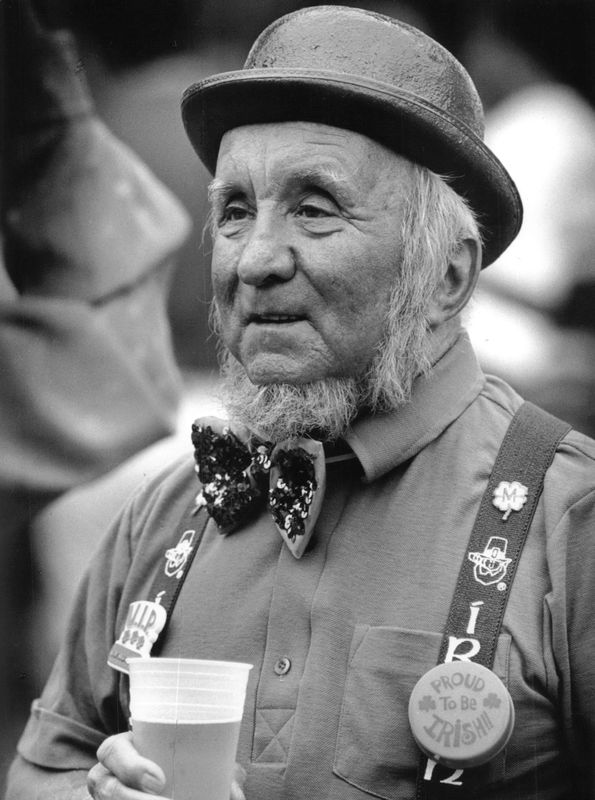
The Irish population continued to move outward into the suburbs through the 20th century. But since 1981, thousands have returned to the Third Ward each year for Irish Fest, now Milwaukee’s largest ethnic festival and the largest celebration of Irish heritage and culture in North America.
But facts and figures do not tell the full story of Irish emigration. That is why, Carey said, the letters are indispensable: They convey the heart-wrenching emotions of leaving loved ones behind and starting anew.
“There’s no other way to capture it,” Carey said.
The journey from Ireland to America was difficult for many
The estimated 7.5 million people who emigrated from Ireland between 1815 and 1915 began the harrowing journey the same way: with a goodbye.
For Edward Hanlon, who wrote from Milwaukee to his father in Downpatrick in September 1843, it meant a long walk with his younger sibling Bernard, who couldn’t bear spending the rest of his life without his big brother.
“He say, ‘Neddy, you might come home [again],'” Hanlon wrote in one of the letters. “It has often made me shed tears since.”
Then came the journey across the Atlantic itself. By the late 19th century, the crossing could take anywhere from 10 days to three weeks, and it was never comfortable. In a May 1888 letter to his brother James, Nick Shanks described those realities.
The rough Atlantic dropped deluges of rain, as strong waves hit each crossing boat in quick succession, rocking the vessels with such ferocity at least one passenger — but likely many more — fell overboard. One of the young men was Henry Sanworth, only known about because of Mary Hanlon, who mentioned him in a letter to her parents.
When the emigrants who survived docked in New York — at Castle Garden before Ellis Island opened in 1893 — their biggest priority was almost always finding stable employment. For men, that usually meant manual labor; some worked as hotel dishwashers, while others joined the military. For women, it often meant domestic work, such as housekeeping or sewing.
Their outlook on their new life in America varied widely.
Some embraced their new lives with optimism. In 1926, George wrote to his parents about his well-paying job as a marble setter and his off-hours pastime: playing on a local hurling team.
Others were more regretful, and even scathing towards the U.S. and its apparent rampant greed and avarice.
“Cash, Sex and Speed seem to be the three American Gods in these days. Ancient Egypt in all her wasteful splendour never could rival that of the newly rich here,” wrote Seamus Quinn in 1923.
“Nor was ancient Rome more immoral than Hollywood,” Quinn continued.
Irish emigration letters help identify with ancestors
If each letter tells a unique story, the entire collection offers a lesson in what historians call the universality of the human condition. It’s the idea that humans are united across all time, space and cultures by shared fundamental traits, core emotions and biological realities.
“[The letters] are a way of identifying with an experience that we all share, actually, regardless of our ethnicity, as Americans,” Carey said.
What carried the letters across the Atlantic were the things the letters had in common: updates on health, questions about relatives and news from home.
They also served practical purposes as a way to send money before the days of Venmo and Zelle. Cash inside the envelope became such an expectation that one son advised his mom to ignore those who shared only words, not wealth.
Neighborhood gossip circulated like it always has and always will, just with less timeliness. In 1880, Massachusetts resident Patrick Sheil heard a secondhand rumor his mother milked a neighbor’s cow — essentially the equivalent of stealing cable from the person across the hall. He offered up a very American solution to the dilemma.
“You know you can sue for any amount for the loss of your carrecter (sic) and repare (sic) your good name,” Sheil wrote.
Beneath those everyday details, though, was a shared effort to stay connected. Authors apologized profusely for not writing as often, and begged their readers to write back. They reminisced about experiences from their old lives. After cameras were invented, they wanted pictures of missed loved ones.
For emigrants building lives an ocean away, the letters made distance feel a little smaller − a sense of connection that still brings people together at Irish Fest today.
Jack Albright can be reached at JAlbright@usatodayco.com.
This article originally appeared on Milwaukee Journal Sentinel: Milwaukee Irish Fest to exhibit thousands of letters from Irish emigrants
Reporting by Jack Albright, Milwaukee Journal Sentinel / Milwaukee Journal Sentinel
USA TODAY Network via Reuters Connect
By Jack Albright, Milwaukee Journal Sentinel | USA TODAY Network