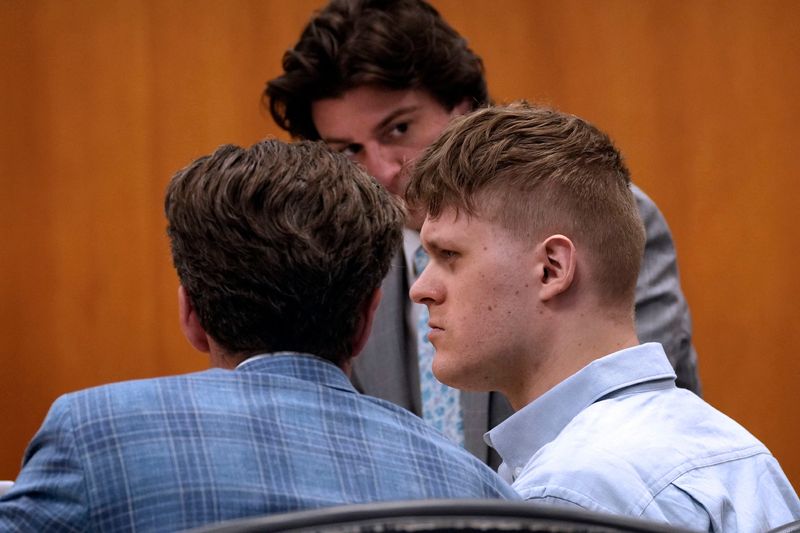
A jury is weighing the fate of Maxwell Anderson who is charged with killing and dismembering Sade Robinson.
Anderson, 34, is charged with first-degree intentional homicide, mutilation of a corpse, hiding a corpse and arson in the April 2024 death of Robinson, 19, after they went on a first date in Milwaukee.

Prosecutors urged jurors to consider the totality of the evidence, while the defense argued the state had failed to prove beyond a reasonable doubt that Anderson had killed Robinson.
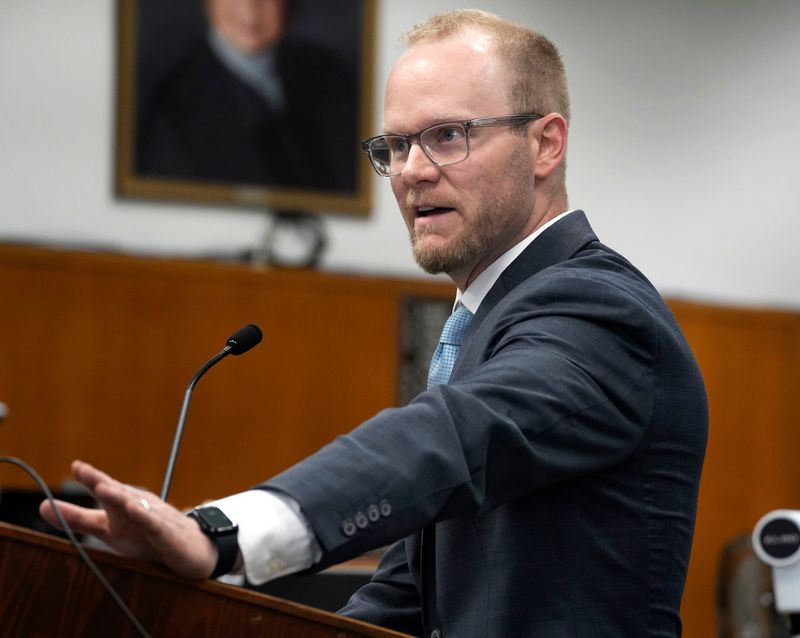
Assistant District Attorney Ian Vance-Curzan told jurors to use “common sense and search for the truth.”
He described Robinson as “anything and everything” that someone that age would want to be. She worked two jobs, went to Milwaukee Area Technical College, supported herself and lived in a small studio apartment on the city’s east side.
“Most of all, she was respected and loved by her family,” Vance-Curzan said.
Defense Attorney Anthony Cotton argued there were holes in the prosecution’s story, and there was no weapon found or clear DNA evidence to back up the state’s claims that Anderson killed Robinson in his home.
“I’m not here to hide a thing,” Cotton said. “Study it all. Study every piece of evidence in this case.”
The state admitted more than 300 pieces of evidence and called more than 65 witnesses. The defense did not call any.
Former girlfriend, tenant testify in Anderson trial’s closing days
The trial has featured hours of testimony from investigators and technical experts to describe and explain phone data, security footage and physical evidence recovered during the investigation into Robinson’s disappearance and death.
Among the witnesses in the trial’s final days were a former girlfriend of Anderson’s and a former tenant. News media was instructed not to identify either witness.
The former girlfriend said she had dated Anderson from May 2022 to March 2023.
The woman said she contacted police when she saw news of Anderson’s arrest. She testified he was sometimes “emotionally abusive,” but never physically harmed her.
She recalled an incident in which Anderson got into a fistfight with her previous boyfriend at a bar on St. Patrick’s Day 2022. She also testified there were multiple hidden compartments throughout Anderson’s home, including a false bottom in a drawer under the bathroom sink.
The former tenant said he did not hear anything amiss in the home on the evening of April 1, 2024 — no screams, struggles or loud tools.
This was out of the norm because Anderson often made noise that could be heard throughout the house, the tenant said. Anderson had loud visitors over in the early morning hours “all the time” and operated power tools for his woodworking several times a month, the tenant said.
The tenant said he heard Anderson moving a heavy object down the stairs between 5 and 6 a.m. one morning that week, but could not recall which day. It was sometime before April 4, 2024, when a SWAT team swarmed the home, the tenant said.
Closing arguments center on digital evidence for prosecution, lack of DNA evidence for defense
Throughout his closing argument, Vance-Curzan used a digital presentation of surveillance footage and phone data to walk the jury through Robinson’s final days.
Vance-Curzan emphasized several facts: the photos showing Robinson incapacitated found on Anderson’s cell phone data and that were deleted; the two’s DNA found on a sweater he was wearing the day after their date ; and that the backpack he is seen wearing on bus security footage has never been found.
He recounted the gruesome details of Robinson’s death to try to prove intent.
“What kind of person cuts off someone’s head off? A killer, a killer who’s trying get away with killing,” Vance-Curzan said. “There is no question about the person responsible for doing it. The killer, it’s him.”
Cotton, in his closing, hammered on the lack of DNA evidence found in Anderson’s house.
“None of Sade’s blood is anywhere in that home,” Cotton said.
Once the attorneys finished their closing arguments, Milwaukee County Circuit Judge Laura Crivello dismissed jurors and asked them to start deliberations June 5 and will resume June 6.
She had earlier given the jury instructions. If the jury is not satisfied that Anderson is guilty of first-degree intentional homicide, they can still convict him of the less serious offense of first-degree reckless homicide.
The verdict must be unanimous. If jurors cannot agree on a verdict, then a hung jury is declared, and the case may be retried. There is no time limit on deliberation, and jurors can deliberate anywhere from hours to weeks to decide a verdict.
“You jurors are the judges of the credibility of the witnesses and the weight of the evidence,” Crivello said.
Maia Pandey, Ariela Lopez and Ashley Luthern of the Milwaukee Journal Sentinel staff contributed to this article.
This article originally appeared on Milwaukee Journal Sentinel: Maxwell Anderson case goes to jury after seven days of testimony
Reporting by David Clarey and Chris Ramirez, Milwaukee Journal Sentinel / Milwaukee Journal Sentinel
USA TODAY Network via Reuters Connect