Wisconsin wouldn’t be the same without Lake Michigan.
The world’s fifth-largest lake, at more than 22,000 square miles, provides Wisconsin residents with a place to cool down on a hot day or get out on a boat to go after some fish.

Ashley Lemke and Harvey Bootsma, with the University of Wisconsin-Milwaukee’s school of freshwater sciences, told the Journal Sentinel some of their favorite facts about Lake Michigan.
What if we all jumped in – or poured it all out?
If the world’s population decided to leap into Lake Michigan all at once and submerged themselves, the lake’s water level would only rise 1/3 of an inch, Bootsma said.
And if we could somehow pour all of the water from Lake Michigan over Wisconsin, the water would measure 95 feet deep.
Shipwrecks and sunken aircraft
Lake Michigan was the sight of one of the deadliest Great Lakes shipwrecks in 1860, when the Lady Elgin, bound for Milwaukee, collided with the Augusta and sank within half an hour, according to the Winnetka Historical Society.
More than 300 people aboard the Lady Elgin died in the wreck.
There are thousands of shipwrecks scattered across Lake Michigan, and the lake also has largest and best persevered collection of sunken U.S. Navy aircraft in the world. The Navy used the Great Lakes for training during World War II.
Many, many mussels
There are at least 300 trillion quagga mussels making their home in Lake Michigan.
That’s so many that someone could walk across Lake Michigan from Milwaukee to Muskegon, Michigan, and be stepping on mussels the entire way.
But there are more than mussels beneath Lake Michigan’s waves, with 68 species of fish in the lake, including 20 that aren’t native to the region, Bootsma said.
Dryland civilizations
There were stone age hunters and archaeological sites in Lake Huron. A smaller lake meant those archeological sites were found in what is now Lake Huron but at the time was dry land. This may seem like a Lake Huron fact, but Lake Michigan and Lake Huron are hydrologically one body of water, Bootsma said, they have the same surface level.
Unexplored lakebed
About 85% of the Lake Michigan’s bottomlands, or lake bed, have not been mapped in high resolution. Only 15% has been mapped that way, which means “there is a ton of the lakebed we know very little or nothing about,” Lemke said. There is an effort to map more of the area.
A smaller lake
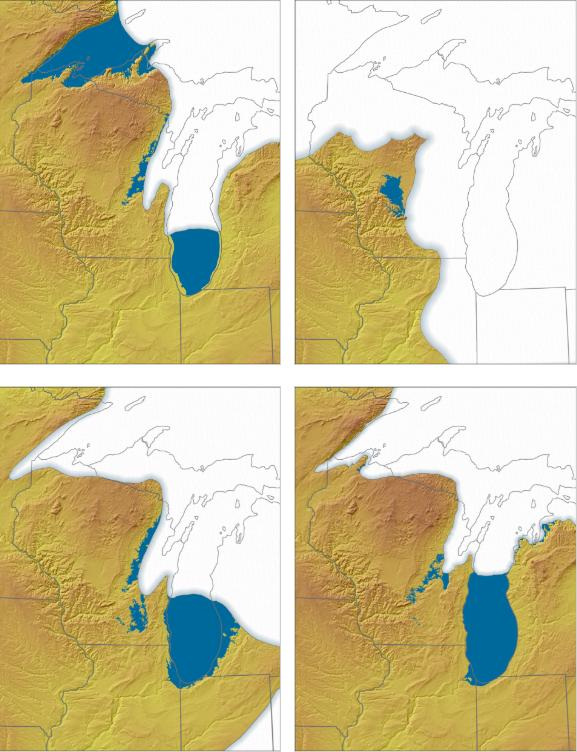
Water levels were much lower during the last ice age, meaning Lake Michigan was much smaller. The University of Illinois says an ancestral form of Lake Michigan known as Glacial Lake Chicago formed 14,000 years ago. That lake rose 60 feet higher than modern Lake Michigan.
Two coasts, different waves
The Wisconsin side of Lake Michigan has cooler, calmer water, while the Michigan side has warmer water and bigger waves.
That’s because winds blow from the west. Cold, deep water comes up from the Wisconsin side while warm surface water is blown to Michigan.
Lake Michigan water cycle
Lake Michigan gets more water from direct rainfall than from every inflowing river combined. On top of that, the amount of water that evaporates from Lake Michigan every year is about the same as the amount of water that flows out into Lake Huron.
This article originally appeared on Milwaukee Journal Sentinel: Lake Michigan holds shipwrecks, sunken aircraft and trillions of mussels
Reporting by Blaise Mesa, Milwaukee Journal Sentinel / Milwaukee Journal Sentinel
USA TODAY Network via Reuters Connect
By Blaise Mesa, Milwaukee Journal Sentinel | USA TODAY Network