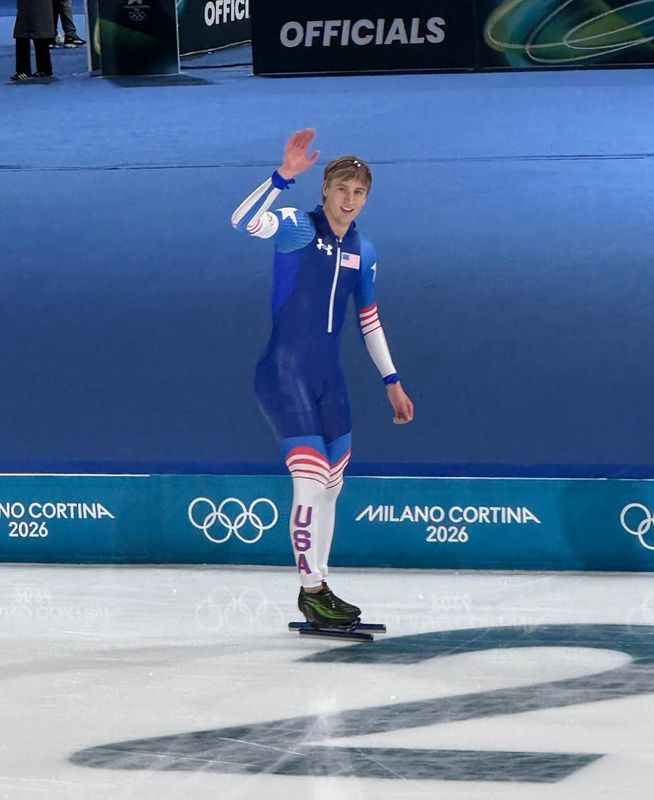
RHO, Italy − By now, the world knows. Jordan Stolz earned an Olympic record in his best race, the 1,000 meters, with a scorching-fast time of 1 minute, 6.28 seconds at the Milano Speed Skating Stadium on Feb. 10.
Of course, he has been training for this moment for four years solid, ever since he left the 2022 Beijing Olympics empty handed as a wide-eyed but extremely driven 17-year-old rookie. He built himself into the top-ranked skater on planet Earth, at 21 years old, the Kewaskum native is a household name already in skating circles.

But what maybe you don’t know is there was a strategy behind what happened.
The night before Stolz’s 2026 Milano-Cortina Winter Olympics debut, he met with his longtime coach, the legendary Bob Corby, who once coached Team USA in 1984, the very one who walked away from the sport, and came out of retirement just for Stolz.
With less than 24 hours before the race, they did was they do best. Talk, plot and scheme.
“Then it became real,” Corby said.
Stolz and Corby looked at the lane assignments and the pairing. It was a doozy. Stolz was paired with Jenning de Boo (pronounced de BEAU), another 21-year-old phenom, from the Netherlands and every bit the match for Stolz. Even though Stolz has almost always had the upper hand, de Boo is fast, strong and talented.
Corby drew out a game plan.
“I knew Jordan was going to come out on the back stretch with 200 meters to go,” Corby said. “And de Boo was going to be in front, going to the outer lane.
“I said: Don’t follow him. Don’t try and get a draft. Just get open so you can see that corner and set up that corner perfectly. You’re not going to get that much of an advantage by getting a draft.”
This was extremely important for two reasons:
One, Stolz is a beast in every way, but his corners are a thing of beauty. He leans his 6-foot, 3/4-inch frame at such an angle that he commands those G-forces to his will. Racing at 39 mph at peak speed, Stolz whips around the corner of an ice rink not with the trepidation of someone trying to hold on, but with super strength and harnessing the power of the turn to his advantage.
And then, reason two, there’s de Boo. Tall, strong, fast and extremely likable, he beat Stolz in 2025 in a World Cup event with Stolz coming back from illness. It was noteworthy because nobody else has beaten Stolz. At all. In any distance.
De Boo brought his own flow to the Olympics and those in the know wondered if an upset was brewing.
“De Boo skated really well,” Corby said. “When he came out of 600 meters a little ahead of Jordan, Jordan was kind of like, ‘Whoa. OK!'”
De Boo was coming off the inner lane; Stolz was coming off the outer.
“It didn’t worry me at all, I knew the last lap was going to be phenomenal,” Corby said.
De Boo has one thing Stolz does not. If you’re watching speed skating for the first time in the Olympics, you probably noticed all the orange in the stands. Dutch speed-skating fans have to be some of the best of any sport on the planet. They travel. And they cheer. With three Dutch men − national hero Kjeld Nius, Joep Wennemars and, of course, de Boo − in the final six pairs of the event, the Skating Stadium felt like an event in the Netherlands.
The starting gun went off for the Stolz-de Boo pairing and the orange-clad fans went crazy for their man. A Dutch skater has won the 1,000 in the past three Olympics.
It made the biggest moment of Stolz’s young life even bigger. It’s one thing to race against the clock. And another to race against a formidable opponent. But it’s really something against 7,000 people.
“We are always like, it’s just a race. It’s just a race! Don’t let the fact that it’s the Olympics distract you too much,” Corby said. “But when he went to the line, he even said: ‘Wow. This is a big deal.'”
As Corby predicted, Stolz found himself behind de Boo just for a bit. There was no panic. Instead, that last corner by Stolz was smoking hot.
“Jordan finishes strong all the time,” Corby said. “There’s no need to try and gain an advantage with a draft. You’re much better off visualizing the corner and going in at the right set-up point. That’s how you’re going to go faster.”
Stolz crossed the finish line with his hands on his knees, muscles on fire, lungs demanding gulps of air. Fastest-ever corner of his life?
“Probably,” Stolz said. “For the second lap of a 1,000, probably. I was trying as hard as I possibly could in that 100 meters before the last turn. I knew I had to because he was a bit ahead.
“And, I didn’t want to get second.”
He met the moment. He met the challenger. He won the race. But he did even more than that. An Olympic record.
It doesn’t feel like winter in northern Italy
The temperatures in Milan and nearby Rho have not been winter-like by Stolz’s standards. It was rainy, humid and misty the day before, with temperatures in the upper 40s. On race day, it was 53 degrees and sunny. That actually affects the ice − even in an indoor, temperature-controlled environment.
That can lead to slower ice and lagging times, but there was reason to be optimistic. Distance skaters have set Olympic records here this week and Jutta Leerdam also set an Olympic record in the 1,000-meter women’s race, just two days earlier.
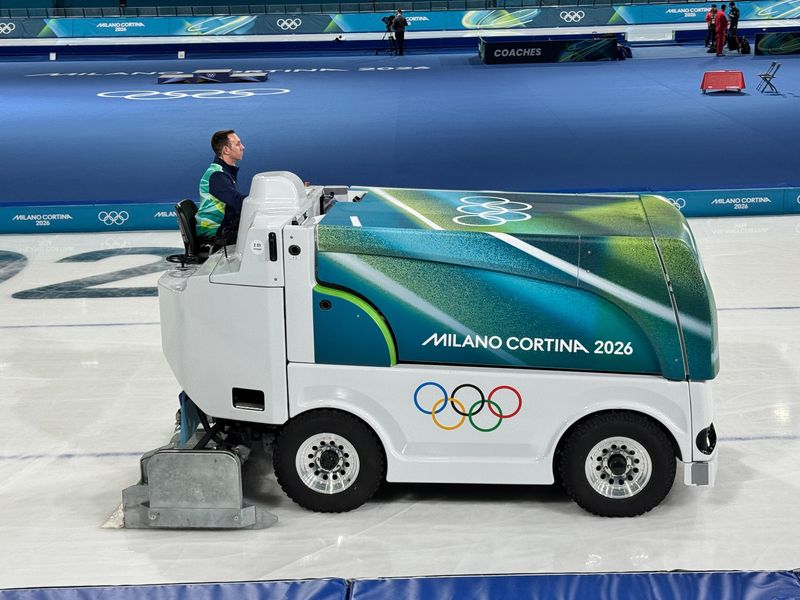
Milwaukee’s own Paul Golomski is here, assisting the head ice maker in Rho, a suburb of Milan. When he’s not driving the Zamboni, he’s on the ice with a spray bottle, touching up bits here and there, to do his part for all the skaters.
“Paul has done an unbelievable job with this ice,” Jane Stolz, Jordan’s mom, said after the race. “It’s been hot in this arena. I can’t even wear a jacket. He said it’s the toughest he’s ever had to make ice. But he’s got it dialed in.”
That’s what makes speed skating beautiful. It’s not just, ‘go fast, turn left.’ It takes a skater with the gift of a feel for the ice, a coach with a vision for how to win, a science-minded ice maker to help out.
And in this case, de Boo helped bring the very best out of the very best skater in the world, Stolz.
But Stolz is just getting started; that was just race No. 1. With decorated Olympian Eric Heiden in the stands sitting next to Snoop Dog, Stolz won. But has three more races to go: the 500 meters, the 1,500 meters, and the wild Mass Start. Stolz is seriously using the next two days to rest and recover from this taxing Olympic-record-setting event to get ready for the next sprint.
No matter what happens, this was a magical night for this close-knit Wisconsin family, for Corby, for the Pettit National Ice Center, and for America in the Olympics.
Jordan is a kid no more.
When Stolz accepted his medal and took his place atop the podium, the Milano Speed Skating Arena fell silent. All the Dutch and American fans remained standing at their seats. The American national anthem played with the flag being raised.
Stolz looked up and took it all in. But what was he thinking? This journey began with him watching Apolo Ohno on TV in the Olympics when Stolz was 5, and asked his dad to clear the pond in the back yard to start skating with his sister, Hannah.
This journey endured, with Jordan’s mom and dad working first and third shifts at their jobs so they could take turns driving Jordan to the Pettit National Ice Center every day for practice. It persevered, after the unexpected death of Jordan’s first coach, and the pandemic Olympics, and through solo hours of training and sacrifices that teenagers usually don’t make and almost no one else sees.
As the anthem played on, it looked for a moment that Jordan Stolz − unflappable, unfazed − got just a bit emotional.
“I wouldn’t doubt it,” Corby said. “I had tears in my eyes.”
This article originally appeared on Milwaukee Journal Sentinel: It took extra strategy for Jordan Stolz to win his first Olympic gold medal | Lori Nickel
Reporting by Lori Nickel, Milwaukee Journal Sentinel / Milwaukee Journal Sentinel
USA TODAY Network via Reuters Connect