Looking back on more than 15 years of constant artistic labor in her backyard, Madeline Buol wrote “when one gets started there is no quitting.”
That’s a sentiment she had in common with many creators collected and exhibited by the John Michael Kohler Arts Center in Sheboygan and its Art Preserve, internationally recognized for championing the work of self-taught artists and artist-built environments.

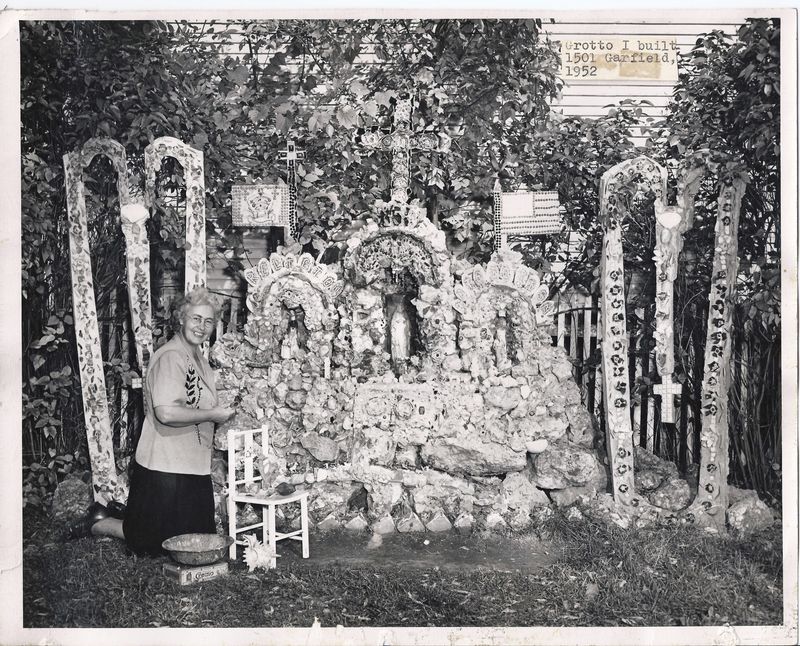
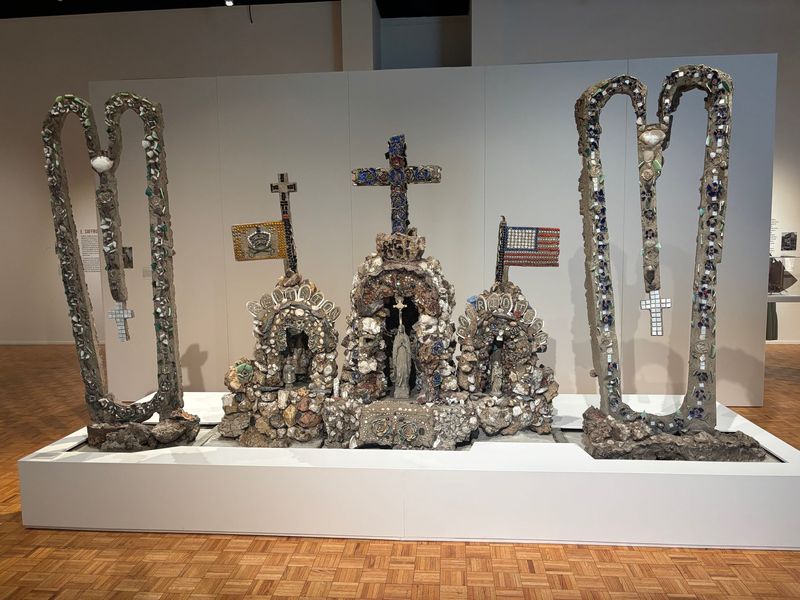
In “A Beautiful Experience: The Midwest Grotto Tradition,” the Kohler is displaying the entire 13-piece grotto that Buol built in her Dubuque, Iowa, yard from concrete, rocks, shells, rosaries, toy spiders, fragments of dinnerware and myriad other objects.
Why is this Iowa woman’s grotto special?
Buol’s creation combines art, religious faith, local geology and a skill at finding and scavenging that would make a battlefield quartermaster proud.
Buol’s grotto was directly inspired by the famed Dickeyville Grotto in Wisconsin’s Grant County. It even incorporates at least four rocks from the Dickeyville site. Mathias Wernerus, the priest who created the Dickeyville Grotto, encouraged Buol to take some rocks when she visited.
“She is one of the only known women to have built a grotto,” particularly at the large scale she worked, said Chava Krivchenia, Kohler Arts Center assistant curator.
Buol’s grotto also stands out because it’s not on a church’s property or adjacent land, like the Dickeyville Grotto or another one of her models, Paul Dobberstein’s Grotto of the Redemption in West Bend, Iowa. Being in her yard, the grotto was a part of Buol’s daily life, Krivchenia noted.
The Kohler Foundation acquired Buol’s grotto and gave it to the center, which is displaying it with samples from the Dickeyville and Redemption grottos, plus new works from two contemporary artists that respond to it.
What is a grotto?
A grotto is a natural or artificial structure resembling a cave, according to Wikipedia.
The roots of grottoes can be traced way back into pagan traditions of going to a cave or natural alcove formation with a spiritual intention, the Kohler’s Krivchenia said.
Later, Catholics combined alcoves in natural environments with architectural elements that turned them into shrines. Visitors to the shrines often brought mementoes or items with spiritual components, which led to a practice of embellishing the shrines, Krivchenia said.
In the Midwest, German immigrants became pastors who created sites for reflection and spiritual practice near a Catholic place of worship, usually outside, Krivchenia said.
In the earlier 1900s when Wernerus and Dobberstein were creating their grottoes, concrete had recently become more available for projects like theirs, Krivchenia said.
Buol’s grotto expresses both religious fervor and patriotism
Buol (1902-1986) and her husband, Frank, moved to a home on Dubuque’s Garfield Avenue in 1943. “I thought what a beautiful place to build an outdoor grotto,” she wrote in an autobiographical document posted online.
After gathering rocks and other material for her incipient grotto, Buol tried to make a foundation, but “whatever I tried to make would fall down,” she reported in her autobiography. She wrote to Dobberstein for help. Her advised her on how to mix the cement and to wait for five days for it to harden.
She first built a niche to house a statue of the Blessed Virgin Mary, incorporating four rocks from the Dickeyville Grotto that Wernerus had given her. Mary’s niche is flanked by niches containing the Infant Jesus of Prague (Buol’s tribute to a famous 16th-century statue) and St. Joseph, and by embellished versions of the U.S. and papal flags. Like the Dickeyville Grotto, Buol’s shrine is an expression of patriotism as well as religious fervor. In the 1940s and ’50s when Buol was creating her grotto, there were still Americans suspicious that Catholics were more loyal to the pope than to their own country.
This triptych of niches is flanked in turn by giant rosaries on either side. Fittingly for a Marian-centered shrine, rosaries are incorporated elsewhere, too.
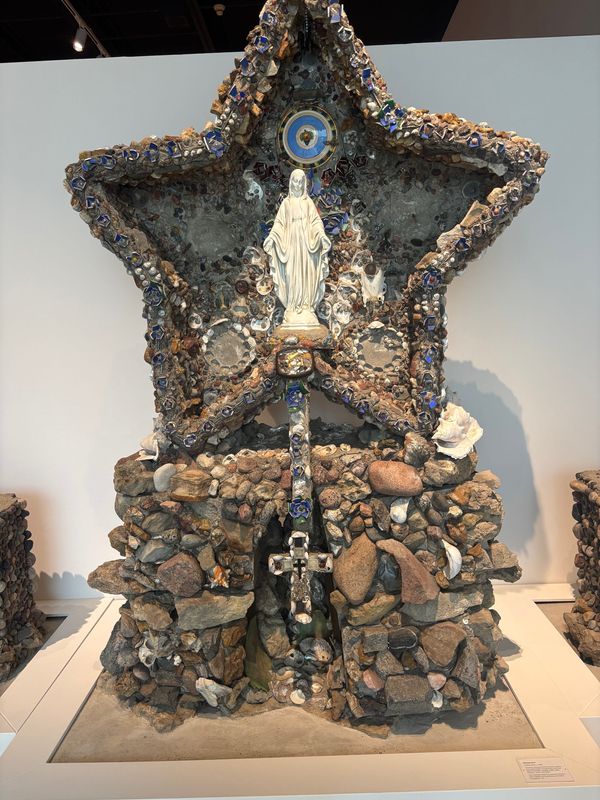
Other sculpted and embellished works in Buol’s grotto pay homage to St. Peter’s Basilica in Rome and the Marian apparition to children in Fatima, as well as St. Anthony, St. Frances and the Sacred Heart.
Buol worked by herself, though Krivchenia notes that she once asked a construction crew with a crane nearby to help her move something. She loved shells and used them prodigiously, gathering them locally and obtaining them from friends and elsewhere.
The artist also had a playful streak. In one of the niches, Krivchenia pointed out a toy spider peeking out from under a shell.
New art in Kohler exhibit a tribute to a Milwaukee Chinese restaurant
Kohler commissioned contemporary artists E. Saffronia Downing and Stephanie H. Shih to create new art in response to Buol’s grotto and other works in the exhibit.
Downing, who often works with wild foraged clay, made several pieces that react to textures and architectural features in Buol’s grotto. She also made her own variation of a rosary by creating beads from clay and stringing them together in an enormous lattice formation.
Milwaukee readers may be particularly interested in Shih’s object. Thinking about grottoes such as Buol’s as a European-American tradition, Shih wondered what kind of grotto might Chinese immigrants in the Midwest in the same time period have made? Shih created a fanciful replica of Toy’s, a popular chop suey restaurant, dance hall and community spot in early 20th century Milwaukee.
A ceramic artist, Shih embraced the embellishment practice of Buol and fellow grotto makers with an open call for people to contribute Asian-related, even problematic, tchotchkes, Krivchenia said. The top of the Toy’s replica is a riot of little Buddhas, China dolls, cats, pandas and other knickknacks.
If you go
“A Beautiful Experience: The Midwest Grotto Tradition” continues through May 10, 2026, at the Kohler Arts Center, 608 New York Ave., Sheboygan. Visit jmkac.org or call (920) 458-6144.
This article originally appeared on Milwaukee Journal Sentinel: How an Iowa woman’s backyard grotto finds a new home at John Michael Kohler Arts Center
Reporting by Jim Higgins, Milwaukee Journal Sentinel / Milwaukee Journal Sentinel
USA TODAY Network via Reuters Connect