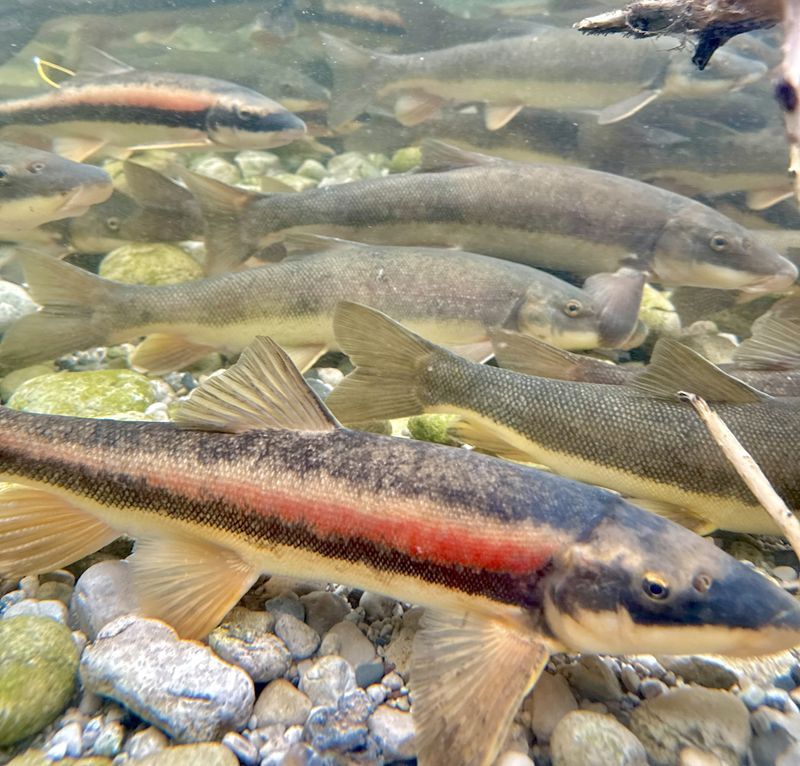
The Door County Land Trust partnered with Chicago’s internationally renowned Shedd Aquarium for a study on the movements of a little-studied but important migratory Great Lakes fish.
The study is examining the movements of 30 longnose suckers (Catostomus catostomus) that were swimming through Heins Creek, which flows from Kangaroo Lake to Lake Michigan south of Baileys Harbor. The land trust protects 74 acres in its Heins Creek Nature Preserve, through which the creek runs, on the east side of State 57.

Researchers will track the suckers via small acoustic tags that were surgically fitted earlier this spring and observe their movements to see whether they return to the same spawning site year after year, how far they move during the year, what type of habitats they prefer, and whether there is a difference in movements between males and females.
According to a news release from the Shedd, this is the first longnose sucker study examining their spatial ecology. The Shedd is leading the study and the land trust purchased the 30 acoustic transmitter tags the suckers now are wearing.
Why a longnose sucker study matters
If you’re wondering why such a study is taking place for a native, non-game fish that many think isn’t that big of a deal, the news release said the migratory longnose suckers “are an essential part of the freshwater ecosystem as they are the most abundant group of migratory fishes in the region. Suckers serve as a food source for other animals, including game fish, mammals and birds, and add important nutrients to the water during their spawning migrations.”
Dr. Karen Murchie, director of freshwater research at the Shedd, said gaining better knowledge of longnose sucker movements will help protect them better.
“There’s still a lot we don’t know about suckers, and we can’t protect what we don’t understand,” Murchie said in the news release. “Tagging longnose suckers allows us to paint a better picture of their behaviors and needs so we can ultimately help these important fish thrive in the Great Lakes.”
Emily Wood, executive director of the Door County Land Trust, echoed Murchie’s thoughts while noting the species’ importance specifically to Door County wildlife.
“Suckers contribute to the incredible biodiversity in Door County that includes trout, walleye, herons, osprey, bald eagles and other beautiful animals,” Wood said in the news release. “This tagging study is integral in understanding how we can best protect suckers as we continue our work to preserve Door County’s lands and waters for future generations.”
How to perform sucker surgery
The tagging operations took place when Murchie and experts from the U.S. Fish and Wildlife Service’s Green Bay Fish and Wildlife Conservation Office traveled to Heins Creek during the 2025 spring spawning migration, when longnose suckers were present.
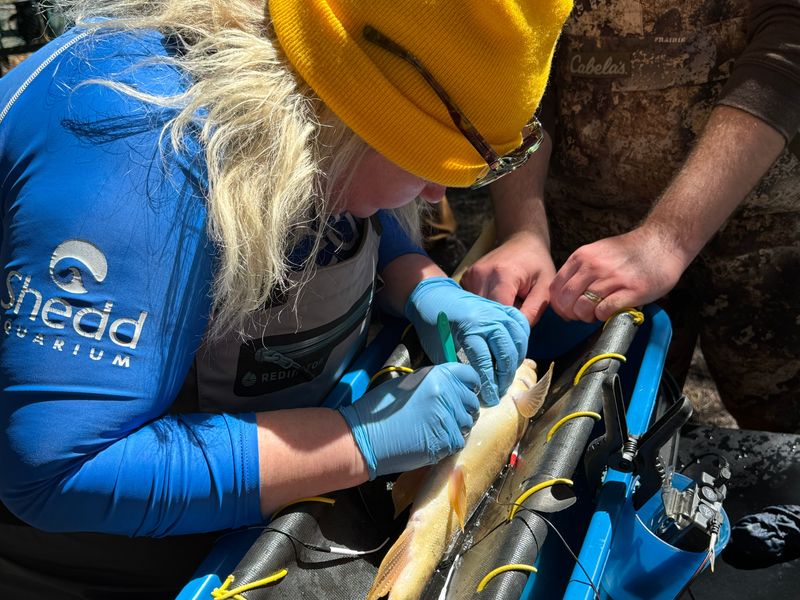
The team worked to carefully catch the suckers and transfer them to floating bins in the creek. The fish then were moved, one at a time, to a surgery table and placed on their backs with water flowing in their mouths while Murchie performed a quick surgery to insert the acoustic transmitters, followed by two small sutures. Then, the suckers were outfitted with external tags on their back to inform resource managers or anglers that the fish are part of Shedd’s study.
The whole process takes about five minutes from start to finish. The news release indicated that while Murchie has performed hundreds of surgeries on various species of fish, she’d never operated on longnose suckers before this. After the tagging is complete, the team briefly monitors the fish before releasing them back into the creek.
Sonically tracking suckers
With the longnose suckers tagged, Murchie will gather data on their movements by utilizing a network of acoustic receivers that are part of the Great Lakes Acoustic Telemetry Observation System (GLATOS). As the tagged suckers swim around, the acoustic tags broadcast a series of pings in the water that are picked up by nearby receivers, allowing researchers to follow each individual fish’s movement through different waterways and observe where each fish spends the most time.
The study will continue to expand with plans to tag more longnose suckers in 2026 via a grant from the Fund for Lake Michigan. The findings on this species’ movements in Wisconsin can also help inform conservation strategies in Illinois, where longnose suckers are state threatened and much less common. The Shedd also is tracking white suckers (Catostomus commersonii) in a study also using the GLATOS network.
For more information
Along with the millions of guests who visit its aquarium on the Lake Michigan shore in downtown Chicago each year, the Shedd Aquarium is considered a national leader in aquatic animal care, education, conservation and science. For more information, visit sheddaquarium.org.
The Door County Land Trust protects more than 10,000 acres of property on the Peninsula, including 15 featured nature preserves open for hiking and other low-impact, nonmotorized recreational activities, all at no charge. About 40% of its lands are in conservation easements and 60% are purchases made possible by donors, grants and local government and conservation partner support. For more information, including including trail maps, donations or memberships, visit doorcountylandtrust.org or call 920-746-1359.
Contact Christopher Clough at 920-562-8900 or cclough@gannett.com.
MORE: Forbes names bank and credit union with Door County branches among best in Wisconsin
MORE: Southern Door Community Auditorium announces its 2025-26 season
FOR MORE DOOR COUNTY NEWS: Check out our website
This article originally appeared on Green Bay Press-Gazette: Door County suckers get surgical tags for a migration study by a famed Chicago aquarium
Reporting by Christopher Clough, Green Bay Press-Gazette / Green Bay Press-Gazette
USA TODAY Network via Reuters Connect