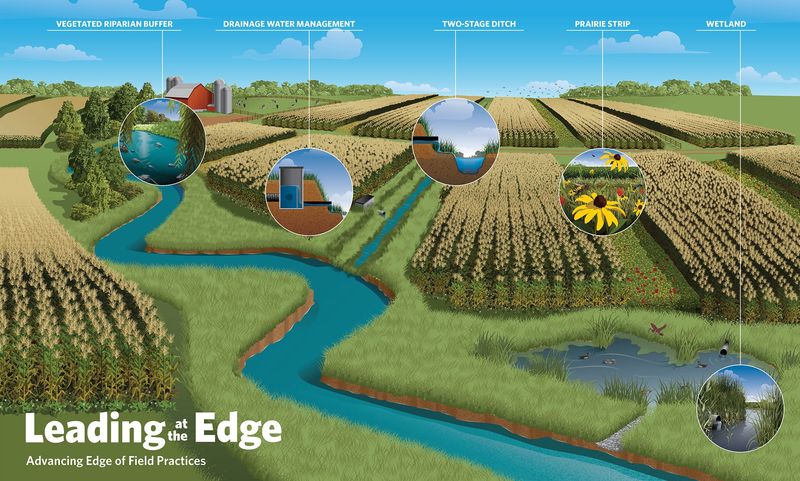
Buffers, filters, and prairie strips all have a role to play in on-farm conservation. But what do they all do? How do they protect surface water and can they work together with in-field practices?

Each practice is based on the simple structure of taking a strip of land out of production, between the crop and the area you are trying to protect. The acres taken out of production can be those with low yield, improving the agronomic efficiency of the field. These practices can reduce the nutrients or the runoff that can make their way from the field to surface waters. Some practices can reduce both.
These practices can benefit each other and integrate with in-field practices like reduced tillage, as well. The differences lie in the type of vegetation planted and whether they are directly adjacent to a sensitive area or not.
Riparian buffers
Riparian buffers are constructed along a waterway or wetland. They include trees and shrubs or solely grass species. Trees can provide benefits for any aquatic life within a stream or river by offering shade, but grass has been shown to be a more efficient “sponge” for nutrients in runoff that enters the buffer. The width of the buffer depends on the grade and how large an area the buffer is responsible for, but usually between 15 and 100 feet. The purpose of a riparian buffer is to capture nutrients and sediment before they enter the stream and to increase bank stability. They require little maintenance once established.
Filter strips
Filter strips are very versatile and can exist between fields – similar to contour farming that utilizes a hay strip, or on the downslope edges of fields – similar to a border strip. They are also called vegetated buffers. They receive sheet runoff from the field; they are not meant to receive concentrated flow, such as from a grassed waterway, unless it is dispersed before entering the filter strip.
Runoff reduction by filter strips is, on average 52%, but very dependent on the width of the strip. Sediment reduction averages 78% but is dependent on width and the ratio of the area of the strip to the drainage area. Total phosphorus and nitrogen reductions depend on the saturated hydraulic conductivity of the soil in the filter strip. For goals of nutrient removal, the focus should be on increasing the infiltration of the soil by choosing certain grass species or other management decisions.
If loss of phosphorus is a concern, consider harvesting the strip for forage. The grasses in the strip takes up phosphorus after it is carried into the strip by field runoff. Over time, the grasses grow, die, and decay within the strip. The phosphorus is then available for runoff from the strip, turning what was meant to be a nutrient sink, into a nutrient source. This applies to any edge-of-field practice that utilizes non-native perennial grasses.
Native prairie strips
Native prairie strips are structurally the same as filter strips: they can be placed anywhere between a field and a sensitive area that ought to be protected from excess nutrients. However, there are key differences in function and benefits to water quality. This is because they are populated by native prairie species. The maintenance required is quite different from a vegetated buffer or filter strip as native grasses cannot tolerate harvest, or regular grazing. If this is a practice that interests you, we recommend seeking out technical assistance from an agency or from a fellow producer.
Native prairie grasses provide significant nutrient reduction to counter their potentially higher maintenance costs. They increase soil organic matter, improve infiltration, and the stiff stems of tallgrass prairie species slow runoff and hold soil in place. A prairie strip as small as 10% of the original field size can reduce sediment export by 95%, total phosphorus export by 90% and nitrogen export (surface) by 85%, compared to a 100% row crop no-till field. The strips also have shown the ability to reduce runoff volume by 37% (Schulte et al. 2017). This reduction in runoff volume could affect downstream flood potential in extreme rain events. Furthermore, native prairie grasses offer high quality habitat to pheasants, pollinators, and insectivores, which can provide other ecosystem benefits to the field or farm as a whole.
All of these edge-of-field plantings have varying benefits to nutrient and runoff reduction, but they have one benefit in common: As they are stacked or layered with other practices, like reduced tillage or cover crops, they function as well or better. Stacked or layered practices are shown in the visual below.
A variety of conservation practices implemented on a field, farm, or watershed increases its overall ability to handle a variety of conditions and still improve water quality outcomes and soil health. As the climate conditions of Wisconsin continue to swing widely and precipitation becomes more erratic, taking this approach to conservation is a positive for fields, farms, and communities.
Sheryl “Sheri” Schwert is a Water Quality Outreach Specialist – Southwest Region, University of Wisconsin-Madison Division of Extension
This article originally appeared on Wisconsin State Farmer: Conservation buffers and strips. What are they and what role do they play?
Reporting by Sheryl Schwert / Wisconsin State Farmer
USA TODAY Network via Reuters Connect