Brown County will be a patchwork of regulations on artificial intelligence data centers.
The county declined to pursue a temporary moratorium on such projects. County planning director Dan Teaters on Feb. 4 told the Brown County Planning Commission that the county is one of the few in the state without county-wide zoning laws. The regulation of these facilities would be left up to local governments.

The information came “much to all of our surprise,” Corrie Campbell, a commissioner from Ashwaubenon, told her village’s Plan Commission on April 9.
Several local governments have since begun to consider how to write zoning laws for a 21st century utility whose upsides are touted in dollars, jobs, and opportunity, whose downsides are pegged to public health, character, and skepticism. Such talk has picked up in recent weeks following public opposition in Wrightstown at giving any thought to developer Cloverleaf Infrastructure’s interest in a roughly 1-gigawatt facility in northeastern Wisconsin.
Ashwaubenon’s Village Board on June 23 adopted a 12-month law forbidding the village from accepting applications, permits, and the like for any data center project larger than 100,000 square feet or whose electricity consumption surpasses 20 megawatts.
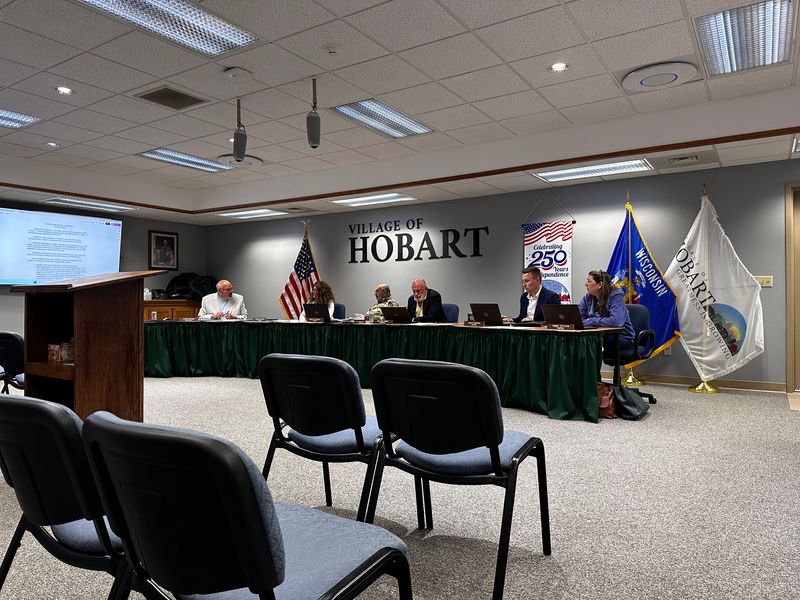
A week prior, Hobart’s Village Board on June 16 unanimously directed its Planning and Zoning Commission to take up a similarly drafted law. The same day, Wrightstown’s Village Board approved a postponement on “high-energy demand data centers” at the urging of a resident-led petition. Unlike in Ashwaubenon and Hobart, this pause will be in effect until results are returned from an Aug. 11 referendum to take the village’s temperature on a data center in the village.
Ashwaubenon and Hobart officials have said that the moratoriums were not to be interpreted as stances for or against data centers themselves. They framed their intent as both to uphold the interests of their residents and a measure allowing time to get more information on data centers before drafting zoning laws to govern their development.
“I’m an agnostic on this,” Hobart Village Board president Rich Heidel told his board on June 16. “I am not an advocate one way or the other on this thing at all. I’m in fact-finding mode.”
Pittsfield’s Planning Committee will talk of data centers in July “after the Town lawyer reviews the ordinances and gives the Town possible new language that could be adapted,” June minutes read. The matter of data centers has appeared on the committee’s minutes since March.
Why is Brown County a possible site for a data center?
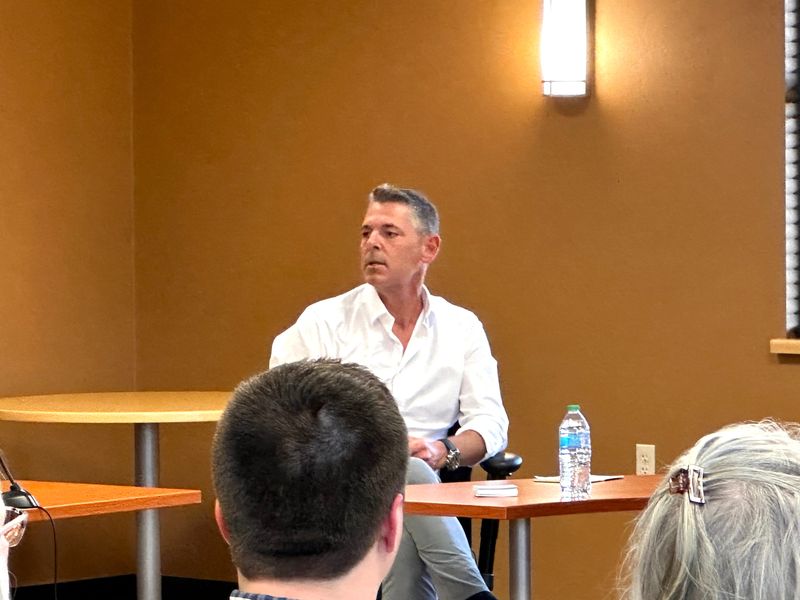
Aaron Bilyeu, chief development officer at Cloverleaf Infrastructure, previously told the Green Bay Press-Gazette there’s much that’s attractive about northeastern Wisconsin to artificial intelligence data center development.
There’s abundant land for the acreage they demand. There’s a capable workforce to build and operate a center. The two primary factors, however, are favorable economics and access to high amounts of electricity, Bilyeu said. Wisconsin has exempted data centers from sales and use taxes since 2023. Several 345kV transmission lines, considered the highways of the electric grid, run through Brown County, Kewaunee County, and Manitowoc County. Also needed was political support of local officials, Bilyeu said.
Bilyeu told the Town of Carlton, in Kewaunee County, on Aug. 13, 2025 of Cloverleaf Infrastructure’s wish for about 800 acres of land for a 100-megawatt facility. Bilyeu later told the Press-Gazette the minimum amount of land required for a small data center would be about 200-300 acres.
Bilyeu has since confirmed to residents of Wrightstown on May 26 his company’s desire for a facility that would take about 1 gigawatt of electricity, one order of magnitude greater than a megawatt.
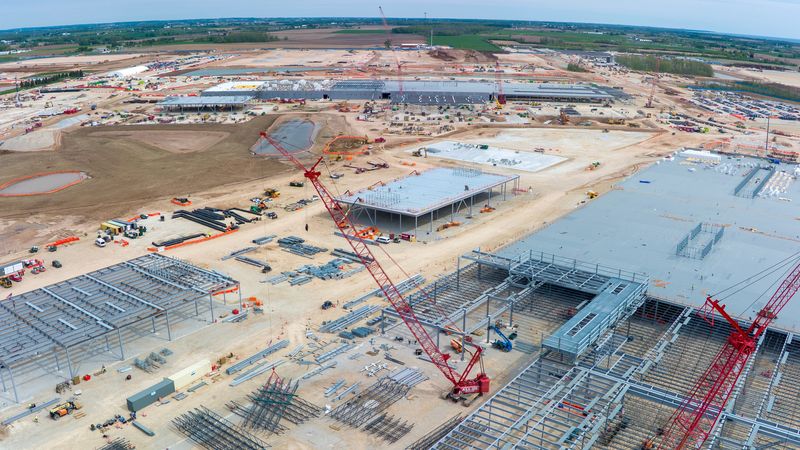
That amount of power is equivalent to 1 billion watts, or the output of an average nuclear power plant, according to the U.S. Department of Energy. For comparison, the largest power plant in the state, Point Beach Nuclear Power Plant in Two Rivers, produces just over 1 gigawatt of electricity. The next most productive producer of electricity in the region, the Fox Energy Center in Wrightstown, generates about 618 megawatts, about 60% of a gigawatt.
There is not consensus on the number of homes that a gigawatt of electricity can power. However, estimates are in the hundreds of thousands. The U.S. Department of the Interior has estimated that one gigawatt of wind power can power up to 300,000 average homes a year. According to the investment advisor Carbon Collective, it would be enough for about 876,000.
The ultimate size and scope of a data center project would be determined by the amount of land that Cloverleaf Infrastructure could acquire, Bilyeu previously told the Press-Gazette.
What’s been proposed in Brown County?
Cloverleaf Infrastructure first engaged in exploratory discussions with officials from Greenleaf, in southern Brown County, in the second half of 2025. The Green Bay Press-Gazette reported exclusively that Greenleaf officials did not disclose these discussions to residents seeking to know the extent of their officials’ dealings with the developer.
The company offered to buy land from residents, spurring vocal public opposition in January. The company then ended its pursuit of a data center in that village.
At the same time, the company engaged with officials from the neighboring Village of Wrightstown who’ve expressed their openness to hosting a data center project.
In emails from January to March between Village Administrator Travis Coenen and Cloverleaf Infrastructure representatives, Coenen asked that a principal development manager send “the zoning you used in other communities so I can get it in our zoning code rewrite.”
The Press-Gazette reported that Cloverleaf Infrastructure had sent Coenen a two-page document summarizing the impact of data centers investments on local communities, as well as copies of pre-development agreements used by the company to begin development in Port Washington. Coenen was also sent a white paper on data center development, to which Coenen replied he’d already seen the paper, then sent it to the Village Board “while the Greenleaf controversy was going on. We will strategize on a better plan for Wrightstown as I see both Greenleaf and Kewanee [sic] have not gone well.”
Coenen has said that the emails were his attempts to educate himself, village officials, and residents.
Cloverleaf Infrastructure has not publicly announced that it has submitted any formal proposals for a data center, nor has any local government.
What have officials been told?
Local officials and state legislators on March 25 were invited by New North, the economic development agency for Wisconsin’s northeast, to the Weidner Center for a two-hour forum on data centers. New North, in a news release, billed the event as “a neutral, educational space to support leaders’ understanding of the rapidly evolving industry and considerations associated with this type of development.”
The news release said the panelists and expert presenters would give officials information on how data centers function; their infrastructure needs, like electricity and water demands; the possible economic and community considerations; and questions to consider “as opportunities emerge.”
Jason Stein, president of the Wisconsin Policy Forum, presented a January report that said data center developments will add to electricity and water usage after years of declining demand.
The report said the four new data centers planned in Wisconsin, including at Port Washington and Beaver Dam, may require new power plants and water mains. It noted that many of the newly proposed centers would be in “relatively small communities where they can represent an enormous increase in total energy use.” It said data centers are becoming more water-efficient over time and that water quality concerns associated with data center “also exist to a greater extent for many large manufacturing users, such as a paper plant or cheese factory.” The report suggested water-related concerns “are likely limited” due to the water being recycled through its cooling systems.
The report did not touch upon water quality concerns during a data center’s construction – some residents have said construction caused well water in Beaver Dam to turn undrinkable. Bilyeu has said the circumstances in those anecdotes were coincidental.
Kevin Lahner, city manager of Janesville, made the case for that city’s data center project on what was once a General Motor’s plant. Spectrum News has since reported that the Janesville City Council tabled data center discussions for the time being.
Lahner addressed the protests against the city’s support for a data center, saying concerns would be addressed with what he called a robust development agreement and zoning modifications. He said restrictions will be placed on noise, the type of cooling systems used, buffer zones, community investments, local hiring, and environmental cleanup. He said a local attorney that’s worked on the agreement with the developer, Viridian Partners, “just kept on asking, and they never said no. It all got into the development agreement.”
“So we’re going to ask for the moon,” Lahner said, “and we’re going to expect it because of what this industry is and what they’re about to do and the impacts that could have on our community.”
A self-described futurist, Garry Golden presented the future of data centers as part of what he expected to be a multitrillion-dollar industry with growing demand. The benefit of artificial intelligence, he said, would be solving societal ills previously unanswered by humans, pointing to cancer and poverty.
Dale Lewis, director of project development at Boldt, called data center development the “fifth industrial revolution.”
“It seems surreal, but, you know, these are Fortune 500 companies, trillion-dollar companies that are making these investments,” Lewis said. “I like to call it the largest redistribution of wealth that our country has ever seen because of the level of investment coming to the communities. That works its way down, trickles down to the community across all sectors of business and economic development.”
He added, “If it it’s managed correctly from a municipal level, it could be a real boon for any community that is lucky enough to attract it.”
And addressing questions posed by some officials over concerns in negotiating with such large companies, Lewis said, “You can ask for everything that your heart desires or your community is demanding. And they will deliver.”
Residents in Greenleaf and Wrightstown have been critical of such economic promises, arguing the monetary considerations were moot in the face of their desires for a rural life. Many have not been swayed by Cloverleaf Infrastructure’s attempts to assuage concerns that their electricity will not cost more and that water will remain drinkable.
Prescott Balch, a former senior vice president of U.S. Bank, caveated the economic promises of data centers. He said indirect economic development is often overstated, a statement that Bilyeu denied.
Prescott said the tax benefits brought by data center developments may be squandered if not well-managed, a point Bilyeu agreed with.
And in Beaver Dam and Port Washington, data center construction was kicked off in a way that residents will not see tax benefits for years because of their decades-long nature of the tax financing incentives given out, Prescott said.
What have officials said about data centers?
State Sen. André Jacque, R-Scott, declined to take a position on data center developments during a May 26 listening session in Wrightstown. An aide reasoned that the state senator believed in local control.
Jacque declined to directly answer a question from the audience if he would live next to a data center, saying “I have not experienced a large data center anywhere in the state of Wisconsin. Again, my stance has been for full transparency, and people doing their homework.”
Some Wrightstown Village Board members have indicated their openness to data centers, emphasizing their struggle to maintain and upgrade public services in the village each budget cycle.
In Ashwaubenon, village officials have shown hesitation at the size of data centers currently under development in the state’s southeast, saying the village does not have the land necessary for any project that large.
Pittsfield’s chairman Scott Mielke was not immediately available for an interview with the Press-Gazette to talk about that town’s data center discussions.
Jesse Lin is a reporter covering the community of Green Bay and its surroundings, as well as politics in northeastern Wisconsin. He also writes a weekly column answering reader questions about Green Bay. Contact and send him questions at 920-834-4250 or jlin@usatodayco.com.
This article originally appeared on Green Bay Press-Gazette: AI data center rules won’t be uniform across Brown County
Reporting by Jesse Lin, Green Bay Press-Gazette / Green Bay Press-Gazette
USA TODAY Network via Reuters Connect
By Jesse Lin, Green Bay Press-Gazette | USA TODAY Network